


What Is a Nuclear Moratorium?
A nuclear moratorium is a state-imposed ban or restriction on building new nuclear capacity, but this definition takes various forms depending on the state.
Some states may require legislative approval or consent from voters before construction can begin. Others might want to ensure that a federally demonstrable technology or method for high-level waste disposal exists, or is operational, before approving a new nuclear facility. Environmental and safety considerations can also play a role.
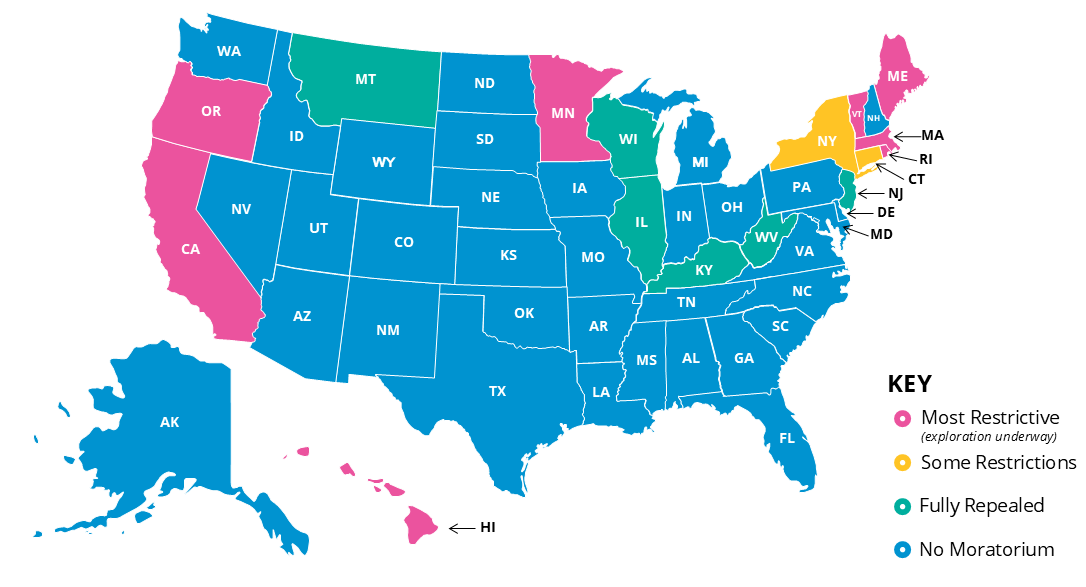
Today, eight states continue to enforce nuclear moratoriums.
Understanding the Past
It is important to understand that most nuclear moratoria were structured as temporary safeguards rather than permanent bans on nuclear energy. And many of these restrictions are conditional, meaning that a set of criteria must be met before construction can proceed. In practice, this means that a state may prohibit new nuclear development while continuing to operate existing reactors.
So, what are some of the reasons why certain states enacted nuclear moratoriums in the first place?
- One of the primary catalysts for these safeguards was a sharp decline in public confidence following the partial reactor meltdown at Three Mile Island in 1979. In the aftermath, several states moved to halt new nuclear development and public support for nuclear energy fell by nearly 23 percent.
- Economic and financial risk intensified these concerns. By the late 1970s, with nuclear projects experiencing cost overruns, construction delays and even cancellations, moratoriums gave states leverage to limit financial exposure while markets stabilized.
- Uncertainty surrounding permanent high-level waste disposal also played a central role. The absence of an operational federal geological repository left states concerned about the long-term management of used fuel. Although the Nuclear Waste Policy Act of 1982, and its subsequent 1987 amendment mandated the study of Yucca Mountain as a permanent solution, state and local skepticism persisted. The 2002 federal designation of Yucca Mountain as the sole repository site did not resolve these concerns, and funding was withdrawn by Congress in 2011 due to continued state opposition. Today, the project remains untouched, and the U.S. still lacks a permanent waste site, but the country’s interim storage solution continues to be safe, secure and regulated by the Nuclear Regulatory Commission.
Most Restrictions
These states uphold long-standing nuclear moratoriums:
California maintains a 50-year moratorium on new nuclear construction, citing the need for a federal solution to permanent high-level waste disposal and reprocessing.
Hawaii’s state constitution requires a two-thirds vote from both legislative houses to build new nuclear facilities.
Maine seeks voter approval through a statewide election before new nuclear construction may proceed. If voters approve the new build, the state Public Utilities Commission must certify that the proposed method for high-level waste disposal complies with federal standards. In addition, a permanent high-level waste storage facility must be fully operational by the time the plant is complete.
Massachusetts calls for a statewide ballot initiative with voter approval before new nuclear construction can begin. If a majority vote is achieved, both legislative houses must certify that a federally approved, permanent high-level waste disposal pathway is in place in addition to an emergency preparedness plan and a decommissioning strategy.
Minnesota holds a 32-year moratorium on the construction of new nuclear, citing the need for a permanent, federally approved high-level waste disposal facility before approving new builds.
Oregon continues to uphold a long-standing ban on building new nuclear, requiring the development of a federal high-level waste repository, as well as a statewide vote of approval.
Rhode Island requires legislative approval for the siting and construction of new nuclear facilities within its borders, although the state can still purchase nuclear power from neighboring states with existing plants. This policy was approved by the state House and Senate in May 2025.
Vermont seeks legislative approval for the construction of new nuclear facilities.
Some Restrictions
These states have partially lifted their nuclear moratorium, or hold unique exceptions:
In 2022, Connecticut partially lifted its moratorium to allow for new construction at Millstone Nuclear Power Station, the state’s only commercially operating nuclear site. In 2025, the legislature passed Act 25-173, which not only reaffirms the state's interest in adding additional capacity to the Millstone site, but enables communities to "opt-in" to hosting advanced reactor facilities through a local vote. It also established the Advanced Nuclear Reactor Site Readiness Funding Program, which supports early planning and community engagement efforts.
New York’s statewide moratorium was conditionally lifted decades ago; however, a specific Long Island moratorium limits new nuclear construction in Nassau County, Suffolk County, and portions of Queens—a Long Island Lighting Company service area that hosts the previously decommissioned Shoreham Nuclear Power Plant.
Looking to the Future
Why are states reconsidering decades-old moratoria?
- The U.S. is undergoing an unprecedented surge in energy demand from artificial intelligence, advanced manufacturing and electrification, which is prompting moratorium states to reassess long-standing restrictions on new nuclear capacity.
- States are recognizing nuclear energy’s vital role in delivering safe, reliable and clean electricity—from the large reactors that have powered communities for decades to innovative advanced designs expanding future deployment opportunities. Across all technologies, nuclear plants uphold the highest standards of safety, security and federal oversight that protect workers and neighboring communities.
- The clean energy goals of most states require reliable, around-the-clock power, and nuclear energy provides a clean source that is both dependable and cost-effective long term.
- At the federal level, energy independence and national security considerations are elevating the role of nuclear energy in strengthening domestic energy supply and reducing reliance on imports. Increased federal funding and cost-recovery opportunities are incentivizing states to take full advantage of new nuclear technology.
- Capitalizing on nuclear energy creates economic opportunity and employment, which is a huge motivator for states looking to support their residents. Beyond employing 500 to 800 people directly, each nuclear power plant generates 250 additional U.S. jobs for every 100 workers on site.
Fully Repealed
Within the past decade, these states have chosen to repeal their statutes, paving the way for new nuclear construction and investment:
- New Jersey (2026)
- Illinois (2026)
- West Virginia (2022)
- Montana (2021)
- Kentucky (2017)
- Wisconsin (2016)
So, what’s the good news? States are motivated to reassess, and in some cases, dismantle outdated contingencies on nuclear energy. By tapping into the potential of advanced nuclear technologies like small modular reactors and microreactors, states can improve grid reliability and accommodate demand.
With the right policies in place to enable new nuclear deployment, states can effectively position themselves to meet rising electricity demand, support clean energy goals, enhance energy security and create long-term economic opportunities in their communities for decades to come.
Interested in bringing nuclear energy to your state? Learn how to become an advocate for state policies that preserve the existing fleet and encourage new nuclear development at nuclearmatters.com
Related Resources
Policy Options for States to Support New Nuclear Energy