- New Jersey becomes fourth state to grant zero emissions credits to nuclear plants
- Exelon’s Joe Dominguez wins industry leadership award for New York, Illinois ZECs
- Local issues, market conditions resonate deeply in states
Three years ago there were about a dozen nuclear-related bills in state houses; this year there are about 100. That’s because more and more the 30 states hosting our 99 nuclear plants are waking up to the fact that without them, their economic and environmental well-being are in jeopardy. Even in states without plants, nuclear technology is at the center of debates on clean energy, grid security and resiliency.
Two years ago New York and Illinois pioneered zero emissions credit (ZEC) programs that compensated nuclear plants in those states for their carbon-free attributes.
Last October Connecticut joined those states with its Zero Carbon Procurement measure, which allows the Millstone nuclear plant to bid into markets with other zero-carbon energy sources like hydropower, wind and solar.
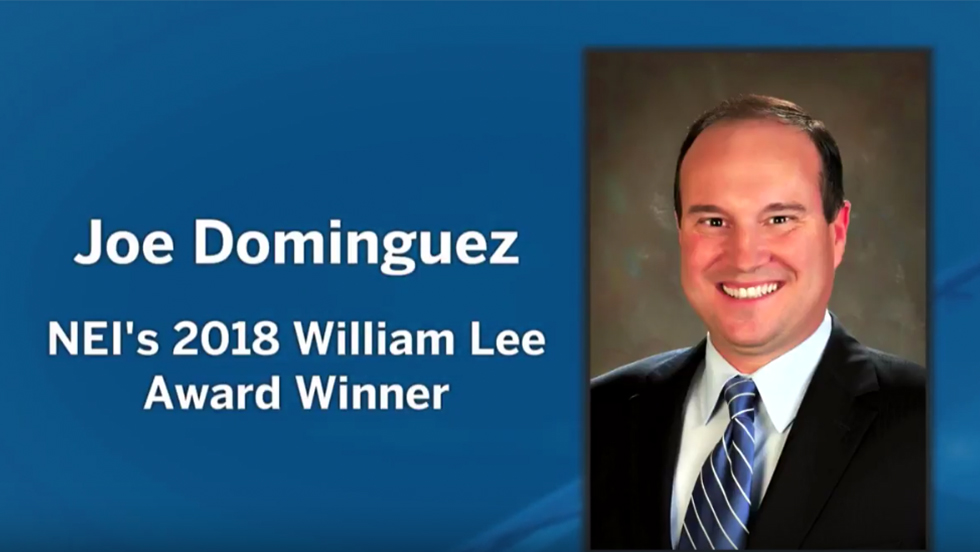
As the architect of the New York and Illinois ZEC programs, Joe Dominguez, Exelon Corp.’s executive vice president of governmental and regulatory affairs and public policy, received the William S. Lee Award for Industry Leadership this week.
“Achieving the ZEC programs in New York and Illinois took Joe and his team years of daunting work,” NEI Chairman Donald Brandt said at the award ceremony during NEI’s annual conference, the Nuclear Energy Assembly. “Joe’s leadership and achievements on this effort have benefited the entire nuclear industry.”
On the same day, New Jersey became the latest state to preserve its largest source of resilient and reliable carbon-free energy when Gov. Phil Murphy signed that state’s zero emission credit bill into law.
“The Salem and Hope Creek nuclear plants play pivotal roles in New Jersey’s economy and environment, and Gov. Murphy is to be commended for signing this bill into law to help preserve these critical energy assets,” NEI President and Chief Executive Officer Maria Korsnick said.
Ohio and Pennsylvania have considered similar measures, with stakeholders from across the political spectrum putting pressure on lawmakers to act quickly in response to plant closure announcements.
“Policymakers in Ohio and Pennsylvania have limited time to act to preserve nuclear plants in their states,” Korsnick added.
At this year’s Nuclear Energy Assembly, state representatives discussed how state- or region-specific legislative and regulatory approaches must reflect local concerns in order to advance the pro-nuclear conversation.
Dominion Energy’s two nuclear reactors at the Millstone Power Station provide Connecticut with almost half of its electricity—and 98 percent of its emission-free power. Last October, Gov. Dannel Malloy signed the Zero Carbon Procurement bill into law. Connecticut State Rep. Lonnie Reed (D) explained how the bill passed after two years of debate.
“We had to humanize the nuclear discussion. The climate change message resonates in Connecticut. People see how the level of Long Island Sound has been rising and have experienced increased tidal flooding of the roads and railways that run along our shoreline,” Reed said.
Stan Wise, former chairman of the Georgia Public Service Commission (PSC), said the PSC has long been a supporter of Georgia’s nuclear fleet, including the Vogtle 3 and 4 AP1000 new build project. Georgia’s four nuclear plants provide about a quarter of the state’s electricity and approximately two-thirds of its emission-free electricity.
“We appreciate nuclear energy for its attributes of stable and affordable rates and reliable, dependable generation. Public confidence in the PSC and in our utilities has gone a long way toward maintaining our pro-nuclear position. The governor also has been supportive in keeping all the Vogtle construction partners together,” Wise said.
“I am confident that we’ll turn the switch on Vogtle 3 and 4 in 2022.”
Maryland’s two Calvert Cliffs nuclear reactors provide the state with nearly 40 percent of its electricity and almost 90 percent of its emission-free power. Maryland PSC commissioner Tony O’Donnell said the state legislature has recently formed a nuclear energy caucus and is considering carbon policy.
“The message is you cannot meet our aggressive greenhouse gas reduction goals, our renewable portfolio standards, our clean air and water policies, without nuclear,” he said.
Industry honors Exelon's Joseph Dominguez with William S. Lee Award.