
- China, Russia use new technology, financing to erode America’s influence
- Two-thirds of global reactors under construction use Russian, Chinese designs
- U.S. norms in nuclear safety, nonproliferation could wane
The Trump administration must not neglect the influence the of the U.S. commercial nuclear industry in building alliances and spreading American norms for nuclear safety and nonproliferation in the face of increasing Chinese and Russian competition, a new report from the Atlantic Council urges.
“Nuclear power should be elevated in the Trump administration’s U.S. National Security Strategy, including its ‘energy dominance,’ defense-industry capacity development, and international partnership efforts with allies,” the report says.
“U.S. global nuclear engagement is critical—not only because it supports military needs and advances commercial interests, but also because it brings with it a culture that promotes safety, security of nuclear materials, and nonproliferation.”
The report from the influential Washington, D.C.-based think tank analyzes the growing clout of China’s and Russia’s growing commercial nuclear industries and how the nations use these industries to further their foreign policy agendas. It points out that as China and Russia push to expand their domestic nuclear industries, they also are aggressively exporting their reactor technologies into new international markets.
“The results of these efforts are striking—nearly two-thirds of the new reactors under construction worldwide are estimated to be using designs from China and Russia,” the report says. “The two countries’ overseas nuclear push challenges the post-World War II nuclear-safety and nonproliferation policy and legal framework, which were put in place through the combined efforts of the U.S. government and industry, as well as U.S. leadership in international organizations.”
Projected Installed Nuclear Generation Capacity (Gigawatts), 2016–2040
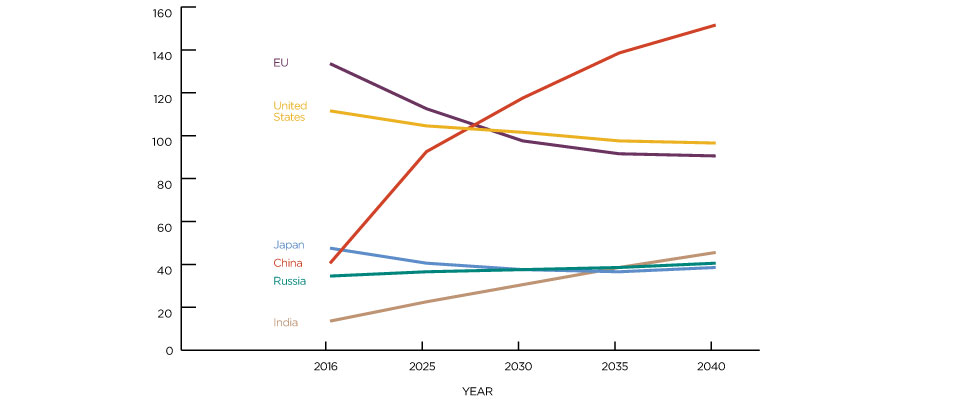 Source: Atlantic Council, International Energy Agency
According to the report, Russia and China lead the international market in commercial nuclear energy by offering a complete package of construction and operation of new nuclear power plants, technological innovation and attractive financing options. In contrast, the U.S. often struggles to offer its international customers a comparable comprehensive deal.
The report says China brings “a complete package of design, construction, labor, technology, and financing, which improves the economics compared to industries in the West.”
Russia, through its state-owned nuclear company Rosatom, offers an “integrated solution” to commercial nuclear customers including construction, operation and maintenance and human resources development. Rosatom is involved in seven nuclear reactor construction projects in Russia and 33 abroad. Russia is building reactors or pursuing commercial nuclear deals in India, Bangladesh, Turkey, Hungary, Belarus, Egypt, Jordan, Iran and Saudi Arabia.
To make the decision to build plants even more attractive, the report notes that both countries offer attractive financing packages to fund these projects. China goes into markets abroad with financing options from its own Export-Import (Ex-Im) Bank, while Russia uses resources from both the Russian state budget and the Russia Wealth Fund.
In contrast, the U.S. Export-Import Bank’s board of directors remains without a quorum and as a result cannot consider medium- and long-term transactions exceeding $10 million. Typically, commercial nuclear deals are measured in billions of dollars, not millions: Turkish President Tayyip Erdoğan said this week that the investment in the country’s first nuclear power plant, being built by Russia’s Rosatom, will exceed $20 billion.
“Potential foreign customers of nuclear power projects generally require a secure array of viable financing options to choose from when they walk into the room.” NEI Vice President of Suppliers, New Reactors and International Programs Dan Lipman said.
Not having a full quorum on Ex-Im Bank’s board hampers our ability to close multibillion dollar deals in the face of international competitors who offer attractive financing from day one.
The report notes that Russia and China also are positioning themselves to be leaders in advanced commercial nuclear technology. China is pumping money into the development of small modular reactors, high-temperature gas-cooled reactors and pressurized heavy water reactors. Russia is focusing on modular reactors and fast reactors with a closed fuel cycle, which will allow used nuclear fuel to be processed and reused.
“The Chinese and Russian use of nuclear-power financing and technology as a means of expanding their overseas physical presence, and their foreign-policy influence in key countries, has important implications for the United States,” the report says. “Russia and China are vying for expanded influence in countries critical to U.S. diplomacy, namely Iran, Saudi Arabia, Turkey, Jordan, Egypt, and Pakistan.”
Lipman said the report shows the need for the administration and Congress to support American commercial nuclear exports through concrete action.
“It’s critical for our industry that, given aggressive overseas, state-owned competitors, we work with the White House and Congress to give American companies the tools they need to compete and win abroad,” Lipman said.
“That means reestablishing a quorum at Ex-Im Bank, ensuring the U.S. Department of Energy’s Part 810 nuclear export controls are made more efficient, ensuring Section 123 bilateral nuclear cooperation agreements are concluded in a timely fashion, and fully funding commercial nuclear energy research and development in the federal budget. It’s not only American jobs that are at stake, but our influence on safety, security and nonproliferation norms across the world.”