
- New maintenance procedures reduce operations cost by millions per year
- U.S. plants continue stellar run in reliability and safety
- Emphasis on critical safety equipment helps focus maintenance schedules
Andrew Winter, a senior manager of equipment reliability at Exelon Nuclear, has a unique occupation: he oversees maintenance schedules for the critical equipment that keeps nuclear power plants running safely and reliably. Winter oversees the maintenance strategy, including preventive maintenance programs, for 22 Exelon reactors at 13 sites. From water pumps to air compressors to power supplies, Andy and his team are responsible for inspecting and maintaining literally thousands of components per plant.
Inspecting and maintaining all these systems requires a huge commitment of time and money. So, when an opportunity came to streamline and focus maintenance schedules for nuclear plant equipment, Winter and his team jumped at the opportunity.
Value-Based Maintenance (VBM) establishes more cost-effective maintenance strategies for critical safety equipment at nuclear power plants advancing safety and reliability. VBM is part of the industry’s Delivering the Nuclear Promise (DNP) initiative that seeks to strengthen safety and reliability, implement efficiency improvements and drive market changes to properly value nuclear energy.
“Value-based maintenance is shifting us from a culture of having to rigorously inspect and maintain a very large number of critical safety plant components to allowing us to look at a smaller population of components that are truly critical to plant safety,” Winter says.
VBM insights and best practices were shared across the industry as part of its DNP initiative via Efficiency Bulletins issued by NEI last year (EB-17-03a, EB-17-03b and EB-16-25).
Altogether, since the DNP initiative began in 2015, it has enabled savings of $1.6 billion across the industry and the total generating costs of nuclear energy have dropped approximately 19 percent. Reducing plant operating costs has become a top priority for the industry as nuclear plants have been forced to shut down prematurely, causing severe hardships for the regions they serve. Usually, this means hundreds of job losses, significant declines in air quality, and multimillion-dollar shortfalls in the municipal budgets that fund schools, police forces, emergency preparedness and other vital necessities for communities.
Boosting Efficiency
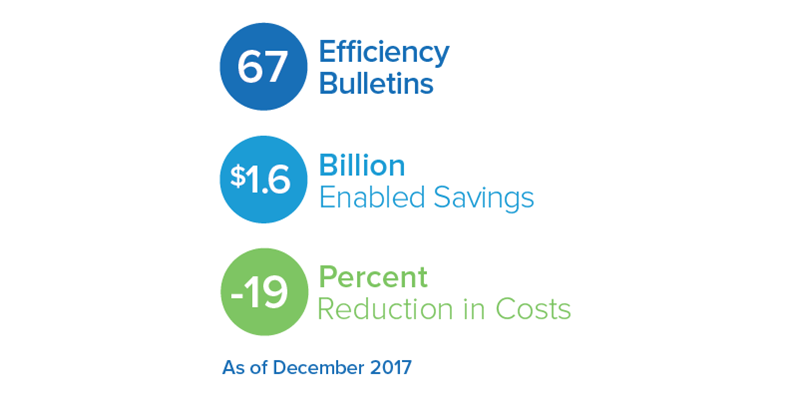
These bulletins provide a method for plants to redefine which components are truly critical for plant safety and reliability. Winter estimated that implementing the changes in those two bulletins allowed the number of components deemed critical to safety to go from 25,000 components to 4,000.
As shown in EB-17-03a, the science behind VBM is clear that unnecessary maintenance actually leads to greater failure rates.
“Critical safety equipment is protected and I spend more money intentionally to protect them,” Winter says. “So, I’ll do more maintenance, we’ll spend more money for parts for them. For the non-critical equipment, I don’t do as much. Overall, I’m actually reducing my opportunities for introducing failures.”
In other words, over-maintaining a component will cause it to fail just as often as under-maintenance.
Not only is focus increased on the most important equipment through VBM, plants also save time and money. Winter estimates that VBM will save Exelon approximately $2 million per plant site each year.
“It’s one of the more substantial savings from Delivering the Nuclear Promise,” Winter says.
To help share best practices, U.S. and Canadian nuclear utilities have fed data from their maintenance programs to the Electric Power Research Institute’s (EPRI) Work Order Data Visualization Tool. Along with displaying detailed maintenance cost information for each utility, EPRI will make the work order data generic, allowing it to be shared with utilities interested in streamlining and managing costs in their own maintenance programs.
“This tool represents our first big step heading down the industry’s path to let data drive and improve our decision-making when it comes to implementing VBM methodology,” says Jeffrey Greene, project manager at EPRI.
Winter emphasizes that the improvement in focus and cost savings have not negatively impacted reliability and safety.
“This year, in fact, we are seeing reduced scrams [unintended shutdowns],” Winter says. “We have not seen any negative impacts.”
NRC WITHDRAWS DRAFT REQUIREMENTS ON MANUFACTURERS’ MAINTENANCE
In another development affecting the cumulative burden of maintaining nuclear power plants, the U.S. Nuclear Regulatory Commission has withdrawn proposed guidance that would have eventually required nuclear power plants to follow manufacturers’ recommendations for maintaining plant equipment without regard to any other factors.
In a notice in the Federal Register, the NRC withdrew the “Service Life” Regulatory Issue Summary. It is estimated that the change would have added millions of dollars in costs for plants to maintain their equipment, according to NEI Senior Project Manager Jim Slider.
“Nuclear power plants follow NRC regulations, industry best practices and other stringent requirements to maintain and inspect thousands upon thousands of components,” Slider says. “Making manufacturers’ guidelines the primary, or only, consideration in scheduling preventive maintenance would have added millions in cost with little or no safety or reliability benefit compared to current practices.”