
The daunting task of picking a major in college is challenging for most young adults. 75 percent of students change their major at least once during their college career. But having come from a “nuclear family” (no pun intended), I knew I wanted to get into the nuclear industry. A decade later, nuclear is still my calling and now I get to help students pursue a similar passion for nuclear energy.
For certain disciplines within the nuclear industry, such as health physics and radiation protection, we have seen a wane in the number of graduates at all levels, as independent scientific organizations have noted. This is worrisome, as radiation protection staff are a critical piece to a nuclear facility’s successful operation and decommissioning. This is compounded by the not-so-secret fact that the U.S. nuclear workforce is aging and we need to refill the pipeline with new talent.
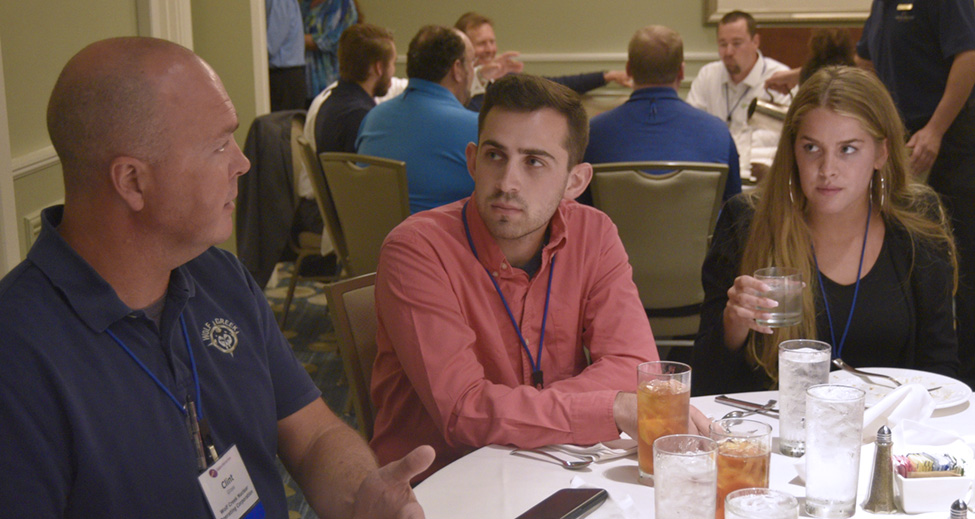 A mentor talks with students at a Radiation Protection Forum luncheon.
To remedy the situation, NEI started the “Student Program” at our annual Radiation Protection Forum in the early 2000s, which has not only borne fruit for the nuclear industry, but also continues to be a successful method to introduce and energize college students about nuclear energy careers.
The reason why today it's very important for us to get new people into the pipeline for the nuclear industry is because the talent that's there, the resources, the individuals that have all the experience are at retirement age.
Recently, NEI hosted the 2018 forum in Naples, Florida, where we had 12 motivated students from across the country participate in the Student Program. Students arrive one day early, to receive a comprehensive, full day of orientation from NEI and other industry groups like the U.S. Nuclear Regulatory Commission, the Institute of Nuclear Power Operations and American Nuclear Insurers (ANI). They are also paired with a personal mentor, typically an experienced radiation protection manager. Students and mentors attend special breakfasts and lunches together and communicate throughout the conference. This not only helps the student navigate complex topics but encourages the students to engage and ask questions.
One interesting thing I learned during orientation today is there's a lot of information that I didn't know about the NRC, INPO, ANI. There's a lot more to the nuclear world than just working at a power plant.
It was encouraging to see some mentors invite their student to official business dinners with suppliers and vendors. Those students got the added after-hours experience to see how the sausage is made in the industry world. According to a survey given after the forum, 92 percent of the program’s students plan on keeping in touch with their mentor and pursuing a career in the nuclear industry—and they have their mentor’s business card to prove it. Plus, all of the students were more interested in learning about nuclear energy after attending the forum.
The savvy students, who are selected by their professors and graciously funded by utility and supplier companies, realize that attending the forum is essentially a several days-long job interview. As it turns out, many students of past programs have been successful in this quest, and now work at reactors as radiation protection technicians. Some students even come full circle and attend the forum as general participants, mentors and even managers, years later.
A lot of times if you're at a plant, you may not see the big picture and where your opportunities are. You may be thinking 'oh there's just a survey to do' or maybe there's just a more menial task. This [forum] … gives you a bigger picture of what the industry is all about, the opportunities you may have, and where you may be able to progress.
The success of the mentor relationships reminded me of my first professional mentor. In the same way that my mentor helped me grow and improve, I saw the same level of coaching at the forum. Something as little as a mentor leaning over to a student to explain a technical topic being discussed by the NRC highlights the value of those connections.
Through nearly two decades of running a successful program, students are set up for a world of opportunity, in an area of need for our industry. NEI Director of Radiation and Materials Safety Ellen Anderson has shepherded the Student Program over the past decade, and last year, the baton was handed over to me. After listening, watching and observing the students all week, as we said our goodbyes, I had a sense of calm and confidence—what I observed was a fresh crop of youth, with a strong desire to enter this industry. I saw students convinced they chose the right major.