
- Very small reactors are well suited to remote, off-grid locations
- Can eliminate the need for constant, costly diesel fuel resupply
- NEI’s new road map outlines what is needed to make project a reality
With more than 70 advanced nuclear reactor projects in various stages of development in the United States alone, there is exciting growth in this field. “Micro-reactors” are one class of these innovative technologies, whose particular attributes hold out special promise to the nation’s largest energy user—the United States military.
 Small modular reactors and micro-reactors can power remote communities, both military and civilian. [Image: Third Way]
Working closely with the reactor vendors and with relevant offices at the U.S. departments of Defense (DOD) and Energy (DOE), the Nuclear Energy Institute this week published a road map laying out the actions needed to ensure the successful deployment of a first-of-a-kind micro-reactor at a domestic defense installation by the end of 2027.
“Small reactors are one of the most promising new nuclear technologies to emerge in decades,” NEI Director of New Reactor Deployment Marc Nichol said.
“Energy is important to our national security; it must be reliable and resilient so that it’s there when our men and women in uniform need it. Micro-reactors can enhance our military capabilities by providing that resilient energy.”
The Pentagon has been interested in small nuclear reactors for nearly a decade, as robust and reliable power sources for military installations within the territorial United States and overseas. The very small “micro-reactor” designs now emerging from companies like General Atomics, NuScale Power LLC, Oklo Inc., Westinghouse Electric Co. and X-energy LLC are particularly well aligned with DOD’s needs for energy security and resilience.
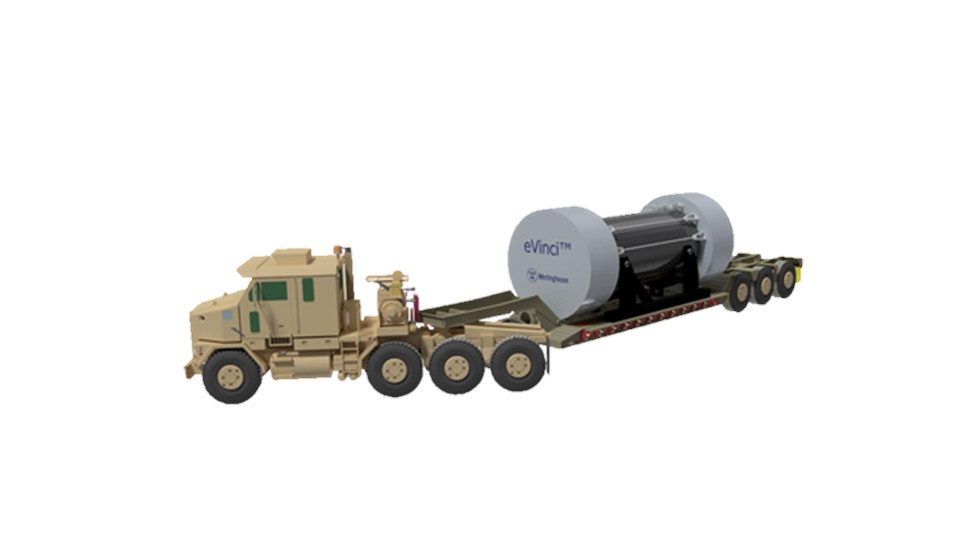 Micro-reactors, like Westinghouse's eVinci, are easily transportable and do not need refueling for years. [Image: Westinghouse]
In contrast with the large nuclear reactors in operation all over the world that have a generating capacity of about 1,000 megawatts-electric (MWe), micro-reactors are typically less than 10 MWe in size. These smaller reactor designs are well-suited for transportation to and installation at remote military bases, where they can provide both electricity and heat for years at a time without refueling. They are capable of operating independently of external electricity grids that could be vulnerable to threats, natural and otherwise, in areas where DOD bases operate.
Micro-reactors are thus capable of providing the resilient energy the military needs, providing primary power under normal and emergency conditions and enhancing DOD’s range of operations, endurance, agility and mission assurance.
”Ultimately our goal is resilience,” said Troy Warshel, director of operations at the Pentagon’s Office of the Deputy Assistant Secretary for Operational Energy at NEI’s Oct. 4 press event on the publication of the road map.
“And what does resilience mean for the Department of Defense? It means for our critical missions, when we flip the switch—there’s power. … We see nuclear energy as a huge potential partner in achieving our resilience goals.”
As a reflection of DOD’s interest in this technology, the 2019 National Defense Authorization Act (NDAA) that Congress passed in August directed the secretary of energy to report to Congress within a year on the requirements and components needed for a pilot program to “site, construct and operate at least one licensed micro-reactor that provides resilience for national security infrastructure at a DOD or DOE facility.”
NEI’s technical report, “Road Map for the Deployment of Micro-Reactors for U.S. Department of Defense Domestic Installations,” provides guidance and input for the pilot program. The road map outlines the timelines and challenges for deploying the first micro-reactor at a domestic DOD facility and recommends actions to ensure its installment by Dec. 31, 2027, as prescribed in the NDAA.
Among NEI’s recommended actions for DOD, DOE and industry are:
- DOD should identify the host installation and site requirements, perform an assessment of the designs, and enter into a contract or agreement with a commercial entity by the end of 2019.
- DOE should provide high assay low-enriched uranium (HALEU) by the end of 2022. This is uranium enriched in fissile uranium-235 to a slightly higher level than that used by current commercial nuclear reactors and is needed for some micro-reactor designs.
- Developers should sustain the development of micro-reactor designs to enable deployment within the program timeline, including designing for manufacturability, constructability and operability, and optionally entering into private-public partnerships with DOE.
- DOD should work closely with the industry and the U.S. Nuclear Regulatory Commission to identify and resolve unique regulatory issues associated with micro-reactors.
- Industry should immediately begin working with the NRC to explore options for accelerating the review schedule for micro-reactors.
While the road map focuses on domestic defense installations, micro-reactors are equally suitable for forward operating bases overseas. For these applications, the Pentagon also is interested in micro-reactors for their potential to eliminate the need for fuel resupply.
“Unleash us from the tether of fuel,” Secretary of Defense James Mattis is reported to have said when he was lieutenant general of the Marine Corps in Iraq in 2003.
“The Pentagon is constantly developing new technologies to prepare for its future challenges,” Nichol added. “These advanced capabilities, which include supercomputing, artificial intelligence, robotics and directed energy weapons, will demand ever more energy, and this energy will need to be highly resilient. Micro-reactors are the perfect fit to enable the military of the future.”
