
- TVA shows small reactors’ safety features means emergency planning can be scaled down
- Staff conclusions encouraging for SMRs and other new reactor designs
- Industry engaging with NRC to develop emergency preparedness regulations for advanced reactor technologies
In a potential regulatory breakthrough that could accelerate future deployment of small modular and advanced reactors, Nuclear Regulatory Commission staff agreed with the Tennessee Valley Authority that scalable emergency planning zones (EPZs) for small modular reactors are feasible. The industry believes that this recognition of the enhanced safety features of small and advanced reactors could greatly simplify the licensing of these technologies and increase their cost competitiveness.
The preliminary finding was made public this week in the NRC staff’s advanced safety evaluation of TVA’s 2016 early site permit application (ESPA) for a potential nuclear plant at TVA’s Clinch River Nuclear Site in Tennessee. The plant would comprise multiple small modular reactors (SMRs).
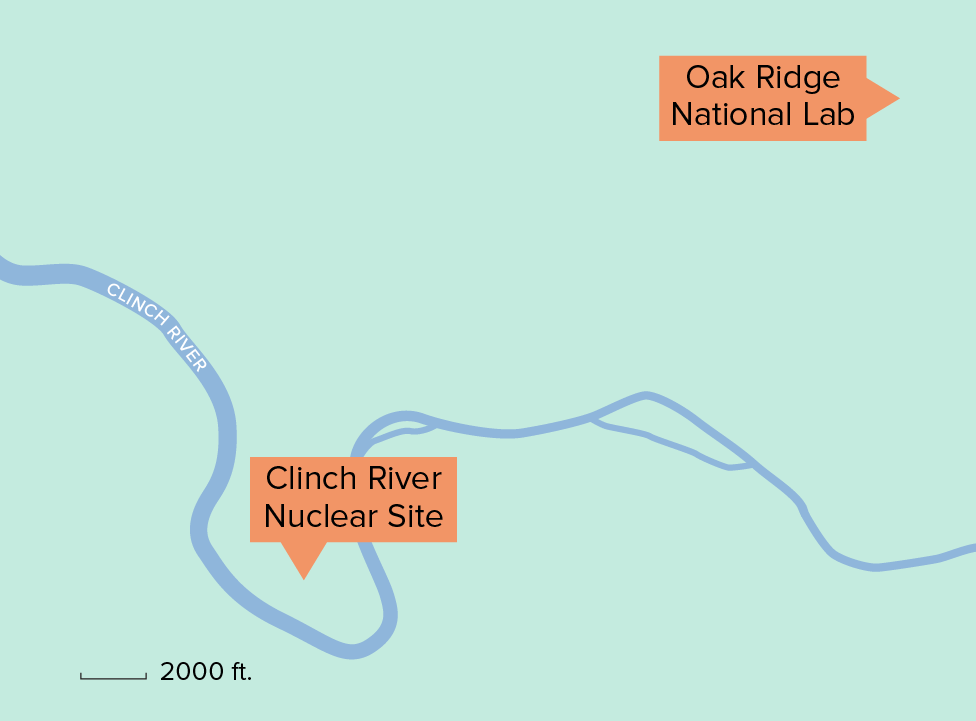 Tennessee Valley Authority's proposed Clinch River SMR site, near Oak Ridge National Laboratory. [Source: TVA]
TVA’s ESPA uses information from four SMR designs—BWXT’s mPower, Holtec International’s SMR-160, NuScale Power’s SMR, and Westinghouse’s SMR—to provide the technical basis for a requested exemption to the 10-mile EPZ requirement currently in use for the U.S. operating fleet of large light water reactors. Of these four designs, the most detailed information was provided on the NuScale SMR, for which a design certification application was submitted to the NRC in January 2017.
As part of the ESPA, TVA provided the agency with a detailed analysis of the unique safety and performance attributes of SMRs that allow for scalable emergency preparedness (EP) requirements. TVA showed that the enhanced safety characteristics of the SMR designs encompassed by the ESP application—the smaller amount of fuel in the reactor cores, simpler systems, and reliance on built-in passive safety features—eliminate several potential emergency scenarios.
As a result, off-site EP requirements and plans can be scaled down to be proportionate with those reduced risks, including an EPZ size that need not extend beyond the plant site boundary.
The staff found TVA’s proposed dose-based, consequence-oriented methodology to be a “reasonable technical basis” for determining EPZ size, consistent with the basis used to determine EPZ size for large light water reactors.
The agency also granted TVA its exemption from a 10-mile EPZ for future combined construction and operating license applications for which the radioactive source term is bounded by the conditions established by the NRC. A July 2018 staff audit report found that an SMR plant at the Clinch River site based on the NuScale SMR design would meet the conditions for a site boundary-sized EPZ.
These preliminary findings will be discussed at an Aug. 22 meeting of the NRC’s Advisory Committee on Reactor Safeguards.
Also to be reviewed that day is the NRC staff’s proposed rulemaking to develop EP requirements and associated guidance for SMRs and other new nuclear technologies that would be commensurate with the lower consequences to public health and safety from potential accidents at these types of facilities. The commission already has approved the staff’s plan and schedule for the rulemaking.
The proposed rule will be based on the public health and safety protection standards contained in the Environmental Protection Agency’s Protective Action Guidelines. These are the same standards used for the current large light water reactor fleet. This approach ensures that new EP requirements will provide the same level of public protection as existing requirements.
“NEI and our members are pleased that the NRC has recognized the need to promulgate new EP regulations that reflect the inherently lower risk profile of advanced reactor technologies,” NEI Technical Advisor for Nuclear Generation David Young said.
This rulemaking is consistent with direction from Congress, which has been encouraging the agency to modernize its regulatory framework to facilitate the licensing of these new technologies, particularly through recognition of their enhanced safety features.
“Absent a change to existing regulations, new reactor technology facilities would be subject to current EP requirements, which would impose an unnecessary regulatory burden on applicants and licensees. This will diminish the cost competitiveness of advanced reactors, thus hindering their development and deployment,” Young noted.
The rulemaking will promote the establishment of a clear, predictable and stable licensing process for advanced reactor applicants and licensees, and avoid the inefficiency and uncertainty associated with achieving compliance through alternative measures, exemptions and license conditions, he added.