
- Regulatory transformation critical for timely adoption of new technologies
- Risk insights, agility, predictability and flexibility crucial in new paradigm
- NEI says transformation needed “urgently”
Since its founding in 1974, the U.S. Nuclear Regulatory Commission’s primary mission has been to protect public health and safety. Among the hallmarks of its “Principles of Good Regulation” are independence, openness, efficiency, clarity and reliability. As a result, the U.S. nuclear industry has never injured a single member of the public in its entire history.
Today a new generation of innovators is developing advanced nuclear technologies—not just new reactor designs but components like advanced nuclear fuels that promise improved safety and performance. Digital instrumentation and control systems and plant system monitoring sensors could allow more efficient data collection, maintenance monitoring and safety trend analyses. Other high-tech developments like drone technology, artificial intelligence and “big data” are already being applied in other industries and could potentially transform the nuclear energy sector too.
For example, the commercial aviation industry routinely uses digital cockpit instrumentation, satellite-based navigation and communications, and computerized monitoring of aircraft systems performance. By contrast, many of the underlying technologies in the nuclear industry have not changed for decades, with the 1960s-era control room dials being one of the most glaring examples.
The NRC has increasingly recognized that it is not effectively keeping pace with new risk methodologies and breakthrough technologies that could improve regulatory efficiency and operational safety.
This January, the agency’s Executive Director of Operations Victor McCree created an NRC Transformation Team, charged with identifying “transformative changes to the NRC’s regulatory framework, culture and infrastructure.” The effort will inform not only the licensing of new technologies such as advanced reactors and accident tolerant fuels, but also allow the use of modern technologies and regulatory processes in the oversight of existing reactors. The NRC staff is expected to provide its recommendations to the agency leadership in May.
“Many of the NRC’s processes and much of our regulatory framework were developed to serve mid-20th-century nuclear technologies and needs,” McCree said at the NRC’s annual conference earlier this month. “We recognize that the changes occurring in the nuclear industry will challenge this framework and additional regulatory change is needed.”
The staff-led initiative encompasses a number of areas, including increasing the use of digital instrumentation and control in nuclear power plant control rooms, using risk assessments to inform rules, advanced reactor licensing, and using analytical insights to make regulations and plant operations more efficient.
“The agency staff’s innovation and transformation efforts are central to chart the course to the NRC’s future,” NRC Chairman Kristine Svinicki added.
The transformation team has been talking to the U.S. Navy, the Federal Aviation Administration and international partners to learn how highly technical, mission-critical industries have made transitions to more modern technologies, Commissioner Jeff Baran noted.
Responding to the NRC’s request for industry input on its initiative, NEI last week submitted to the agency a report, “A Framework for Regulatory Transformation,” which provides recommendations on how to achieve a more risk-informed, agile, predictable and results-driven regulatory framework.
The NRC has traditionally focused on regulating safety using highly prescriptive, deterministic regulation, NEI says. The agency’s processes have become cumbersome, resource-intensive and not focused on the most safety-significant issues. Streamlining processes through risk-informed decision-making not only will also allow more effective use of NRC and industry resources to address safety-significant issues but will speed the adoption of new technologies.
Delays in the adoption of innovative technologies are missed opportunities to improve safety and efficiency. Without the ability to innovate and operate more effectively, the U.S. reactor fleet will be more at risk of premature closures.
These closures and missed opportunities in turn are putting the U.S. nuclear industry at a disadvantage to foreign competitors like China and Russia, NEI warns. The United States is at risk of losing critical infrastructure and energy security assets. Some U.S.-based nuclear entrepreneurs are being driven to develop their technologies overseas. Other countries are moving ahead of the United States in deploying their own advanced reactor designs, resulting in the loss of U.S. technological pre-eminence, global energy security and geopolitical influence.
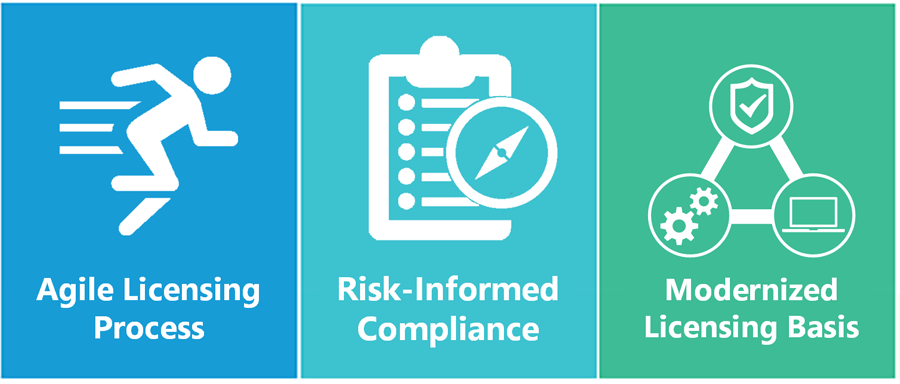
NEI calls for a two-part culture shift within the NRC—the agency must firstly focus its resources on safety-significant areas and then be more efficient in how it regulates those areas. The report recommends four primary objectives:
- early use of risk insights such as probabilistic risk assessments in decision-making, regulatory changes and reviews
- development of a results-driven, efficient and predictable framework that allows reasonable assurance of adequate protection and safety margin
- a transformed regulatory oversight process that better focuses on risk- and safety-significant issues, allowing timelier decision-making
- flexibility to allow alternative ways to achieve safety objectives, including new approaches, methods and technologies.
Other voices also have identified the need for transformative change at the NRC. The center-left think tank Third Way advocates for a predictable, phased regulatory approach that allows for more timely licensing of innovative technologies. Third Way recommends taking lessons from regulatory approaches used by the Federal Aviation Administration and the Food and Drug Administration, both of which “routinely manage the tension between innovation and safety regulation.”
Across the political spectrum, the policy organization R Street Institute has several recommendations for lowering regulatory barriers to new nuclear technology, which it says must remain viable both for deep decarbonization of the economy and to maintain U.S. global leadership in the field.
NEI urges the NRC to transform itself with all speed, with its short-term recommendations to be implemented within a year and longer-term items within two or three years.
“It is critical for the NRC leadership to fully support the timely implementation of transformation,” NEI’s report says. “The outcome and the timing are what matter most.”