
Two bits of energy business jargon define industrial success these days: steel in the ground and asset management. Steel in the ground means what you’ve built, and asset management means how well you run it. Asset management is a hidden success story for nuclear power.
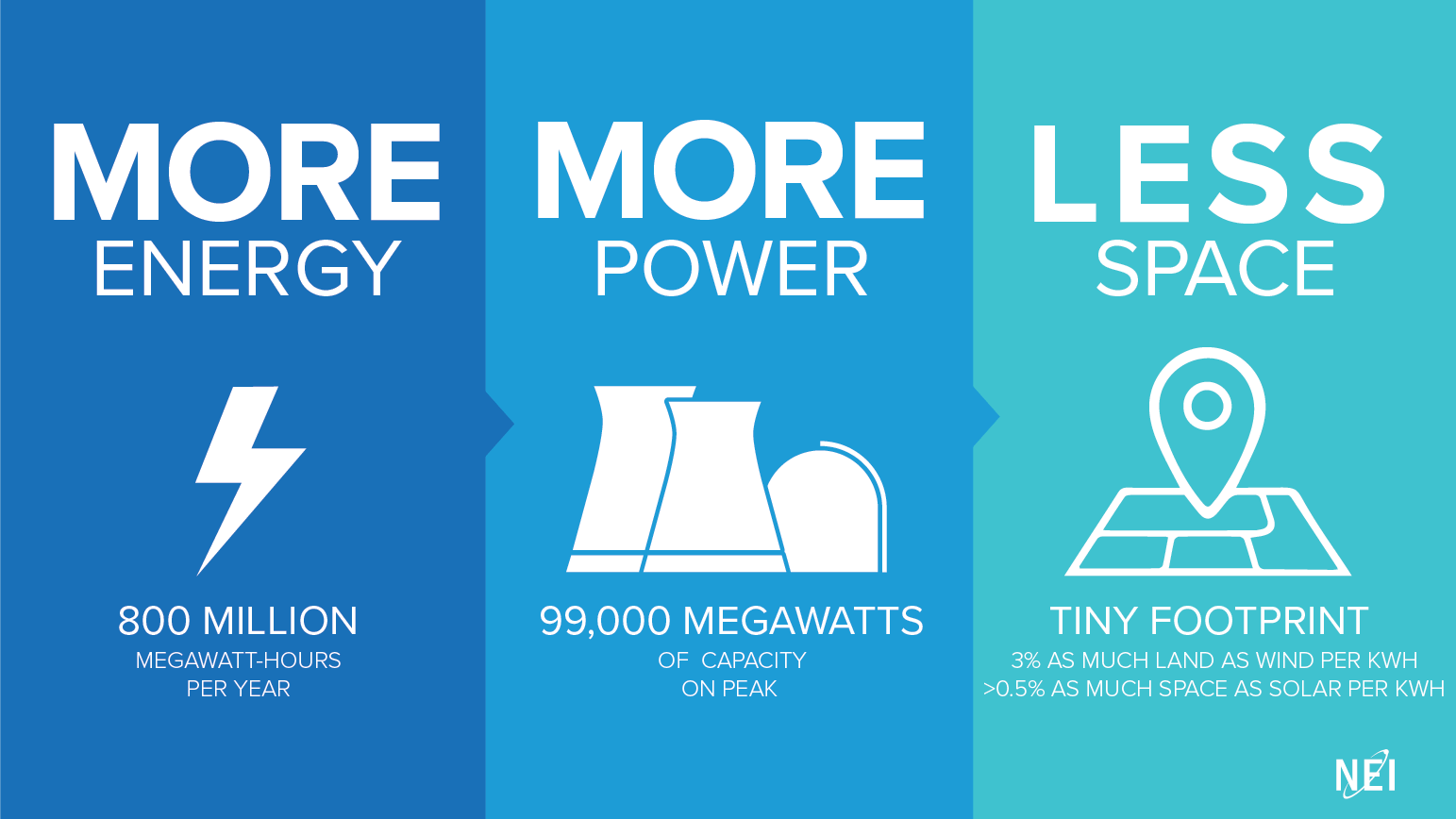
For the last few years, nuclear reactors have produced over 800 million megawatt-hours of electricity a year. (If the number seems hard to conceptualize, recall that a typical suburban house uses about 10 megawatt-hours a year.) The number of reactors has declined a bit, but production has been steady. In fact, the 99 operating commercial power reactors are now doing the work that it would have taken about 140 reactors to do back in the 1980s.
How is this possible?
There are two big changes. Most of the reactors now have substantially higher capacity than they did when first built, and all of them are running more—more than 11 months a year, compared to about 7 months when they were new.
The increase in capacity, called “uprates,” comes from many small improvements. Turbines, the devices that are spun by the flow of steam and produce the torque that turns generators, are more efficient. And the supply of steam is bigger because plants have redesigned their nuclear cores and other components.
This is possible because of technical advances and because in the era when most of the plants were built, design practices were less advanced, and a simple, easy way to assure that a piece of equipment was robust enough was simply to use more steel and more concrete. The result was plants that had many oversized components. Focusing on the few that were not oversized (a process that our colleagues in the petrochemical industry call debottlenecking) it was often possible to make small improvements that produced bigger gains.
Exelon Corp.’s Peach Bottom reactors, on the Susquehanna River in Pennsylvania, now produce 12.4 percent more power at peak than they did originally. Tennessee Valley Authority’s Browns Ferry reactors, near Athens, Alabama, produce 14.3 percent more. Altogether, uprates have added 7,900 megawatts to reactor capacity, the equivalent of seven new state-of-the-art AP1000 reactors of the kind now under construction in Georgia.
There are more innovations to come in today’s nuclear plants. The industry is testing new fuels that are more heat-tolerant. One of those designs has better heat transfer characteristics, which could allow a reactor core to make 20 percent more heat—if the rest of the plant were set up to accommodate that big an increase.
And they run more hours of the year. Annual shutdowns of two or three months used to be common, for refueling and maintenance; now they run about three weeks. And unscheduled, automatic shutdowns used to commonly happen six or eight times a year at each reactor; now the average is less than once a year.
The technical term for this productivity is called “capacity factor.” It is calculated by taking the amount of energy that a generator produced and dividing by the amount that would have been produced if it had run at 100 percent power, 24/7. Average capacity factor lately is over 90 percent. In the 1980s it was under 60 percent.
Capacity factor is another key measure of the value of a generator. The wind industry has markedly improved its capacity factor by building taller towers, designing turbines that can wring a bit of electricity from the air at lower wind speeds, and picking its sites better. Some turbines now have a capacity factor above 40 percent, although most are in the 30s. Solar photovoltaic capacity factors vary heavily by location; outside desert areas, they are in the range of 15 percent. That is why one megawatt of nuclear capacity will produce about six times as much energy as one megawatt of solar capacity in most locations and will produce more than double as much energy as a megawatt of wind capacity.
Of course, there are other ways than nuclear energy to make carbon-free electricity, but they take up a lot of space and uprates take up none. Taking the capacity factor into account, if the amount of electricity produced by nuclear plant uprates came from wind instead, it would require between 5,100 and 7,100 square miles. The smaller number is the size of the state of Connecticut; the larger one is Connecticut plus Rhode Island thrown in twice.
To make that much energy with solar power would require between 1,610 square miles (for solar photovoltaic panels) and 2,300 square miles (for solar thermal.) The smaller number is about three times the size of New York City. The larger one is about the size of Everglades National Park.