
- Five countries competing to build first reactors in the kingdom
- 20 U.S. companies represented in trade delegation to Riyadh, Dhahran
- Cinching nuclear deal could further U.S. foreign policy goals in the region
NEI, in partnership with the U.S.-Saudi Arabian Business Council and the U.S. Departments of Commerce, Energy and State led a trade delegation to the Kingdom of Saudi Arabia this week. The mission provided an opportunity to deepen U.S. industry relationships with officials in the kingdom, clarify Saudi nuclear energy development plans, share U.S. commercial opportunities and identify potential Saudi partners.
“The U.S. industry has a proven record of partnership in industrial development and technology transfer,” said Dan Lipman, NEI vice president for suppliers, new reactors and international programs.
“We were deeply impressed with the scale and scope of Saudi Arabia’s nuclear energy plans, and we look forward to providing assistance in every aspect on its path to becoming a major nuclear energy producer.”
The U.S. delegation consisted of 30 senior executives representing 20 world-leading companies from across the U.S. commercial nuclear supply chain, underscoring the strong interest of U.S. industry in partnering with Saudi Arabia as it plans to launch an ambitious commercial nuclear energy program.
To meet soaring electricity demand and diversify its electricity-generating mix away from fossil fuels, Saudi Arabia plans to develop two large nuclear power plants in the first phase of a multibillion-dollar program that envisions up to 16 nuclear plants operating in the country. The kingdom is in the process of selecting finalists from five nations—the U.S., China, Russia, France and South Korea—that it invited to bid on a project to build the two plants. The selection of a winning bid and the signing of contracts are scheduled to take place by the end of 2018.
The delegation held extensive meetings and a workshop with the nuclear energy team of the King Abdullah City for Atomic and Renewable Energy (K.A.CARE), the Saudi government agency tasked with developing nuclear energy in the country.
In Riyadh and Dhahran, the delegation met with the senior leadership of other key Saudi ministries and stakeholders involved in the kingdom’s nuclear energy development plans. The delegation also held business-to-business sessions with Saudi industry executives to discuss potential areas for partnership.
During a conference call this week, Lipman said that high-level support from the U.S. government has been key to moving the American bid forward.
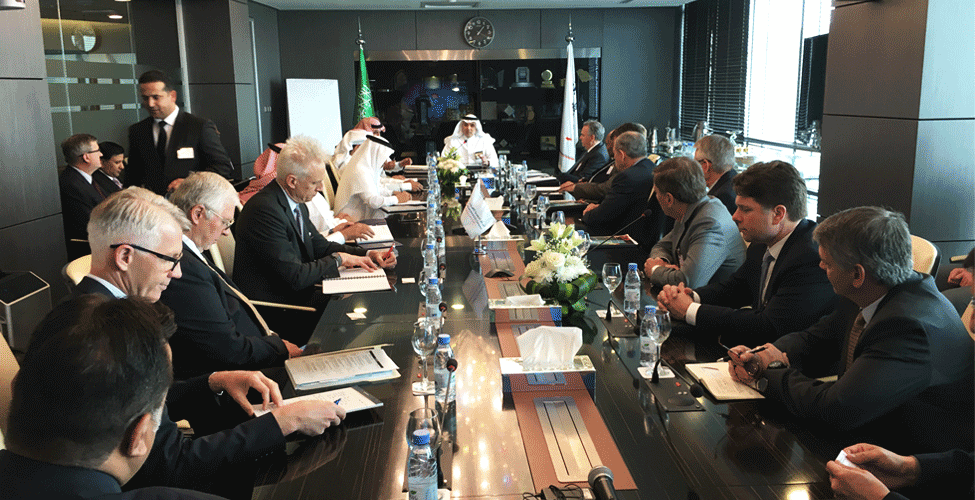 The U.S. trade mission delegation to Saudi Arabia meeting with Ziad bin Mohammed Al-Shiha, CEO of Saudi Electricity Co. [Photo: NEI]
“We have been very pleased with a virtually unprecedented level of support from the Department of Energy and the Trump administration on the Saudi bid, especially Energy Secretary Rick Perry,” Lipman said.
Saudi Arabia, which does not currently have a nuclear energy program, also is seeking assistance on training and human capital development, regulatory and legal development, engineering and construction, precision component manufacturing, uranium mining, and fuel cycle services.
In addition to the large reactors currently under consideration, Saudi Arabia has entered into partnerships with South Korea to develop small modular reactors and with China to develop a high-temperature gas reactor.
Lipman reiterated that more than jobs and an economic boost are on the line as America competes to win the Saudi bid.
“Saudi Arabia is going to purchase small and large nuclear power plants from somewhere. For commercial, technical, safety and nonproliferation reasons, we want them to buy American,” Lipman said.
Foreign Policy Experts Sign Letter Urging Nuclear Trade Agreement With Saudi Arabia
A leading group of 24 nuclear nonproliferation experts has sent a letter to Congressional leaders urging nuclear energy cooperation with Saudi Arabia. The letter recommends that Congress support a commercial nuclear trade agreement (123 Agreement) with the kingdom that prevents the misuse of sensitive commercial nuclear energy technologies.
The letter also urges the United States not to seek conditions that would ultimately cause the Saudis to reject such a cooperation agreement.
“U.S. nuclear cooperation with Saudi Arabia will be advantageous to U.S. foreign policy, national security, and nonproliferation interests in the Middle East and beyond, but a 123 agreement with the kingdom will not be possible if the United States seeks to impose conditions that Saudi Arabia will reject,” the letter says. “The United States needs to adapt its policies to the needs and interests of individual countries.”
The experts noted that the nonproliferation controls in U.S. 123 agreements are more stringent and comprehensive than those of other potential suppliers to Saudi Arabia.
“Other suppliers do not require their cooperating partners to forswear enrichment and reprocessing as a condition of their supply and do not impose the comprehensive restraints that the United States does. Saudi Arabia has made clear that it is prepared to contract with other suppliers if the Kingdom cannot reach an agreement with the United States,” the letter says.
Nuclear Innovation Alliance Policy Director Ashley Finan said that a 123 agreement with Saudi Arabia should be a “pragmatic” part of a larger American strategy.
The successful negotiation of a 123 agreement with Saudi Arabia is one part of a larger strategy, and this letter from eminent nonproliferation experts reinforces the national and global security importance of reaching a pragmatic agreement.
One of the other signatories, Ken Luongo, president of the Partnership for Global Security, said that signing a 123 agreement with Saudi Arabia would help ensure the country develops nuclear technology for peaceful purposes only.
“The most pragmatic way to prevent weapons potential in Saudi Arabia is to deeply engage that nation in the web of U.S. nonproliferation conditions and controls through a nuclear cooperation agreement,” Luongo said.
The United States is in the process of negotiating a 123 agreement with Saudi Arabia and any such agreement will have to conform to current U.S. law, be approved by the president and reviewed by Congress.