
- NRC dockets Turkey Point application, plans to issue decision in 2020
- Three more plants to apply for 80-year operating lifetimes in next two years
- DOE, industry research shows plants can operate safely over long term
When Florida Power & Light Co. (FPL) this January submitted the nuclear industry’s first-ever application to extend the operating lifetime of its Turkey Point Nuclear Plant to 80 years, it did so with little fanfare.
However, the Nuclear Regulatory Commission’s announcement this week that it has accepted the application for an in-depth review marks the first milestone on a path that other reactor operators will be following in the very near future.
“The NRC’s acceptance of the Turkey Point application for review is another positive step forward for making second license renewal a reality,” NEI Senior Project Manager of Life Extension and New Technology Jerud Hanson says. “We look forward to the agency’s prompt review of the application and hope other plants, as planned, will soon follow Turkey Point’s lead.”
Nuclear power plants are given an initial operating license lasting 40 years. License renewal allows them to operate for an additional 20 years, up to 60 years after their commercial operations have begun. Second license renewals will allow plants to operate for an additional 20 years, to a total operating lifetime of up to 80 years.
Nuclear plants are the most powerful way to cut carbon emissions from the electricity sector. The U.S. reactor fleet generates almost 20 percent of the nation’s total electricity—but fully 60 percent of its clean electricity. An NEI analysis (see accompanying chart) using data from the U.S. Energy Information Administration, the U.S. Environmental Protection Agency and the NRC, shows that if all operating U.S. nuclear reactors were to obtain 80-year license extensions, a cumulative total of about 3.5 billion tons of CO2 emissions would be avoided through 2050.
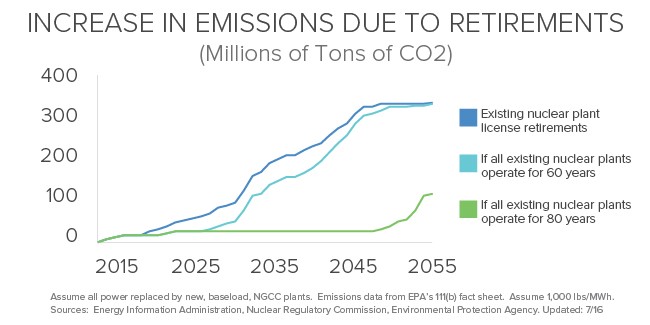
The NRC has scheduled an 18-month review period for the Turkey Point application, meaning a final decision should come in 2020. According to the NRC, three more nuclear power plants plan to submit applications for second license renewal in the next two years:
- Exelon Generation’s Peach Bottom Atomic Power Station in Pennsylvania
- Dominion Energy’s Surry Power Station in Virginia
- Dominion Energy’s North Anna Power Station in Virginia
“NEI invested a significant amount of time and effort working with FPL on its application, and those efforts have now paid off. NEI will continue to work with upcoming second license renewal applicants to assure their success,” Hanson adds.
The NRC’s acceptance of the readiness of the Turkey Point application for review comes after years of collaboration and research conducted by the U.S. Department of Energy’s national laboratories, the Electric Power Research Institute and industry. Among the areas looked at were the potential effects of long-term operations on major metal components in nuclear plants, including reactor pressure vessels. DOE and EPRI also investigated the long-term behavior of concrete and containment structures, electrical cables, and instrumentation and control systems.
This collaboration rigorously demonstrated that there are no generic technical issues that would prevent a well-maintained nuclear power plant from operating safely during its second license renewal period.
“Almost all operating U.S. nuclear power plants have been granted their first license renewals by the NRC. Those plants which have entered operations under renewed licenses demonstrate that U.S. nuclear plants can safely operate beyond their initial 40-year license period,” he notes.
“We are now seeing the lead plants apply for second license renewal. Rigorous inspections, innovative maintenance and repair techniques and continuous upgrades will ensure nuclear power plants continue to operate safely into the future.”