
The Arsenal of Democracy is electric. National strength, including our industrial capability, prosperity, human health and welfare, and environmental health, all rely heavily on electricity, particularly nuclear electricity.
“Arsenal of Democracy” is a phrase coined by President Franklin D. Roosevelt to describe America’s role in meeting the global challenges of the early 1940s. Today, we use approximately 50 times as much electricity—and about one-fifth of that is from nuclear reactors. And stable, secure electricity is even more essential.
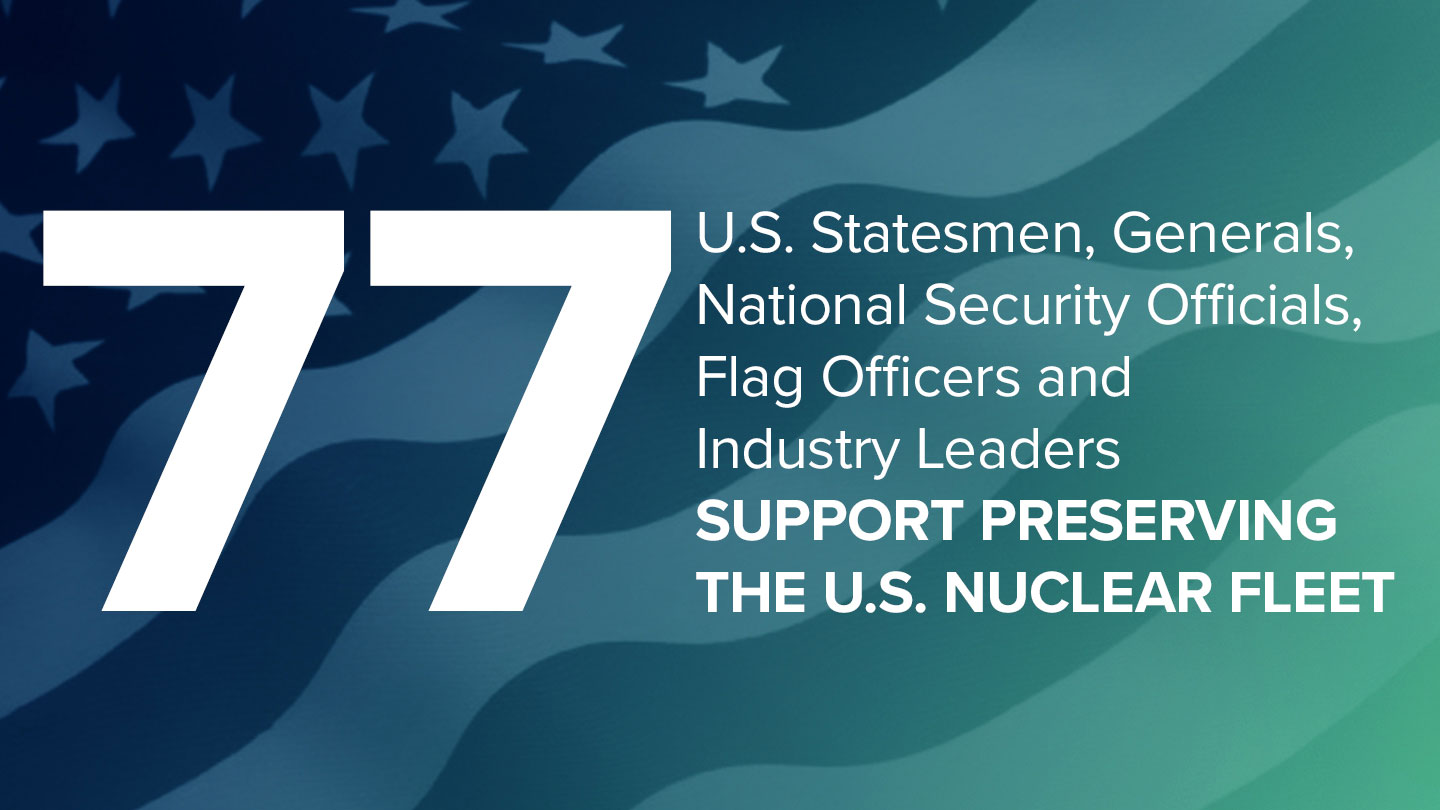
Nuclear energy contributes heavily to our electricity supply, but, in other ways as well, the nuclear industry is vital to our national defense. Now, 77 leaders from the national security community are coming together to make the point that national security ramifications cannot be ignored in a letter to the secretary of energy.
The Pentagon says that 99 percent of its bases are reliant on the grid. It’s hard to defend yourself without radios, radars and the comforts that electricity provides everyone, like drinking water, heat in winter and cool in summer.
The military benefits in another way. Many of the companies in the supply chain for the civilian nuclear industry also serve the U.S. Navy and major Energy Department defense-related programs. And the nuclear industry is an obvious career destination for nuclear Navy vets. That’s one reason that the best and the brightest are drawn to the nuclear Navy.
Nuclear energy is by far our largest source of zero-emissions generation. In an era when climate change has been identified as a risk to national security, minimizing our national impact on climate is a security goal, as well as a prudent idea.
A strong civil nuclear sector is also important to America’s role in the world. The United States has developed its nuclear program over six decades, and American-made reactors, or reactors derived from American designs, dominate the world market. Reactor exports establish a multidecade relationship, beginning with planning and construction, and then 60 or 80 years of operation, followed by decommissioning. Those relationships, commercial and technical, help cement our place in the world. They advance our national security interests, including in nonproliferation, nuclear safety, and physical and cybersecurity.
And in many places around the world, especially Europe, new reactors are a hedge against Russia using natural gas as a cudgel against our allies.
But we are at risk of losing our edge and missing out on further international development, as demand for power surges around the world. Today there are 56 reactors under construction, largely driven by China and Russia.
We are gratified that Secretary of Energy Rick Perry has made the connection between nuclear power and national security and prosperity. As the letter sent by the security experts says, we are hopeful that all policy-makers will see the connection clearly.
The letter is signed by 14 retired admirals, two retired generals, a bipartisan group of 14 former Cabinet secretaries, deputy secretaries, assistant secretaries or undersecretaries, three former ambassadors, three former U.S. senators, and the current or former leaders of several major research institutions and think tanks.
Nuclear power makes other important contributions as well. Most obviously, a stable, secure electric grid is diverse and insulated from what the engineers call “single-point failure.” Diversity, including nuclear, means no cold snap that freezes coal piles, no gas pipeline overload, no hurricane or other natural disaster, can cause widespread failure. Nuclear plants have up to two years of fuel on-site.
Nuclear plants are the only sector of American industry with an individual cybersecurity mandate and a tough regulator checking up on them. They are defended by highly trained, capable guards and by their nature are designed to be tough and robust.
We should treat electricity as a key element of national prosperity and security. After a major blackout in 2003, the National Academy of Sciences estimated that the economic losses were about 40 times more than the electricity would have sold for. In other words, lose something that is cheap, reliable and taken for granted, and the costs run up quickly. If we had any doubt that the grid is a national security asset, consider the reports of hackers—some lone wolves and some probably working for hostile governments—targeting the power system.
The national security implications are obvious.