
- Cars, trucks and heavy industry evolving away from fossil fuels to electricity
- Cleaning up these sectors depends on cleaner electricity, including nuclear
- Nuclear Innovation: Clean Energy initiative to leverage nuclear for decarbonization
What if in the future all our cars were electric? What if the big rig trucks that carry 11.5 billion tons of goods across the country every year were powered by electricity instead of gas or diesel? What if chemical refineries and steel mills used clean electricity instead of burning fossil fuels and belching millions of tons of emissions into the sky?
All this could mean a future of brighter skies and clean, deep breaths. Would this shift result in significantly lower carbon emissions? Not if the electricity isn’t generated from low- or no-carbon sources. And this is where nuclear energy’s role is crucial…
Electricity use in homes, factories and offices has increased steadily from 5 percent of total energy consumption in 1950 to just over 20 percent today. However by 2050, it could jump to 47 percent, according to the Electric Power Research Institute (EPRI).
More and more applications are getting their energy from electricity rather than the burning of fossil fuels—and not just for uses like the electronic devices that proliferate in our homes. Electricity is now breaking into areas that were once the province of fossil fuels—transportation, heating for domestic and industrial applications, and even new industries like indoor agriculture and 3D manufacturing.
EPRI believes that future electrification, if done efficiently, can lower emissions of carbon dioxide and smog-causing pollutants, as well as decrease costs, total energy and water use—while increasing grid efficiency and flexibility. EPRI will be looking at these issues during its first International Electrification Conference next week.
Electrification can be particularly good news for a world seeking to meet ambitious economywide decarbonization goals—provided we do it correctly.
NEI Senior Director of Policy Development Matt Crozat says that electrification could create opportunities to deploy more low-emissions technologies like nuclear power.
“As more functions are served by electricity, they will create more electricity demand,” Crozat says. “This could open more pathways for new deployments of clean generation.”
With nuclear energy’s share of U.S. electricity generation holding steady at about 20 percent and coal generation being largely replaced by natural gas and some renewables, total carbon emissions from the electricity sector have been declining. In fact, in 2016 transportation edged out electricity generation as the largest carbon emitting sector.
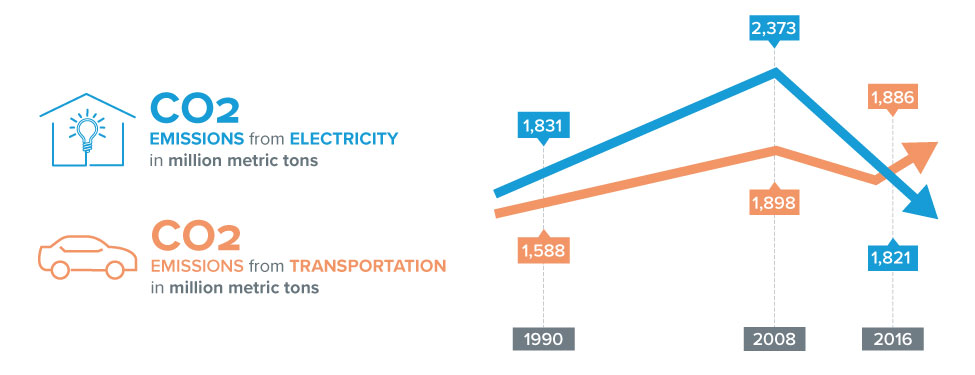 U.S. Energy Information Administration
Making inroads away from fossil fuels in the transportation sector is the next immediate opportunity in decarbonizing economies. One way to do this is via the electric vehicle, or EV. EVs for personal use have been steadily increasing, with multiple models now available from almost every automaker, from Ford to Tesla and Volvo to BMW. However, their growth has not been explosive—so far.
The National Renewable Energy Laboratory (NREL) earlier this year began a study with EPRI, Northern Arizona University, and Lawrence Berkeley and Oak Ridge National Laboratories on the impact of future electrification on electricity demand and consumption. The first of a series of reports from NREL’s Electrification Futures Study notes that although electricity accounted for nearly 40 percent of U.S. energy consumption in 2015, electricity consumption in the transport sector was negligible.
“Large energy footprints coupled with small electricity footprints are a first-order indication of potential for electrification,” NREL says.
One key to greater efficiencies in the sector lies in going beyond the electrification of personal vehicles to public transportation—bus fleets, trains and trucks, and new forms of ride-sharing like Uber and Lyft. These show the promise of more rapid implementation than private cars, because their higher utilization allows amortization of upfront costs, while charging stations can be centralized and optimized. These developments already are changing previous norms of personal car usage and ownership.
Many cities around the world are now testing and buying fleets of battery electric buses. Los Angeles and New York City, with the two largest public bus fleets in the U.S., plan to move to all-electric buses by 2030 and 2040 respectively. And while market penetration in North America is low at present—about 1 percent of the fleet, in China it’s already 20 percent, says Vox’s David Roberts. In fact, China has completed electrifying all 16,000 of the buses in Shenzhen.
“The move to electrified transport via mobility service providers creates the potential for significant new growth for electric utilities, a faster path to decarbonization of our economy, and significantly enhanced mobility options for everyone,” says Jurgen Weiss of The Brattle Group.
Long-haul heavy truck transport is not to be left out. All the major truck manufacturers—and some very new ones—are developing battery-electric trucks—and some companies are looking at hydrogen fuel cell vehicles. These vehicles use hydrogen to generate electricity that powers electric motors—without the need for heavy batteries.
In May, Anheuser-Busch announced an order for “up to 800” hydrogen fuel cell trucks from Nikola Motor Co., following an earlier order for 40 electric trucks from Tesla. While Nikola says it will generate the hydrogen at its network of filling stations, the cheapest and most carbon-neutral source would be nuclear-powered high-temperature electrolysis (HTE).
The U.S. Department of Energy awarded up to $3.5 million in HTE research funding this May.
“This could be an emerging market for clean nuclear power, either from existing nuclear plants or in the longer term from co-located or nearby advanced reactors,” explains Everett Redmond, NEI’s senior technical advisor for new reactor and advanced technology.
The new uses for electricity—transportation, industrial heat, desalination and the rest—can make a big dent in carbon emissions and smog-causing pollutants—but only if the grid they draw recharging power from is clean. In fact, as the grid gets cleaner, carbon emissions from all types of electric technologies decline as well.
As Roberts says, “Electrical grids are giant levers that can move the environmental needle on hundreds of millions of distributed technologies at once. Every device, appliance or vehicle that runs on electricity benefits from the grid’s every incremental improvement … Clean up electricity, and electrify everything.”