Nuclear energy’s primary contribution to public health is to keep pollutants out of the air and to supply the electricity we need for homes, hospitals, supermarkets, water treatment plants and other staples of modern life. But at times of crisis, like this pandemic, it can do more.
Here are three nuclear-related technologies now playing a role in fighting the pandemic:
- Bruce Power, a reactor operator in Ontario, Canada, is working with a radiochemistry lab, Nordion, to provide materials for sterilizing medical equipment. The companies are producing and distributing Cobalt-60, a man-made material that is manufactured by placing naturally-occurring Cobalt-59 in a nuclear reactor core until it absorbs neutrons.
Cobalt-60 is routinely used to power a medical tool called a gamma knife, which is used on brain tumors. But it is also an excellent tool for sterilizing medical equipment, now a more urgent task because of the pandemic.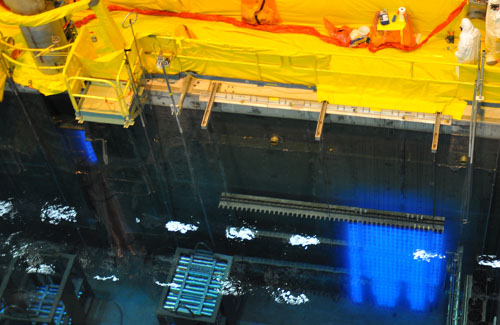 Cobalt-60, glowing blue, in a used fuel pool. Photo Credit: Bruce Power.
- The International Atomic Energy Agency, a United Nations organization, is shipping equipment around the world to help analyze samples to detect COVID-19.
The equipment, which is used for analyzing DNA and identifying the virus, is a refinement of the Polymerase Chain Reaction method. That method originally relied on materials produced in a nuclear reactor, which attached themselves to genetic material, making it easier to track. The method has since evolved to use fluorescent dyes.
In addition to supplying this equipment to hospitals and labs for critical detection efforts, the IAEA is also shipping protective gear and related supplies to facilities around the world. - The Energy Department’s Idaho National Laboratory is offering—for free—patented and patent-pending technologies, including one developed for the nuclear industry for handling hazardous samples in a laboratory. It will be especially valuable for researchers studying the pandemic.
The technology is an adaptation of “glove boxes,” which are airtight, shielded workspaces that a technician can use to handle harmful substances. The Idaho lab’s refinement is a transfer port, a container that can be used to add or remove samples from the glove box without exposing them to the wider environment. It is cheaper to build and simpler to use than existing methods—and it will work just as well with medical samples as with radioactive materials.
The federal government owns many patents and licenses them to private companies in exchange for a share of the profits, but the negotiations often take months. Now, the lab is making this patent available royalty-free, with a minimum amount of paperwork and a non-exclusive arrangement.
Meanwhile, America’s 95 power reactors continue to generate reliable, carbon-free electricity, so that among our many acute problems these days, we don’t add an energy shortage to the list.