The global market for nuclear power could triple by 2050 according to projections from Third Way and the Energy for Growth Hub and, as a recent UxC report demonstrates, this represents an export opportunity for the U.S. nuclear industry that could be worth up to $1.9 trillion.
Exporting nuclear technology is an opportunity to help the world reduce carbon emissions, ensure U.S. national security and lead in the global marketplace. However, the U.S. is increasingly ceding this chance to Russia and China.
As it stands now, the dominant global supplier is Russia and the fast-rising rival is China. Recently, Russian nuclear supplier Rosatom signed an agreement with the African Commission on Nuclear Energy to cooperate on nuclear projects, giving it an edge in a region that is looking to expand its use of the technology. And China is gearing up to quadruple its nuclear capacity in an effort to reduce carbon emissions that will position them as a leader in nuclear energy.
If these headlines alone don’t illustrate the urgency of the moment, this map should. It shows where Russia and China are building relationships around the world and demonstrates the stark reality of the global marketplace.
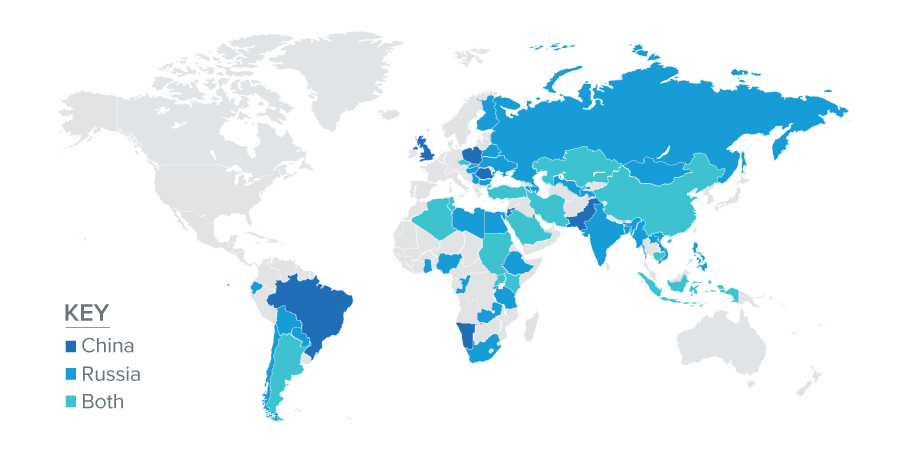
Russia is building seven new reactors domestically and claims to have $133 billion in foreign orders. In just the past five years, China has brought 21 reactors on line and today has 19 additional plants under construction.
There’s more than just overseas business at stake; it’s our national security that could be at risk.
Reactor exports allow countries to form 100-year strategic relationships that span the construction, operation and decommissioning of a nuclear plant. Thirty-eight national security experts wrote Congress about the importance of nuclear exports last year, championing how these supplier relationships bring “long-term influence on nuclear safety, security and nonproliferation, as well as the ability to advance energy security and broader foreign policy interests.”
Russia and China have state-owned and sponsored nuclear suppliers, meaning they can provide competitive financing and other support that U.S. nuclear suppliers have not been able to match. With a focused federal effort to encourage U.S. exports and to counter support offered by geopolitical rivals, the U.S. industry would be better equipped to compete.
There is cause for hope as recent developments in export financing have been a step in the right direction. The Export-Import Bank of the United States, the nation’s official export credit agency, was empowered to support large-scale projects like nuclear again, and the U.S. International Development Finance Corporation, which supports projects in developing countries, ended its ban on financing nuclear projects.
These steps build on a path laid out earlier this year by the U.S. Nuclear Fuel Working Group, which proposed “taking a whole-of-government approach” to help the industry in export pursuits to ensure national security. The report recommended several steps to “empower U.S. export competitiveness,” such as ensuring export financing, increasing efficiencies in export processes, and even designating a senior administration position to lead the issue.
The report was an encouraging first step and recent developments will help level the playing field, but there is still more that needs to be done to match the pace of America’s competitors. We must continue to implement the plan in the Nuclear Fuel Working Group report and go even further. We need a clear national policy to achieve a stronger presence in global nuclear energy markets and a coherent strategy to achieve it.
Nuclear energy will play a major role in the transition to a carbon-free world. The U.S. industry must be able to compete quickly, in order to ensure our national security and regain leadership from Russia and China.