But, what is advanced nuclear technology? Dr. Everett Redmond, NEI’s senior technical advisor for new reactors and advanced technology, explains how nuclear is evolving and discussed the latest technological innovations which will make nuclear reactors smaller, simpler, and safer.
.jpg?language=en-US)
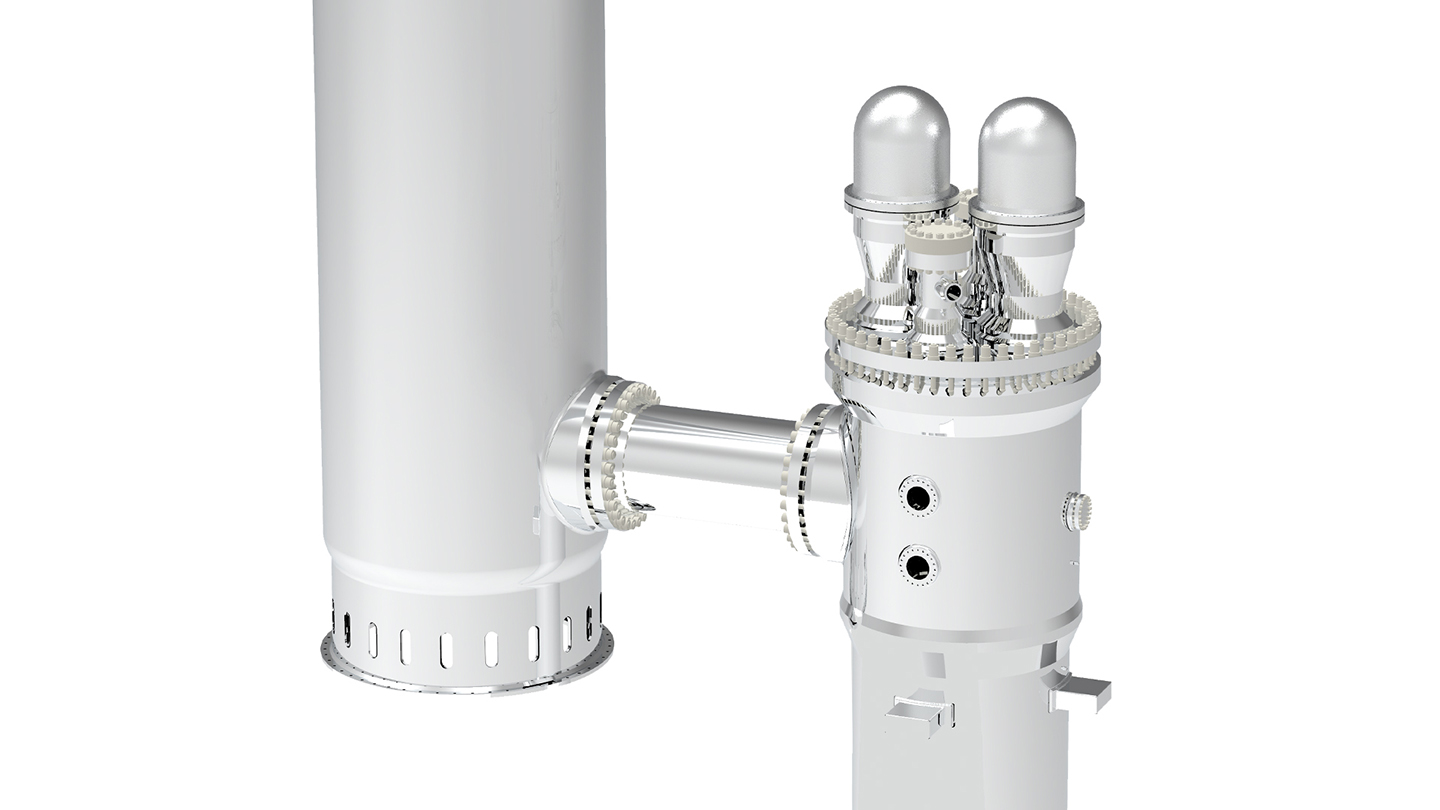
“Advanced reactors refer to designs that haven’t been built yet,” Dr. Redmond, told Insight Out Horizons. “The reactors in the United States that are currently operating typically are between 800-1300 megawatt electric, and they are water cooled reactors—they’re either pressurized water reactors or boiling reactors. The new designs that are coming will include both water cooled and non-water cooled reactors and will range in sizes from a few megawatt electric to hundreds of megawatt electric. We refer to the really small ones with a few megawatt electric as micro-reactors, and those under 300 megawatt electric are referred to as small modular reactors.
Some of these new designs will use molten salt, high-temperature gas, or liquid metal. Many of the new designs have more inherent safety features. They automatically shut down, for example, and some of the new designs will operate at close to atmospheric pressure. The light water reactors we currently have operate under high pressure but the molten salt reactors and the liquid metal reactors, for example, will operate at close to atmospheric pressure, and that has many safety advantages associated with it. They will also be operating at higher temperatures, and that has a potential for an increase in efficiency.”
In a recent report, the Nuclear Innovation Alliance (NIA) took a deep dive into each of the new technologies that will help power our carbon-free future. Although these designs haven’t been built yet, many are in development and demonstration. Here are a few.
Small Modular Reactors
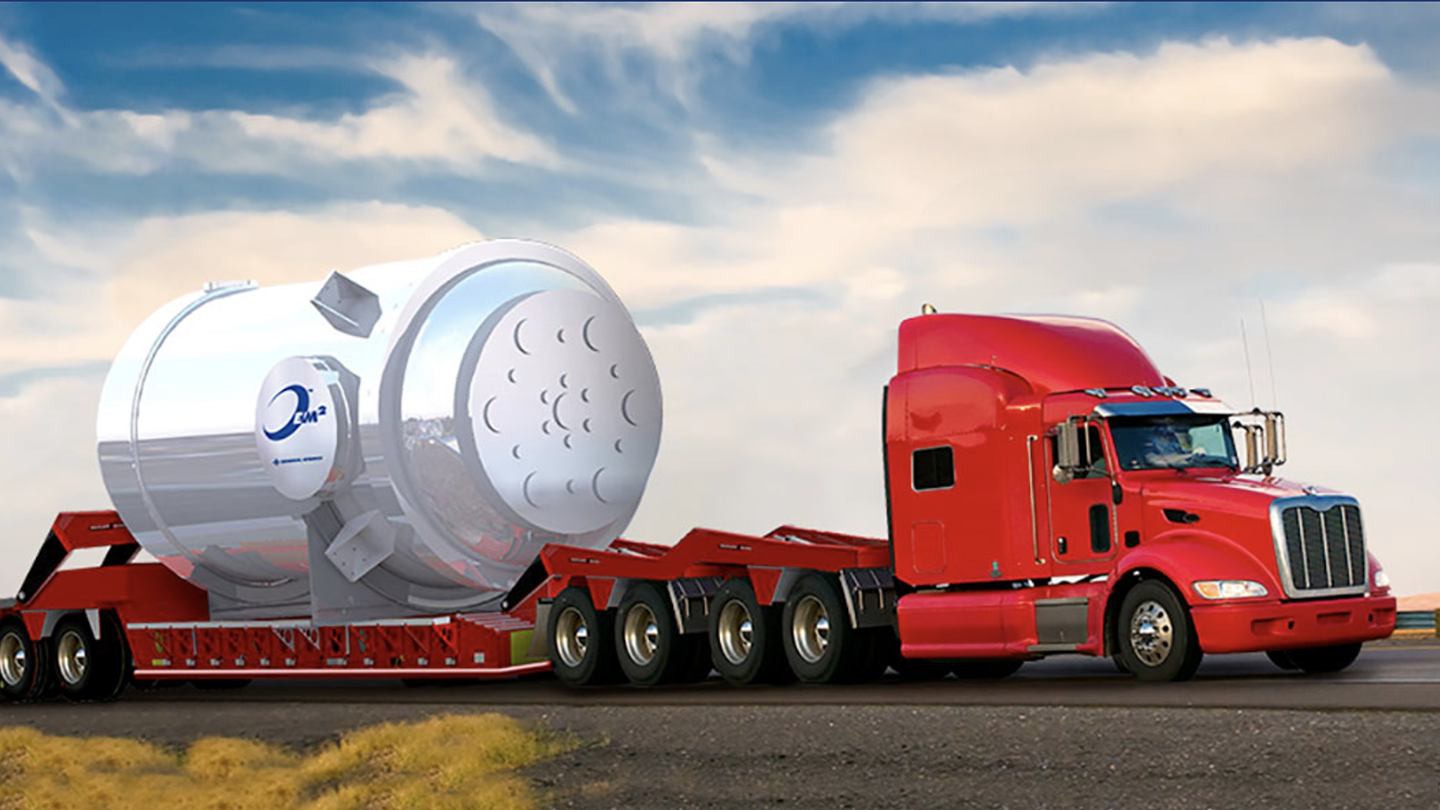
Small modular reactors (SMRs) were named because of their size, not their power. SMRs are new generation reactors that typically produce 300 megawatts of electricity or less. This is a substantial amount of energy, as a megawatt of power will run about 1,000 window air conditioners or a Walmart Supercenter. SMRs will change the clean energy landscape because they are easier to construct than a traditional reactor, as their components can be built in factories then shipped. According to NIA, “factory construction allows higher quality at lower cost and allows the buildings and the reactors to be built simultaneously, cutting deployment time.” SMRs are also able to use a variety of fuel types and coolants, in contrast to traditional reactors.
GE-Hitachi, NuScale Power, and Holtec are all currently advancing water cooled SMRs. Holtec recently announced that the SMR-160 is on track for commission by 2030.
Small Modular Light Water Reactors (SMRs)
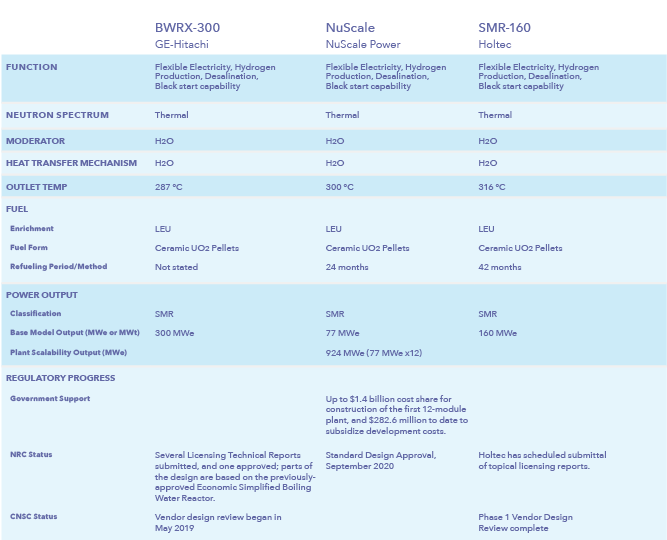 NIA shares the latest on water cooled SMRs
Salt- and Sodium-Cooled Reactors
While traditional reactors, and some advanced technology, use water as a heat transfer medium, some new technologies are using other substances like molten salt or liquid metals. This allows reactors to run safely at higher temperatures and lower pressures while providing lower construction and design costs because the materials do not require components that can withstand extremely high pressure like water reactors.
TerraPower, Terrestrial Energy, Moltex Energy, Kairos Power, and GE Hitachi are working to advance non-water cooled advanced reactors.
Molten Salt Reactors (MSRs)
.png?language=en-US "NIA Report")
Molten Fluoride Salt-Cooled High-Temperature Reactor (FHR) (MSR); Sodium-Cooled Fast Reactor (SFR)
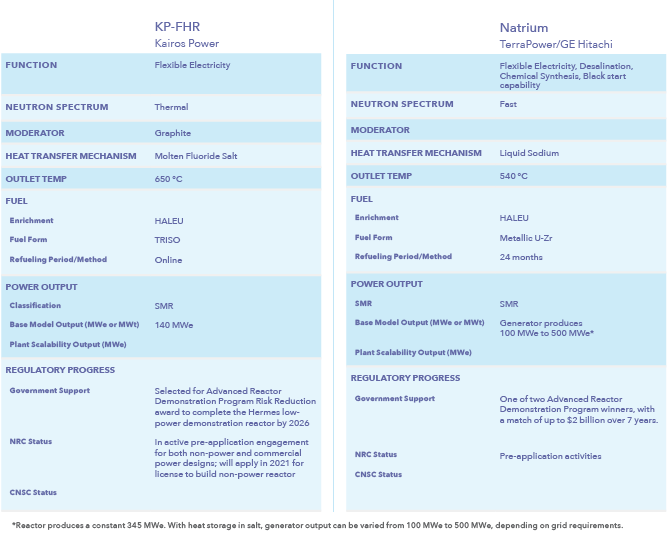 NIA shares the latest on salt- and sodium-cooled reactors
Micro-Reactors
Micro-reactors are named because of their size. They are one percent or less of the size of traditional reactors operating today. Micro-reactors produce approximately 1 to 10 megawatts and are mobile, which means they can be moved from location to location depending on where they are needed. This technology will be crucial in remote areas that currently rely on fossil fuels, for example. Micro-reactors are the answer to providing these areas with clean, carbon-free energy as they can easily be transported to where they need to be, operated for weeks or months, then moved to their next location.
Oklo, Ultra Safe Nuclear, BWX Technologies, X-energy, Westinghouse and others are working to advance micro-reactor designs.
Micro-Reactors
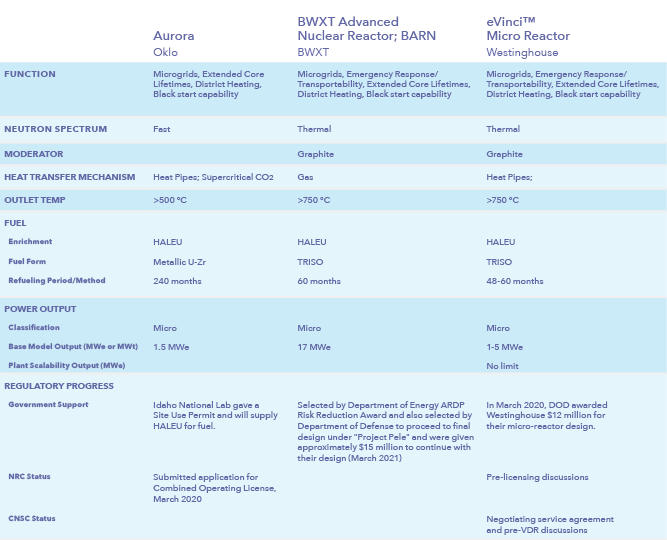
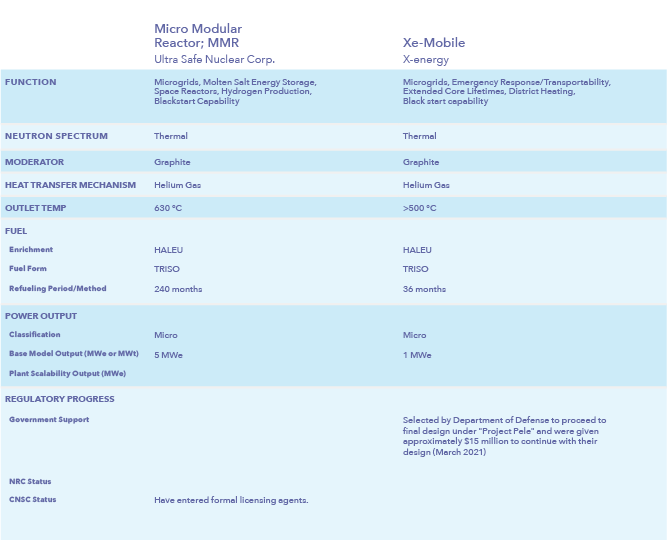 NIA shares the latest on micro-reactors
High-Temperature Gas-Cooled Reactors
Another type of advanced reactor, high-temperature gas-cooled reactors, uses inert gas like helium instead of water for cooling. As NIA states, “in most designs, the gas is compressed and run through multiple heat exchangers to produce steam and subsequently, electricity.” High-temperature gas-cooled reactors are another good example of clean-energy technology that can also reach remote locations. X-energy, for example, is developing a reactor for the Department of Defense which could be used at remote military sites which have traditionally been dependent on fossil fuels.
In addition to X-energy, General Atomics and Framatome are working to develop high-temperature gas-cooled small modular reactors.
High-Temperature Gas-Cooled Reactors (HTGR)
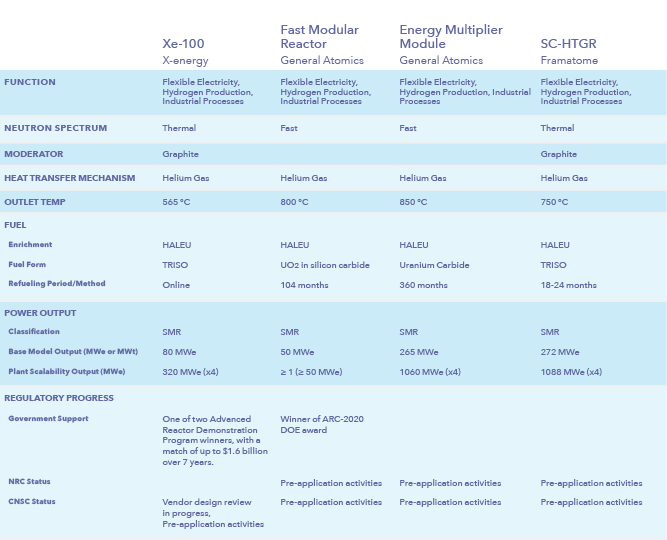 NIA shares the latest on high-temperature gas-cooled reactors
New technologies are in the works to make delivering carbon-free nuclear energy faster, easier, safer and more efficient. These technologies, combined with existing nuclear infrastructure and wind and solar, will be necessary to move us forward.
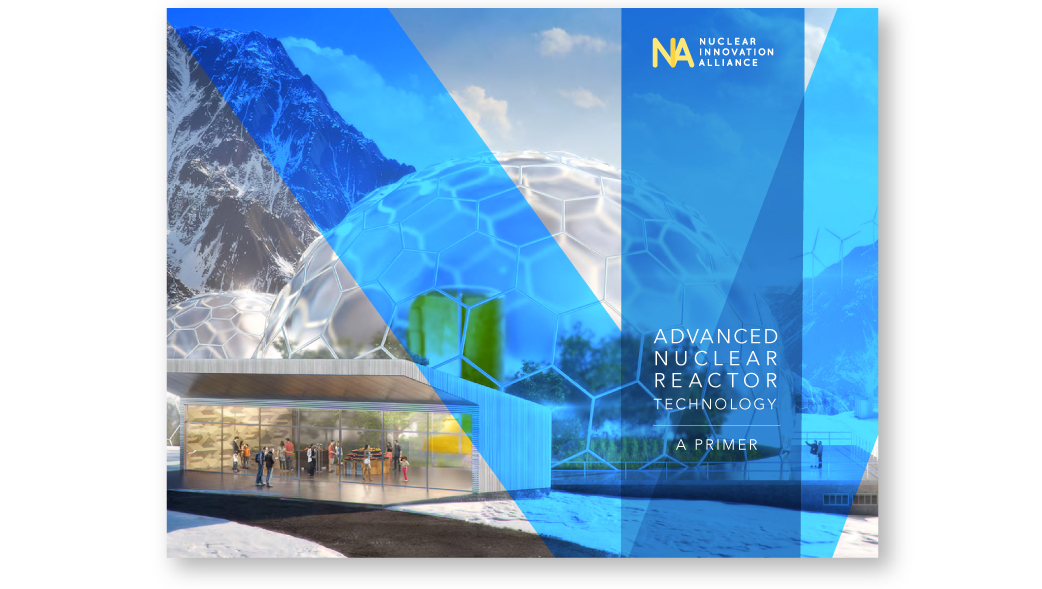
To learn more about advanced nuclear and the exciting innovations happening across the industry, click here to read NIA’s Advanced Nuclear Reactor Technology Primer.
.jpg?language=en-US)