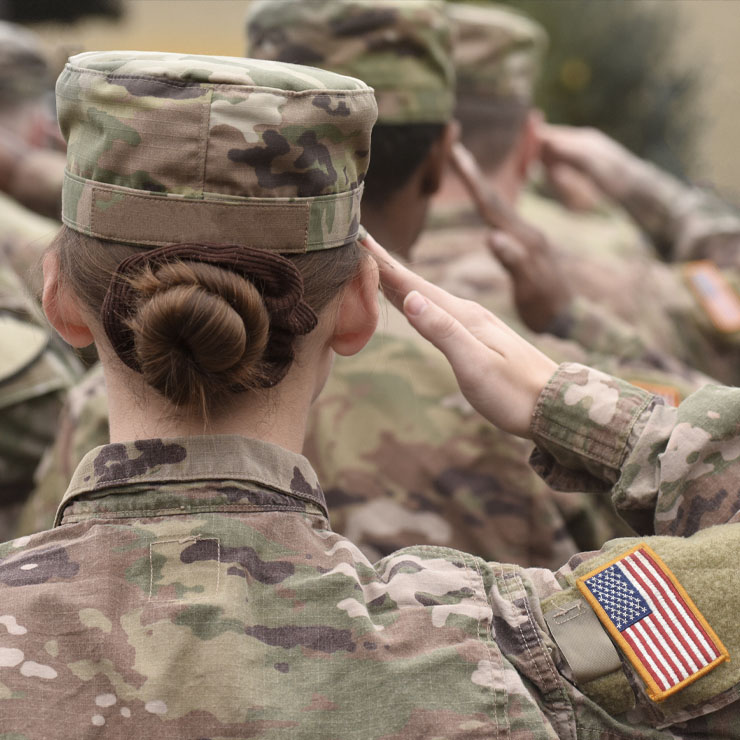
As we observe Veterans Day and thank our military veterans for their service, we also recognize the important part veterans play in the nuclear industry.
According to a 2021 survey, 19.9% of all nuclear utility employees are veterans and 19.2% of all nuclear utility hires are veterans. Military training, especially in programs such as the nuclear Navy, prepares people well for a career in nuclear, and we are thankful for this large community within our industry.
The nuclear Navy is the portion of naval ships powered by nuclear energy, and Navy officers and sailors are trained at Nuclear Power School to operate and monitor the nuclear reactors that power the vessels. Nuclear Navy officers emerge from this experience with finely tuned nuclear power plant management skills, creating a natural military-to-civilian talent pipeline.

Scot Greenlee, who is the Senior Vice President of Engineering and Technical Support at Exelon Generation, sat down to talk with us about the ten years he spent in active duty in the Navy, as well as how this background contributed to where he is today.
He joined the armed forces while he was still in college after receiving a note in the mail about an opportunity to join the nuclear Navy. Since he was obtaining a degree in electrical engineering, he thought this would be a terrific way to start his career.
“After I finished college, I went through a lot of training and then reported to a nuclear submarine—the USS Houston in mid-1985,” Greenlee said.
His training involved memorizing every circuit of every piece of electronics that controlled the Navy’s submarine reactors. He recalls that during this training, he was in the same class as Daniel Dorman, who is now the director of operations for the Nuclear Regulatory Commission (NRC). Many of his peers went on to also work in the industry.
After he finished training, Greenlee worked under the sea for three and a half years conducting submarine operations similar to that described in the book entitled “Blind Man’s Bluff: The Untold Story of American Submarine Espionage.”
“This was during the height of the cold war, and my submarine was one of the most active submarines in the fleet. I loved it. I even extended my tour to be the communications officer for another western pacific run. As the communications officer, I was tied in with all the top-secret parts of the mission, which was very cool.”
Greenlee went on to work for the NRC as a regional inspector.
“It was the best decision of my life to go into the NRC. It was a great learning experience, and I got lots of exposure to different areas of nuclear—operations, maintenance, and chemical engineering to name a few,” he said.
He then wanted more time with hands-on operations, so he transitioned to working in operations and engineering on the utility side of the industry for companies such as PSEG and Florida Power & Light.
Greenlee said he always chose positions that challenged his leadership abilities and grew his understanding of nuclear technologies. In his last tour in the Navy before entering the private sector, he helped operate a reactor prototype with counterparts from the Department of Energy (DOE), which is where he met connections that eventually brought him to Exelon.
Greenlee now oversees engineering and technical services for 21 Exelon nuclear power plants and credits his nuclear Navy experience with the broad level of knowledge and connections that got him where he is today.
“I tell everyone that I have the best job in the nuclear industry,” he said. “I get to influence making Exelon the best nuclear operator in the world, and I get to influence my industry and our regulator in making nuclear power the foundation of operational excellence and the core of combating climate change.”