Sustainability is becoming increasingly important in the eyes of consumers and in investors’ portfolios. This emphasis signals a fundamental shift in how businesses are run, supply chains are managed, and cultures are created.
This kind of transformation requires leadership from the top down, which is why companies are adding chief sustainability officers (CSOs) to their teams.
According to the latest report from CSO recruitment firm the Weinreb Group, demand for CSOs has grown 228% in corporate America over the last decade. As of March, 2021, there were almost 100. This number is poised to grow significantly in the coming years and, with these leadership roles expanding, so are their sustainability teams.
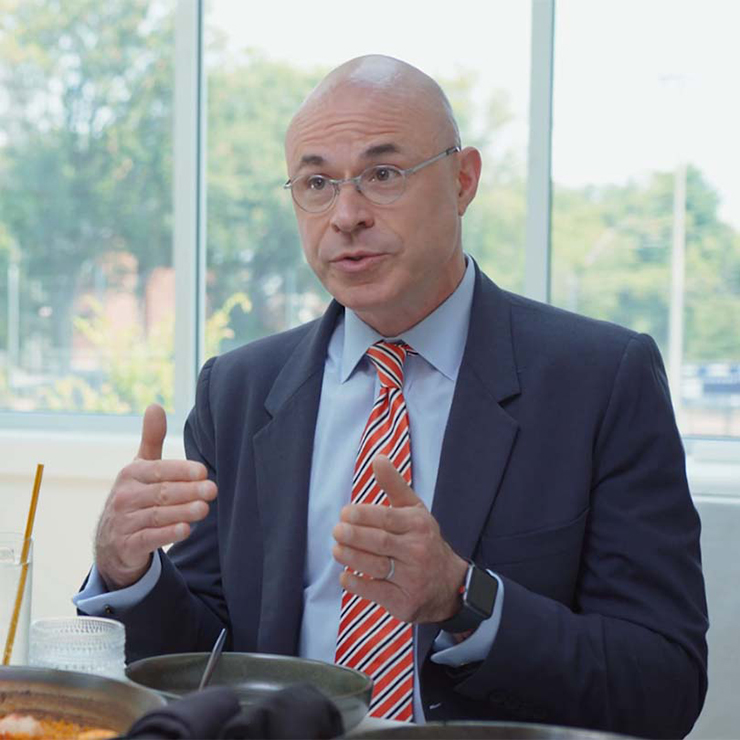
NEI’s Monica Trauzzi sat down with Roger Martella, GE’s first Chief Sustainability Officer, to consider where sustainability trends are heading and where real impacts are taking place.
Sustainability means something different at each company and to each person, and Martella discussed how businesses are facing pressure to incorporate more than just climate change into their business practices. Demands for social justice are now driving the sustainability agenda, and companies are devoting greater focus and resources to the “s” and the “g” in ESG—social and governance.
“When people think about sustainability, my guess is a lot of people think immediately about climate change or about the environment, and those are absolutely top of mind issues. I tend to take a bit of a broader view. I think of sustainability and making sure everyone has equal access to a good environment, healthcare, good opportunities, gender equality. That all around the world we're making sure that people have equity in the opportunities they have,” said Martella.
As the focus shifts to both climate change and social justice, net-zero and carbon-free commitments lie at the center of these initiatives. The most recent business to commit to net-zero emissions by 2050 is fast food giant McDonald’s, an initiative spearheaded by its own CSO.
Nuclear power, as our nation’s largest source of carbon-free energy, will play a critical role in the energy mix as companies look to decarbonize the grid. It is designed to meet global demand, protect our climate, promote health and wellbeing, and provide reliable, affordable, and stable energy.
But are the commitments simply performative or truly driving impact?
“The way I think of how we want to run sustainability at GE is we want to run it with the same rigor that we run our businesses,” said Martella. “Sharing what our goals are, what our performance are, where we're meeting expectations, we're going to want to talk about it. When we have more work to do, we're going to explain why that is and what we're going to do to address it. So, we do see that accountability and I think that's going to become an important theme in the sustainability space.”
For more on the future of sustainability in the business community, watch the full episode with Martella. Also, click here to see other episodes of Off the Menu with Monica Trauzzi.
Transcript
Monica Trauzzi
What does it mean for a business to be sustainable? From DE&I to climate change, the definition is rapidly evolving. GE's first Chief Sustainability Officer, Roger Martella, joins me today for a conversation at Modena.
I'm Monica Trauzzi. This is "Off The Menu."
Roger Martella
Monica.
Monica Trauzzi
Roger, hi, how are you?
Roger Martella
Good to see you.
Monica Trauzzi
Oh, it's so nice to see you too. Thanks for joining me for lunch.
Roger Martella
I'm looking forward to it.
Monica Trauzzi
Should we head in?
Roger Martella
Absolutely.
Monica Trauzzi
Congratulations, because you were recently named GE's first Chief Sustainability Officer. What does sustainability mean to you?
Roger Martella
When people think about sustainability, my guess is a lot of people think immediately about climate change or about the environment, and those are absolutely top of mind issues. I tend to take a bit of a broader view. I think of sustainability and making sure everyone has equal access to a good environment, healthcare, good opportunities, gender equality. That all around the world we're making sure that people have equity in the opportunities they have.
Monica Trauzzi
So, is it your sense that we're moving away from this more performative approach to sustainability? Which, I mean, we've seen for years, right?
Roger Martella
Yeah.
Monica Trauzzi
It sounds good, it sounds like there's action happening, but it's not necessarily ending up in impact. Are we moving away from that and moving towards actually driving impact?
Roger Martella
The way I think of how we want to run sustainability at GE is we want to run it with the same rigor that we run our businesses. We hold ourselves very accountable for our businesses, we're very transparent with the performance, we're judged positive and negative on how we're doing, and when we don't do so well on something, we explain why that is. That's exactly, I think, the type of accountability we look to run our sustainability program with. Sharing what our goals are, what our performance are, where we're meeting expectations, we're going to want to talk about it. When we have more work to do, we're going to explain why that is and what we're going to do to address it. So, we do see that accountability and I think that's going to become an important theme in the sustainability space.
Monica Trauzzi
What does a greater focus on sustainability, a "carbon neutral by 2030" pledge, a "net zero by 2050" as you look at scope three emissions, all of those things, what does that mean for the energy mix that you're using at GE? Is it moving exclusively towards carbon-free energy like wind and solar and nuclear?
Roger Martella
So when we think about energy, which is one of the three sustainability challenges we're working very hard to solve, we come to this with the perspective that one-third of the world's energy is generated on GE equipment. So we have some very specific views on where we think we need to move to decarbonize the energy sector. We support the Paris Agreement, we support President Biden's ambitious goals for decarbonization in the energy sector and our focus is on how do you find the right technologies at the right scale, not only in the U.S., but globally. Because everywhere we work, in 170 countries, the markets are very different.
Monica Trauzzi
When I think about ESG, I've kind of seen ESG take a similar trajectory sustainability as a phrase, that it kind of is used a lot, but there's no clear definition to what it means, you've obviously outlined your definition for sustainability, and now we're seeing an effort behind kind of standardizing what ESG what looks like.
Roger Martella
Sure.
Monica Trauzzi
Standardizing these screens. Do you think we're at a place where we're going to move towards a more impactful way of looking at ESG standards?
Roger Martella
I do. When I think of ESG, I think this is the impacts part of what we do on our environmental, social, governance, how are we protecting our people, how are we protecting our communities, how are we protecting the planet. First of all, there's going to more disclosure. There's going to be more I think uniformity. Whether that's coming from regulators, from our investors, from our customers, we all recognize that the focus on transparency, the focus on standardizing metrics, and key performance indicators is growing. I think the next phase of that is what do you do with that information, where do you go with it. It's one thing to share what your impacts are, it's another thing to show how you are going to improve them.
Monica Trauzzi
Cheers. These are mocktails, because it's the middle of the day.
Roger Martella
Absolutely.
Monica Trauzzi
But congratulations to you and so good to see you.
Roger Martella
Great to see you too.
Monica Trauzzi
15 years of friendship.
Roger Martella
Not a coincidence you picked a nice Italian setting.
Monica Trauzzi
Well, we're both Italian, so ... Thank you. Nice to see you.
Roger Martella
Thanks Monica. You too.