The energy transition is top of mind for world leaders and the private sector. Companies and countries are investing in clean energy, while simultaneously trying to boost economies, create jobs, and provide energy security. The Financial Times hosted a conference in Houston last week that brought leaders and experts together to tackle the pressing question—what’s next for America’s energy transition?
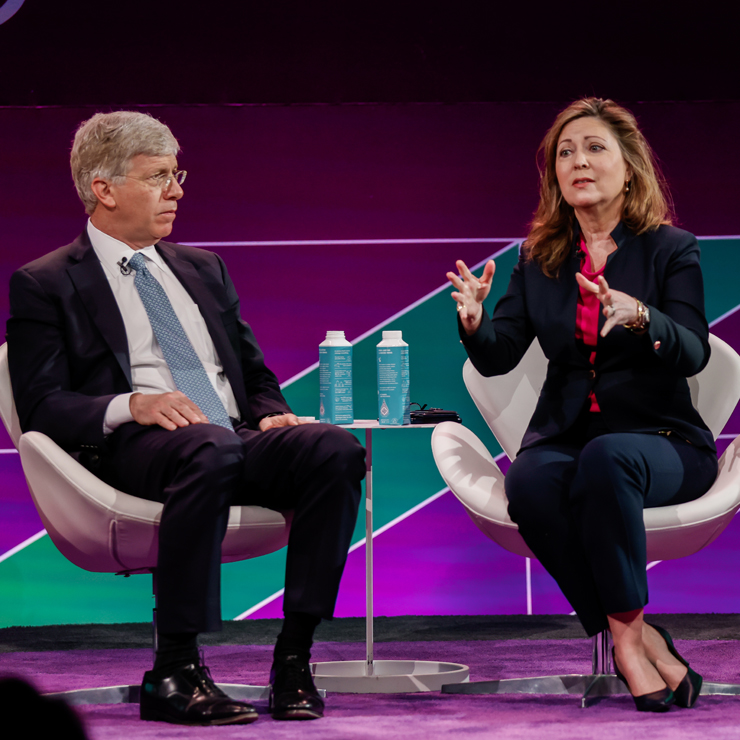
The Energy Source Live conference featured NEI’s President and Chief Executive Officer Maria Korsnick, who participated in a discussion on nuclear energy hosted by Financial Times reporter Myles McCormick. Korsnick was joined on the panel by Chris Colbert, chief strategy officer and chief financial officer of NuScale Power, and Marcia Burkey, executive vice president and chief financial officer of TerraPower.
A main theme during the discussion was now that countries and companies are committing to net zero targets, the path to decarbonization is becoming clearer, and more pressing.
“It’s energy security, it’s national security, it’s reliable energy. We just saw the IPCC report come out recently that mentioned time is running even shorter … but more importantly it said that you have the tools and the toolbox you need. And when you look at all the tools, it includes nuclear,” said Korsnick.
What we don’t have is time. What we do have is American nuclear technology.
The nuclear technologies of tomorrow are based on the proven, reliable, affordable technologies of today, and carbon-free nuclear energy can decarbonize not only the electric sector—reactors can decarbonize entire economies.
“We’re needing a source that is reliable not only for electricity but also has other opportunities. And with nuclear you can use it to produce high-temperature steam or hydrogen,” said Korsnick.
The panel discussed that this value proposition is prompting world leaders to add nuclear to their long-term climate plans and causing public and private sector customers to raise their hands to invest and build new nuclear.
“For the first project NuScale will be pursuing with our first customer, that involved support from six local cities, counties, state delegations, and 27 member utilities all participating in supporting it,” said Colbert.
As states and utilities across the country look to reduce their dependence on fossil fuels, they’re looking at nuclear energy, and the U.S. government is recognizing that nuclear can produce the scalable, carbon-free energy we need to make our decarbonization plans a reality.
“The U.S. has a national [climate] strategy, which we’ve never had, and that will help to create the momentum for the tactics on how to get there, so that’s a big sea change,” said Burkey.
We are seeing this momentum demonstrated in bipartisan support from Congress for both existing and new nuclear, as well as in strong public and private partnerships.
Just last week U.S. Senators Joe Manchin (D-WV), Chairman of the Senate Energy and Natural Resources Committee, and Jim Risch (R-ID), Ranking Member of the Senate Foreign Relations Committee, introduced the International Nuclear Energy Act of 2022. This bipartisan legislation establishes an Executive Office for Nuclear Energy Policy to promote engagement with ally and partner nations to develop a civil nuclear export strategy and offset China and Russia’s growing influence on international nuclear energy development. This office would also coordinate civil nuclear exports strategy and establish financing relationships.
Policy signals at the state and federal level are providing needed funding and creating the conditions for a new wave of investments. And this year, the EU included nuclear in its green taxonomy framework.
“You have now 65 percent of the world’s GDP behind some sort of strategy between 2040 and 2070. You have…earmarked about 3 trillion dollars in sustainability funds, more than six thousand of them. But of companies, of funds, of economies saying that we want to put money to work on energy transition,” said Burkey.
The puzzle pieces are coming together, but all financial frameworks need to be updated to properly value decarbonization efforts; and as the business community considers what counts as a sustainable investment, ESG screens need to include carbon-free nuclear energy.
This recognition, combined with support from the public sector, will mobilize the necessary investments for the energy infrastructure of tomorrow, and as Korsnick asserted in Houston, nuclear can not only get us through the energy transition, it is also uniquely positioned to power our country on a carbon-free grid.