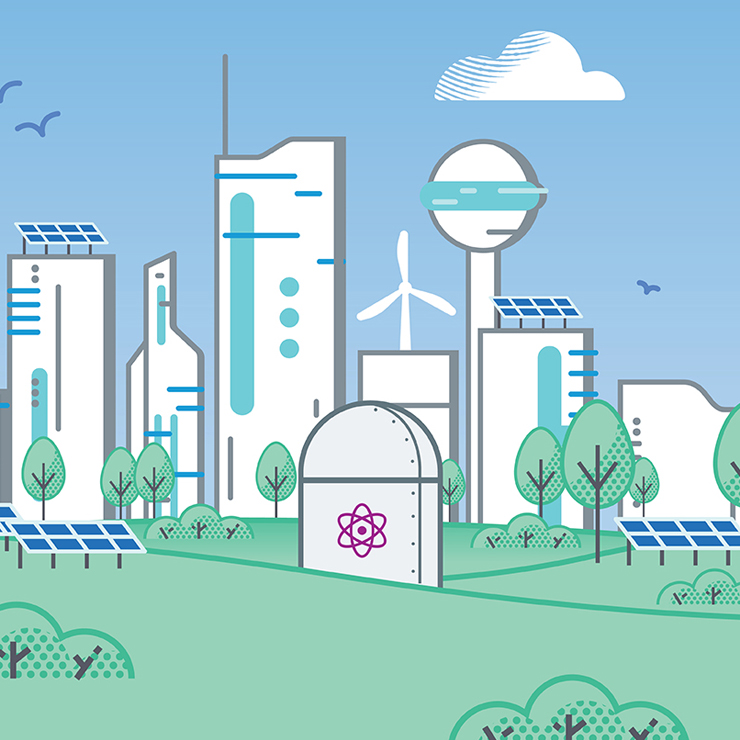
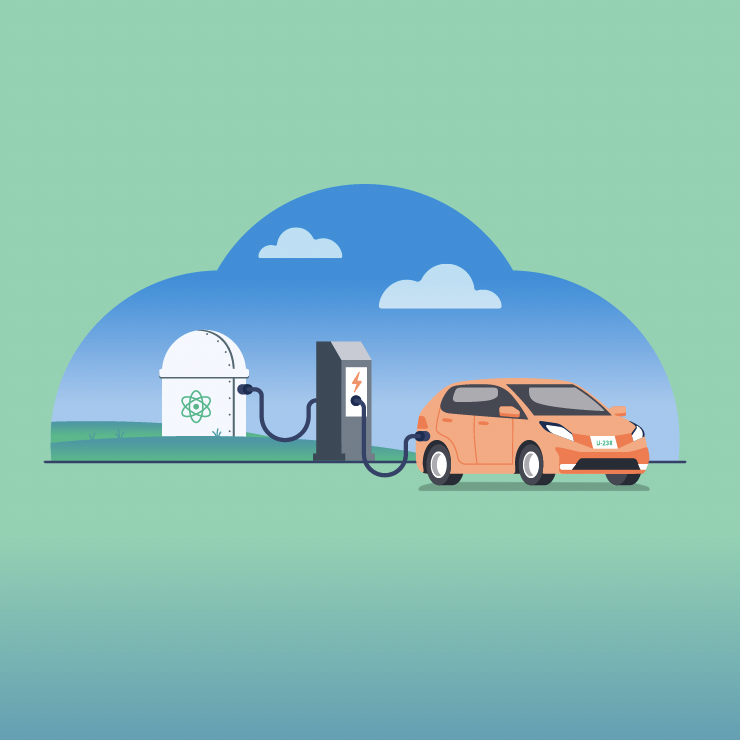
Nuclear energy pairs perfectly with renewables such as wind and solar to create a reliable, clean energy system. It provides carbon-free, around-the-clock power to fill the gaps when the sun isn’t shining or the wind isn’t blowing. Nuclear also complements renewables because it generates more power with less land—31 times less than solar facilities and 173 times less than wind farms.
Wind and solar farms are located where wind and sunlight are abundantly available and require sprawling amounts of land for turbines and panels, whereas nuclear energy is contained to nuclear power plants. A nuclear energy facility has a small area footprint, requiring about 1.3 square miles per 1,000 megawatts of energy. This figure is based on the median land area of the 54 nuclear plant sites in the United States.
The graph below demonstrates land use by acres per megawatt-hour of power, calculated from both direct and indirect land use. Direct land use is the immediate ground underneath the installation, for example a turbine or power plant, while indirect land use takes into consideration the total amount of space required to produce a certain amount of energy, for example an entire wind farm or solar facility.
For some energy sources you can build on top of land that’s being utilized for other purposes. For example, wind turbines can be installed on farms, and crypto mining centers and hydrogen production facilities are exploring siting at nuclear plants. Indirect land use is important because the amount of land required still impacts the buildout of large amounts of energy.
To generate the same amount of electricity as a 1,000 megawatt reactor, a wind farm would require over 140,000 acres, which is over 170 times the land needed for a nuclear reactor.
Princeton University’s Net-Zero America Project maps out potential energy pathways to a carbon-free U.S. economy by 2050. The most land-intensive plan eliminates all nuclear plants. To build the amount of wind and solar needed to support the grid, the U.S. energy footprint would quadruple in size, and wind farms would occupy areas equivalent to Arkansas, Iowa, Kansas, Missouri, Nebraska and Oklahoma.
In Princeton’s least land-intensive scenario, the pace of wind and solar development remains constant, but investments in carbon-capture and nuclear power blossom.
We’re seeing this play out in real life. Advanced nuclear is poised to provide the next generation of nuclear technologies, and as states and utilities across the country look to reduce their dependence on fossil fuels, they’re looking to nuclear.
The nuclear technologies of tomorrow are based on the proven, safe, affordable technologies of today. Advanced nuclear will be smaller, simpler, and more versatile—all while sustaining the reliability we already enjoy.
What makes nuclear power so reliable, and also an ideal companion to wind and solar, is its high capacity factor, which measures how often a power plant runs for a specific period of time. Nuclear energy facilities have an average capacity factor of 90 percent, meaning the average nuclear plant remains online, generating electricity more than 90 percent of the time, which is much higher than intermittent sources like wind and solar.
By contrast, wind farms had an average capacity factor of 34.6% in 2021 and solar farms had an average capacity factor of 24.6% in 2021 according to the U.S. Energy Information Administration. Nuclear energy also has high energy density, which is the amount of energy contained in a fuel. With our current energy system, energy dense fuels are easily moved from place to place. Because wind and solar are spread out, they require more transmission lines to bring the electricity that powers homes and businesses.
“Transmission line capacity would need to more than triple under the high-renewable scenario laid out by the Princeton researchers. Without it, many new wind and solar projects would be stranded,” said Bloomberg journalist Dave Merrill.
The need to increase transmission line capacity poses infrastructure challenges that are lessened when nuclear energy is on the grid.
As the U.S. transitions to a green economy, our carbon-free energy sources are more important than ever. Study after study has shown that we have the energy tools we need to power us to a brighter future. Wind, solar and nuclear can work together to support a grid that provides power wherever and whenever we need it.