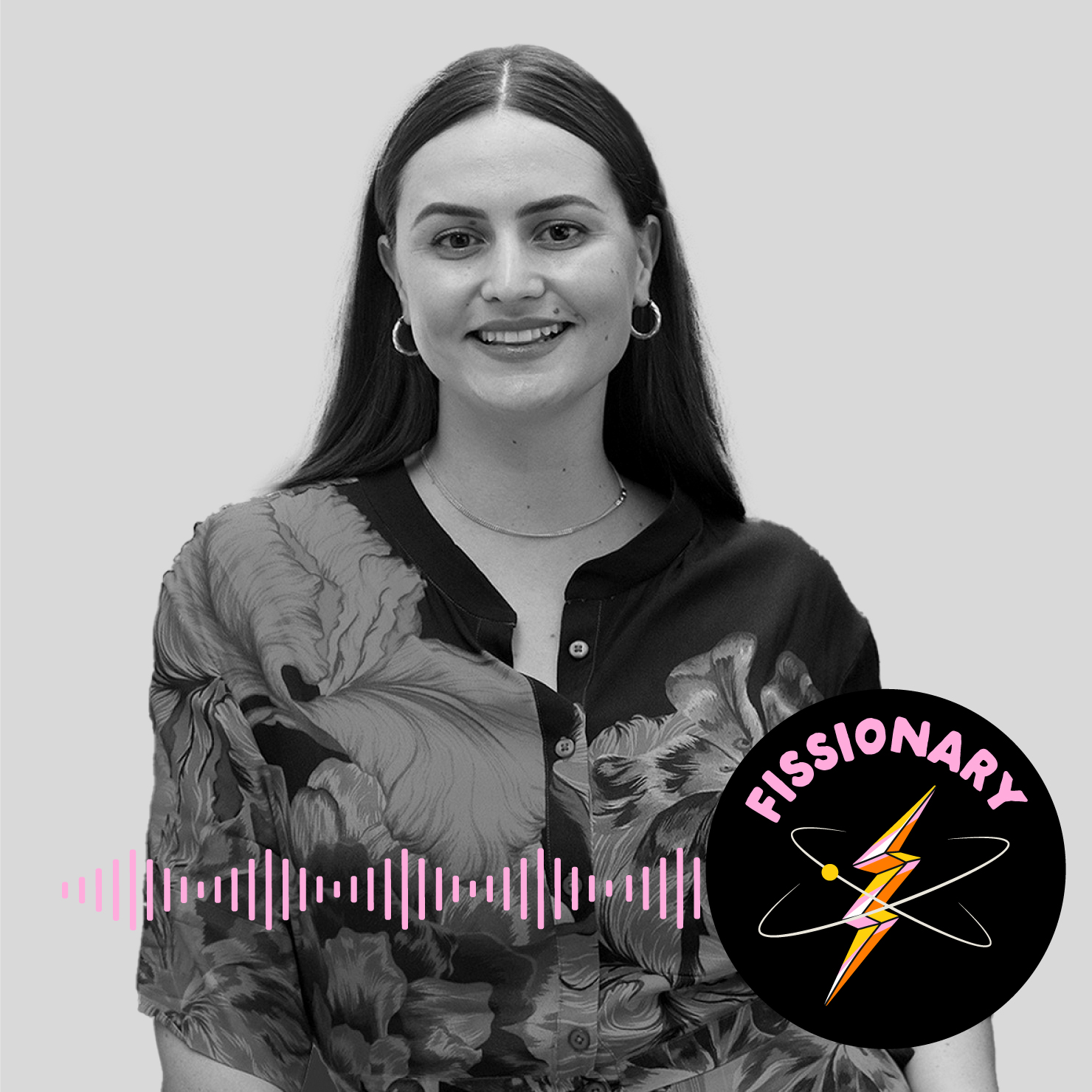
Jenifer Avellaneda, also known as Nuclear Hazelnut, is an engineer specializing in risk analysis at Westinghouse as well as a nuclear influencer. By day, she helps nuclear engineers assess the potential risk associated with nuclear power plants. By night (or really all day, every day), she tweets easily digestible information about nuclear energy.
Whether it be in a conversation with an engineer, in a tweet about Taylor Swift using a nuclear microreactor, or in an interview that you can listen to wherever you get your podcasts—Jenifer is always trying to communicate how safe and important nuclear energy is.
As a nuclear communicator or, sometimes, as people like to call me, a nuclear influencer, I wanted to contribute by creating a positive narrative around nuclear energy.
There are, at times, misconceptions in the public about the effectiveness and safety of nuclear energy. This is something that Nuclear Hazelnut, as someone who works within it every day, is in a unique position to influence.
I do believe that influencing the public perception and promoting informed decision making is essential for the future of nuclear energy, a hundred percent.
In her day-to-day job as a Probabilistic Risk Assessment Engineer, Jenifer’s role is to evaluate the likelihood of dangerous events—like an earthquake, a fire, or even human error—and how they could affect a nuclear reactor. She also helps plan for those worst-case scenarios.
Not only is there a gap in the public knowledge about how safe nuclear energy is, but there is also a lack of public awareness around all the work being done to ensure it is safe. If the public can see all of the work being done behind the scenes, they can start to understand the reality around nuclear energy.
While it is important for everyone to have a firm understanding of this, Jenifer has built a unique relationship with younger people—the people who are early in their careers, starting to vote, or even still in school.
Something that I like to achieve by doing this is attracting younger generations to this industry. We need people. We need more people to get surrounded by this, to start having experience with this, and also fall in love with the idea that nuclear energy could help us all.
The next generation of nuclear reactors and humans are crucial to a cleaner environment. To influence this next generation, we need ~influencers~. Whether you want to be an engineer, an accountant, or a podcast host, you can have a role in shaping the future of nuclear energy. That’s why people like Jenifer, who inform wide swaths of the population, are so important right now.
Mary Carpenter
This is Fissionary, a show exploring how nuclear powers your world. I’m Mary Carpenter.
Jordan Houghton
And I’m Jordan Houghton. Let’s jump in.
Mary Carpenter
Hey, Jordan.
Jordan Houghton
Hey, Mary. How are you?
Mary Carpenter
I’m excited because we have such a fun episode today, talking with someone who is really doing a great job of sharing real facts about nuclear with different audiences that might not know about it in the first place.
Jordan Houghton
I’m so excited to talk to her. She really thinks of herself as a nuclear communicator, but we kind of lump her in amongst this new rising group of nuclear influencers, which I think is just absolutely fascinating because there are influencers for pretty much everything else; fashion, skincare, travel.
Mary Carpenter
I’m booking some trips right now, and when I want to figure out what hotels to stay at, I look at what hotels travel influencers stayed at. You know, people really trust the things that influencers put out on the internet. And, you know, why doesn’t nuclear have that same kind of influence that other industries have?
Jordan Houghton
I think that’s a great point you made, talking about a voice you can trust from their experience. Our guest today is actually a nuclear engineer, so you know she’s coming from a place of knowledge. And I think that I think what she said is incredibly important, this idea that you can build trust with your audience because of where you’re coming from, and people will know that you know what you’re talking about.
Mary Carpenter
Do you follow influencers?
Jordan Houghton
I do. I follow many influencers. They’ve been incredibly helpful for me, especially—I’m a skincare junkie, so I have followed many people who have made some really great recommendations for skincare products, and I just love knowing that there’s someone out there or multiple people out there whose opinions I can trust because of their experience.
Mary Carpenter
And we know influencing works. I was reading a little bit before this. In 2022, the influencer industry reached 16.4 billion dollars. It’s working, people are responding, brands are using them, nuclear should too.
Jordan Houghton
I’m loving it. I love that, like, the skincare is great, the travel’s great, but if these influencers can help fight climate change, that’s even better.
Mary Carpenter
It’s influencing for a positive reason.
Jordan Houghton
We are thrilled to welcome Jenifer Avellaneda to the podcast today, she is a nuclear engineer specializing in risk analysis at Westinghouse. And she’s also known, perhaps better known to some folks on social media, as Nuclear Hazelnut, where she focuses on educating and spreading awareness about the positives of nuclear energy. And we’re just so excited to have you here today. I’ve been following you on Twitter for several months and as a nuclear communicator, I love the way you sort through all the noise and really just get to boil stuff down to what’s important and make it clear and concise for everyone out there. I’m hoping you can start by just giving us a little bit of background on yourself and how you got here.
Jenifer Avellaneda
Thank you so much for the invitation, it’s such an honor to be here with you all. I am currently working as a PRA engineer in the risk analysis department at Westinghouse Electric Company. But first of all, what is PRA? So, it means probabilistic risk assessment. The nuclear engineers use it to assess the potential risk associated with nuclear power plants. The PRA engineers evaluate, basically, the likelihood of an accident or a certain incident happening, and also the possible consequences of such events, right? This type of methodology is also used internationally. Safety and risk are connected. And it’s something really important and interesting surrounding the nuclear energy industry because safety isn’t showing that things don’t go wrong, but risk is understanding what could happen if something goes wrong. So that’s me in a nutshell.
Jordan Houghton
You’ve come on to social media to bring this messaging of safety and the importance of nuclear energy out to the masses. What made you want to do that?
Jenifer Avellaneda
I believe nuclear science and nuclear technology is crucial for us to start addressing the world’s energy needs, while also mitigating a problem that we all share, which is climate change. As a nuclear communicator or, sometimes, as people like to call me, a nuclear influencer, I wanted to contribute by creating a positive narrative around nuclear energy. How? Well, by sharing accurate information, debunking myths, or even fostering open discussions or open conversations. And that’s why I like to use Twitter. This is also very helpful to me because I aim to raise awareness about the many benefits and also safety that’s behind of nuclear power, which is something mainly surrounding the industry and surrounding nuclear power plants and that topic. I do believe that influencing the public perception and promoting informed decision making is essential for the future of nuclear energy, a hundred percent.
Mary Carpenter
You’re such a good person to communicate on these messages because you’re in it every day. You know, you’re looking at risk, you’re looking at safety. Tell us a little bit about kind of what your day-to-day looks like in your current job.
Jenifer Avellaneda
Yeah, of course. As a day-to-day activity—this is a very interesting and funny role that I developed, to be honest. I wasn’t a hundred percent aware of what was probabilistic risk assessment until I was welcomed by my colleagues and the company that I currently work for because we are working on many different areas at the same time. As I previously mentioned, we try to evaluate the likelihood of a certain event happening. But what are these events, you know? These events could be caused by human nature, these events could be caused by climate, by an earthquake, for example, by a flood, by a fire—it could be human-originated, or it could be just an accident coming from somewhere else. Every day, we get numbers, we share that with the people working at the plant, and we have certain discussions on how to approach first, the probability, and secondly, the consequences. Not only what will be our plan A. If that doesn’t work, what will be the plan B, the plan C, and even the plan D. And, just to give you an example, one of the first tweets that I decided to introduce while working with Nuclear Hazelnut was, what could happen if an airplane crashes with the containment building? What would be the consequences? What about the people or the population in the surrounding area, right? And I developed this event, like, what would happen, what would be the aerodynamics behind it, the science behind it, and the simple result? I wasn’t expecting the interaction of the people with that tweet because I thought it was something that was already known. But it wasn’t. People were impressed that, at the end of the day, nothing could happen if that terrific event would be taken place there.
Jordan Houghton
I would love to know though—you mentioned the airplane example as being something that you kind of kicked off your social media presence with. But just to be clear, that’s a real scenario you, as a risk analysis, look at in your job, correct?
Jenifer Avellaneda
Yes, that is correct. And that’s where I got the idea from. I was actually updating certain information for a plan that I’m currently working with. And I was like, oh my god, this is very interesting because not everyone knows about it. I need something that, usually, people with no knowledge are pretty concerned about. Like, what would happen because it’s a possibility, you know?
Jordan Houghton
I think it’s interesting and important for the public to know how detailed the analysis is that you do. When we’re talking about risk, when we’re talking about safety, you are going, you and the industry as a whole are going into these really specific scenarios to be sure that you’re ready to mitigate them even in the very unlikely event that some of them actually happen.
Jenifer Avellaneda
Yeah. Yeah, that is correct. Probabilistic risk assessment as a whole for the nuclear power plants, considers both internal events, as we call them, which originate within the power plant, or associated, for example, systems or plumbing, or everything that is located inside the vital area, which is a nuclear power plant. And also, we evaluate external events such as natural disasters, earthquakes, floods, hurricanes, or even human actions, you know, such as the airplane example.
Mary Carpenter
That’s great, and I’m so glad that you’re taking the information that you’re an expert in, and that’s so important, and is a concern for people outside of the industry that don’t understand—that could be nervous about different safety issues, you know, that you’re an expert and you’re sharing this. What are the audiences that you’re trying to reach? Who are you trying to share this information with?
Jenifer Avellaneda
So as for the audience, I didn’t actually have anyone in particular in mind. Something very interesting that I noticed while starting this journey, on Twitter with Nuclear Hazelnut was that many people wanted to take part in that discussion regardless of their backgrounds, their genders, or even their age. They just wanted to take part in it, share what they knew, or even discuss whatever they knew was a lie or was actually a possibility to happen. For example, this thing about—this example that I gave about the plane—it is very interesting that other people no matter where in the world that are actually very concerned about this problem that we all shared, which is climate change. And the fact that they are finding out that nuclear technology is our best friend, not only to fight against climate change but also to improve under certain other areas, for example, agriculture, space industry, health care, art, it’s just an amazing industry that could help us with many different things, and I love the way people are discovering it regardless of their gender, regardless of their background, regardless of even their age. But also something that I like to achieve by doing this is attracting younger generations to this industry. We need people. We need more people to get surrounded by this, to start having experience with this, and also fall in love with the idea that nuclear energy could help us all. Something that I realized people were very interested in and also impressed was the fact that nuclear technologies and nuclear science not only help us to produce electricity, but also help us in some different areas. For example, in health, such as nuclear techniques in order to combat cancer, or even agriculture. And that’s also another topic that I share with my followers, which is called the sterile insect technique, the SIT technique. I need something pretty interesting because instead of using pesticides and us, the consumers, eating those pesticides after they were used on our food, we use this technique, a nuclear technique, in order to sterilize insects—male insects—and just let them free and have them follow their normal ecosystem development, but trying to decrease the way they reproduce themselves. So that way, we don’t actually attack the normal ecosystem, but we reduce the risk that we have, or people there working in the agriculture industry reduce the risk of losing the crops. And that’s also something that nuclear energy does for us. Something else that comes to my mind could be related to art, in which it actually helps us to maintain and keep amazing paintings that we have, such as the Louvre. Or, if we are talking about space, I’ve also read a couple of news talking about batteries or nuclear microreactors that people are expecting to be sent over there in order to have many years of endless energy. So, nuclear energy not only helps us to produce electricity. It also helps us in many other areas of our day-to-day life, you know? So, that’s the perspective that I like to change. That, yes, there is risk, but there’s also risk in the oil and gas industry, you know, there’s also risk in the mining industry. But we have learned to do better, and we are still improving in that way.
Jordan Houghton
You mentioned so many different sectors, space, art, agriculture, where nuclear is helping humanity in so many different ways, and it’s just fascinating. I’m curious—we didn’t ask this right up front. What got you interested in nuclear to begin with?
Jenifer Avellaneda
When I was little, I was like twelve years old, and I was reading this novel called Angels and Demons by Dan Brown, which is very famous for The Da Vinci Code. So, I was reading this novel and there was a topic that was talking about anti-matter and the CERN, which is a nuclear research facility located in Europe. And I was pretty interested by the fact that matter could also be anti-matter, you know? And I was too little, I was questioning almost everything surrounding me. So, when I decided to start doing a little bit of research about what was CERN, and this specific research location, I started to read more about what was nuclear techniques, nuclear energy, radiation. What is radiation, nuclear operators, workers in the nuclear industry, which was mainly led by men, by that gender. And I was like, this is so interesting because so many current issues could be solved by this, so why aren’t we using it as a society? And then I read Chernobyl, for example, one thing led to the other, and I did such an amazing research because of that specific book. And I ended up with an article, and I don’t remember the author of this article, but it was talking about climate change, it was the first time I heard about climate change. And I remember asking my parents at the time, hey, what’s climate change? And they were like, okay, we have an atmosphere, and ozone surrounding the Earth, and this one is being damaged by our daily activities, but there’s nothing we can do about it. And I was like, what about nuclear energy? I’ve read about it. And I remember the answer of my dad that was like, no. It’s too dangerous because of radiation. And then I said, Dad, but I just read the radiation is everywhere surrounding us. So, what do you mean about dangerous? And that’s when I realized that, not only myself, but everyone needs to do a little bit of research in order to have an informed opinion, and also an informed decision making, for example. So, that’s when I knew since everyone surrounding me, including myself, were sharing the same issue which was climate change. We needed to fight against it. Because I wanted to live longer and I want a safe planet for the people surrounding me. So, that’s when my interest in nuclear energy started, just because of a simple novel.
Jordan Houghton
That’s a really fun book, by the way.
Mary Carpenter
Yeah, I love them both.
Jenifer Avellaneda
Yeah, me too!
Mary Carpenter
I love Dan Brown! I love that’s where your love for nuclear started, that’s amazing!
Jordan Houghton
How did you come up with the name Nuclear Hazelnut? We think it’s so cute. We’ve—Mary and I have talked about it so many times, we’re like, it’s just the cutest name.
Mary Carpenter
We love the name. Big fans.
Jenifer Avellaneda
It’s a very funny story. My last name is Avellaneda, which, in Spanish, sounds like ‘avellana’, which means ‘hazelnut’. So—in English, of course. So, some of my friends and family still call me Avellana as my nickname. So, I just decided to pair it with the word ‘nuclear’, just translated into English, ‘Nuclear Hazelnut’, and, you know, to make it something mine, from me.
Jordan Houghton
That—it’s so cute. And I love—you have the little squirrel emoji that you pair with it, I mean, it’s just catchy, it’s so wonderful and very memorable.
Jenifer Avellaneda
I’m very glad to know that. You know, I just decided to create a unique and memorable identity behind that account.
Mary Carpenter
I know your biggest following’s on Twitter. Do you feel like that platform’s the best way to reach, kind of the audience that you’re looking for? What’s your theory behind that?
Jenifer Avellaneda
I started with Twitter because I do have a personal account in which I share my thoughts, you know, as everyone else. And that’s where I saw the potential that Twitter as social platform has. I also started using Instagram but the tricky part about that specific social platform is that you need pictures. So, sometimes there are a couple of ideas that do not necessarily include pictures, and I cannot share it there. And if you shared to, like, a long text, it wouldn’t be as appealing as if you read it on Twitter. And I’ve also been asked a couple of times, to be honest, if I have a TikTok account, but I am not that good, so I’m really sorry for my followers. Probably in the near future, I’ll consider it, but not right now.
Mary Carpenter
Yeah, TikTok’s a whole new ball game. I totally get that. It’s a lot of video content. You have to be pretty confident with taking, like, a lot of selfie videos and talking to the camera a lot.
Jordan Houghton
I’m curious, while you’ve been on this adventure of communicating, what do you think works and what doesn’t as far as getting the information out and how you do it?
Jenifer Avellaneda
Summarizing the numbers, summarizing the point that I want to actually make, and also including references. And that’s something super important to me because many times you can read something on the internet, but you cannot find it somewhere. It’s very important because they can do their own research and—as I’ve been telling you since the beginning, in order to have an informed opinion, you need to have the resources and both phases of the information to put it that way.
Mary Carpenter
What content that you post performs the best?
Jenifer Avellaneda
Could be like fun facts. Something that people are currently questioning themselves but haven’t been able to find, like, the actual resources to read a little bit more about it. So, yeah, kind of fun facts. For example, another one that comes to my mind is comparing radiation with bananas.
Mary Carpenter
Yeah, interesting. So that got a lot of engagement on Twitter?
Jenifer Avellaneda
Yeah. Absolutely. All—any kind of fun facts that you could imagine.
Mary Carpenter
Yeah. I love things like that really—it helps people understand because it’s something they can actually relate to. And it seems like that’s a tactic that you use a lot.
Jenifer Avellaneda
Yes. I think it’s the best way to approach others because not everyone has experience, or the same experience as I do, with the industry.
Jordan Houghton
I also have noticed that you will share news—I’m gonna use Ukraine as an example, around the power plant there—and there’s so much information coming out and you’ve done a really good job of taking topics like that and retweeting something and just sharing what the main point is. Like, everything is okay. There’s no immediate risks. The fact is not everybody’s gonna read the thousand-word stories, and so, you kind of bring the lede back front and center for people to see. I’m presuming that’s something that’s intentional where you’re looking, you know, to bring the essence of something and put it in a soundbite. Is it—do you find that that works from a content perspective? Is that a strategy you use?
Jenifer Avellaneda
Yes, absolutely, and that’s a very interesting topic because many times, as soon as I would like to know what is going on around the world, I open Twitter. And I clicked just a couple of keywords, and I found a couple of resources, and I can read a little bit more about it if I have time. Or, if not, I just keep reading the headlines of a certain tweet, for example. So, I found it very useful, not only for me, but the people following me, because, as you said, instead of reading, I don’t know, many pages of a certain topic, they can certainly go to my tweets and see, okay, this is like the main topic introduction, development, conclusion. And, hey, I also have the sources here, the resources from—the references from whatever information I’m reading here. So, that’s why I like to do what I do. To share what I know, to keep everyone calm, or also, if that was the case, to let them know what’s going on. If that’s a specific event, what would be the risk behind it, and try to share the thought of not sharing fake information, or not sharing information that people are not completely sure about.
Mary Carpenter
I’m so curious what you think—you know, how are we communicating nuclear wrong, and what can we do better?
Jenifer Avellaneda
I think it’s very important to consider while communicating anything surrounding the nuclear energy industry is that not everyone, or not all of the readers that will have access to that information, will have knowledge behind what’s going on, or about a certain topic. So, the easier we can explain something, the better. That’s the only kind of improvement that I would like to make surrounding the communications of nuclear industry. The easier, the better, and straight to the point, because sometimes you look for something like, what is radiation? And you can see a PDF of a hundred and something pages of what is radiation, and why everything surrounding you is radioactive. And if you, of course, do not read that hundred-page PDF, you will say, oh my goodness, I’m gonna live in a cave because everything is radioactive. But guess what? The cave could also be radioactive, and you didn’t know, and it’s okay. We, as humans, are radioactive as well. So, I would like to invite younger generations to start discussing more about topics that you’d like to talk about. There is no need for everyone to agree at a certain point, but it’s very important to know all the facts so you can have an and informed opinion. And additionally to that, on that topic, I would like to invite you to do a little bit more research regarding the STEM areas and the STEM work field. We need more people, and we need young minds, and we need you. So, if you’re interested in this topic, you don’t need to be an engineer to work for the nuclear industry.
Jordan Houghton
We’re not nuclear engineers, and It’s really awesome to have somebody with a technical background coming and speaking in plain terms for people because not everybody has the ability to do that, and that’s okay. But not everyone who is a technical person can come out and explain it in a way that non-technical people understand, so thank you, and other nuclear influencers listening, for sharing your expertise with people.
Mary Carpenter
So, we have one question that we’re asking everyone at the end of each interview. In one word, describe the future of nuclear energy.
Jenifer Avellaneda
Yes. I would say critical.
Mary Carpenter
It’s critical for a lot of reasons. That’s great.
Jenifer Avellaneda
Yeah. We need more criticality being produced at the neutral power stations, and we need it to be critical topic being discussed surrounding all of the social media platforms and all of the news and TV and the radio. We need nuclear power to be critical.
Mary Carpenter
Yes, and it’ll be critical to meet our net-zero goals by 2050.
Jordan Houghton
Thank you so much. You covered so many different topics. It’s been really fun talking to you.
Mary Carpenter
Yeah, thanks so much.
Jenifer Avellaneda
Thank you!
Jordan Houghton
Thank you so much to Jenifer for chatting with us today. What a what a great conversation and an amazing guest. You can find her at @NuclearHazelnut on Twitter.
Mary Carpenter
And thank you for listening. Don’t forget to subscribe to the podcast on whatever platform you’re listening on to hear episodes as soon as they’re out.
The next episode airs on Thursday, October 19—make sure you tune in, Fissionaries!
Sign up for updates and new episodes: