
- Surry is the third nuclear plant applying this year for a second 20-year period of nuclear plant operations
- Extended reactor operations critical to sustaining future supply of carbon-free electricity
- Rigorous inspection, maintenance and repair ensure reactor fleet continues to operate safely
Dominion Energy’s twin-reactor Surry Power Station will continue to provide carbon-free electricity to more than 400,000 homes in Virginia through the middle of the century, once the company’s application for a second renewed 20-year operating license is approved by the Nuclear Regulatory Commission (NRC).
Dominion’s submittal, filed Tuesday, is the third “second license renewal” application to be sent by nuclear utilities to the NRC this year, reflecting the industry’s increasing interest in sustaining the future of its reactor fleet.
“Our application to renew Surry Power Station’s licenses for another 20-year period is good news for our customers, the regional economy and the environment,” said Dan Stoddard, Dominion Energy’s Chief Nuclear Officer in an Oct. 16 press release. “Our customers will benefit from continuing to receive safe, reliable, affordable, and clean electricity from the station through 2053.”
“Renewing the operation of Surry also positions Virginia for economic growth and will help the Commonwealth remain a leader in the production of clean energy among other states in the mid-Atlantic and South,” Stoddard added. “It supports more than 900 high-paying jobs at the station and produces additional economic and tax benefits.”
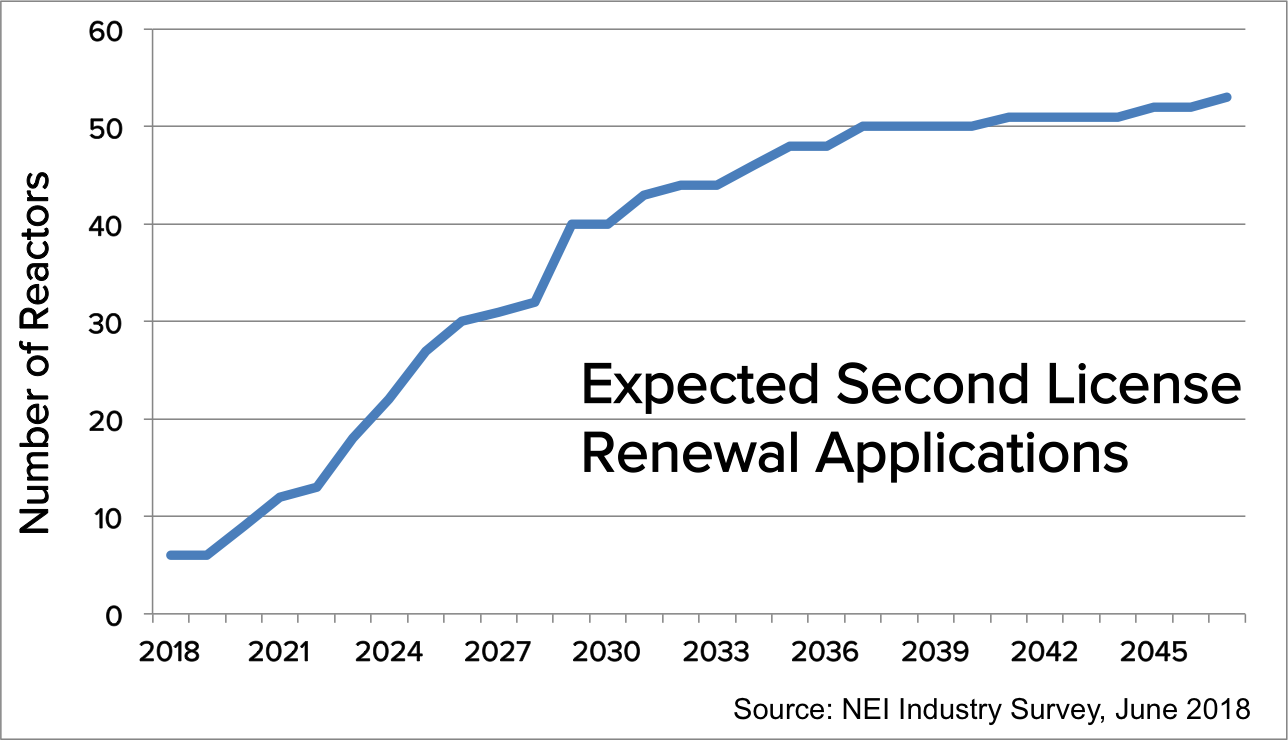 More than half of the operating reactor fleet is anticipated to pursue license renewals to operate for 80 years.
All U.S. nuclear reactors are initially licensed to operate for 40 years, with NRC regulations allowing for licenses to be renewed for 20 years at a time. The reactor license renewal process is well established. It entails a rigorous NRC review of reactor licensees’ plans for managing all plant structures and components for safe long-term operations throughout the renewal period.
The NRC agrees with the industry that there are no technological limitations on restricting the operating lifetime of well-maintained nuclear reactors. Licensees have the discretion to decide whether to pursue extended operations based on economic and other considerations.
Since the first 20-year license renewal was issued in 2000, nearly all the 98 operating reactors in the U.S. fleet have obtained their initial license extensions—Surry’s was obtained in 2003. The remaining few reactors have applications under review or pending submittal. Even so, half of these reactors are expected to reach the end of their 60-year extended periods by 2040, and all by 2050.
The continued operation of America’s nuclear fleet is vital to ensuring an adequate supply of clean, carbon-free energy. Nuclear plants are the largest source of carbon-free electricity in the country. An NEI study finds that if all operating U.S. reactors were to run for 80 years instead of 60, a cumulative total of about 3.5 billion tons of CO2 emissions would be avoided through 2050.
The first SLR application was submitted by Florida Power and Light in January 2018 for its Turkey Point Nuclear Plant in Florida, followed by Exelon’s filing in July for Peach Bottom Atomic Power Station in Pennsylvania. Including the two Surry units, there are now six reactors in the vanguard of the SLR program, with more to come.
“The Peach Bottom SLR application has been an excellent example of industry cooperation. We could not have submitted a high quality application without EPRI and DOE research, and the Nuclear Energy Institute leading the way on interfacing with the NRC on this process,” Exelon Vice President for Licensing and Decommissioning Mike Gallagher said. “We look forward to safely and efficiently operating Peach Bottom for many years to come.”
The NRC has committed to completing SLR application reviews within an 18-month period, and is piloting this review schedule with one of the initial license renewal applications under way.
The success of the program to date, including the NRC’s expedited review schedule, has resulted in the industry’s increasing confidence in the process. As shown by industry surveys conducted in 2017 and 2018, more than half of nuclear plant licensees now want to pursue SLR applications (see accompanying chart).
Among them is Dominion Energy, which already announced its intention to file an SLR application for its two North Anna Power Station units in Louisa County by 2020. Additional announcements are expected in 2019.