- NuScale Power contracts BWX Technologies as its manufacturer
- BWXT to optimize design for ease of manufacture, assembly and transportation
- Refining construction techniques will make industry more cost-competitive
Small modular reactors (SMRs) offer the potential for reduced construction and operating costs. In addition they offer scalable demand-based power output, and their more flexible operation can offer grid synergies with renewables. There are many SMR and advanced reactor designers in the U.S. and overseas, with some like Oregon-based SMR developer NuScale Power LLC moving forward into the manufacturing phase.
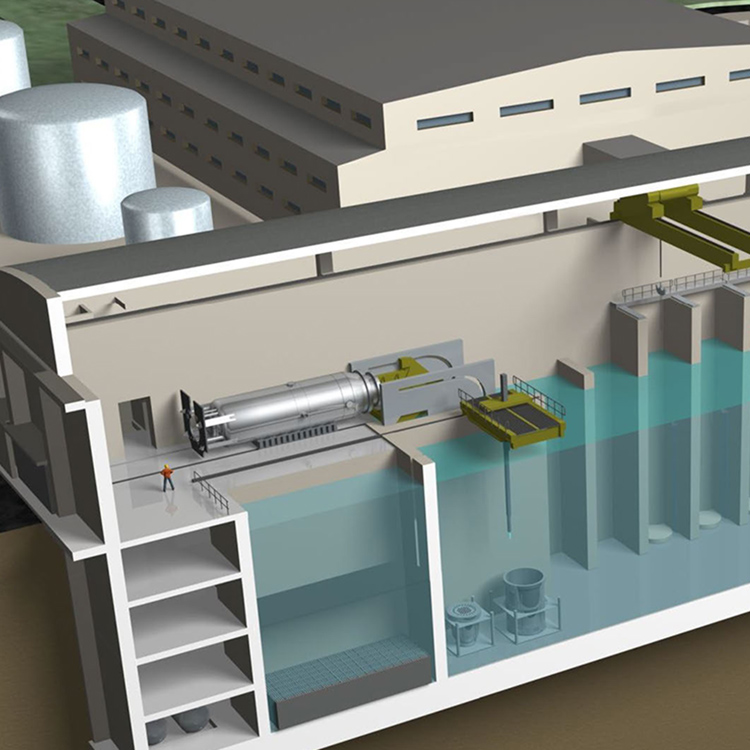
Further evidence of the progress being made by NuScale comes in its selection of BWX Technologies Inc. (BWXT) to begin optimizing the engineering design of the NuScale SMR for manufacture. The announcement signals NuScale’s move to the manufacturing phase of its pioneering SMR project and shows the company’s attention to optimizing fabrication processes and containing first-of-a-kind construction costs.
Lynchburg, Virginia-based BWXT—a long-time supplier of nuclear components and fuel for the civilian and defense nuclear industries—was selected from 83 companies in 10 countries that expressed interest in the project in an 18-month process, NuScale said in a Sept. 25 news release.
“BWXT’s established industry experience was important for us, and so was choosing an American company,” NuScale President and Chief Executive Officer John Hopkins said.
BWXT will immediately begin refining NuScale’s SMR design for its “manufacturability, assembly and transportability,” and the work will continue through June 2020. It expects to use Pennsylvania-based Precision Custom Components as a component manufacturing contractor. NuScale says it will contract out for actual reactor fabrication at a later date.
“The recent study published by the Massachusetts Institute of Technology emphasizes that an important share of dispatchable nuclear energy is critical to affordably meet decarbonization targets,” Nuclear Energy Institute Director for New Reactor Deployment Marc Nichol says.
MIT’s study also recommends increasing modular fabrication as one of several key components to reducing the costs of new reactors to make them more market-competitive.
It is heartening that NuScale and BWXT will be designing for manufacturing during the licensing process. As a result, not just NuScale but the nuclear industry as a whole stands to reap the efficiency and cost savings from moving toward greater factory fabrication.
Other countries such as Russia, China and South Korea also are competing in a global market for these technologies that is estimated to be more than $100 billion by 2035. The U.S. Department of Commerce estimates that every $1 billion of exports by U.S. companies represents at least 5,000 jobs.
“Nearly two-thirds of all nuclear power plants under construction use Chinese or Russian designs. The United States must do everything it can to develop advanced reactor technologies and reestablish its leadership in international markets. This is more than a matter of creating thousands of jobs, it’s about national security,” Nichol says.
There is increasing interest in these forward-looking nuclear technologies, including light water cooled SMRs (based on the large reactors now operating worldwide) and more advanced nuclear technologies based on more exotic reactor coolant and fuel choices. Think tank Third Way notes that more than 70 projects are in various stages of progress in the United States alone.
NuScale is the front-runner in the development of SMRs in terms of its progress through licensing and in the funding support it continues to receive from the U.S. Department of Energy. It was the first to submit a design certification application to the U.S. Nuclear Regulatory Commission in January 2017. The application was accepted by the agency for full technical review two months later, and by April 2018 had completed its Phase 1 technical review.
The review has been marked by important milestones, significant not just for NuScale but for SMRs and advanced reactors in general. In January 2018, the NRC endorsed NuScale’s assertion that its design does not require safety-related emergency power. The Electric Power Research Institute said this will “reduce complexity and cost across the board, supporting industry targets for near-term deployment and improved competitiveness of light water SMRs for the U.S. market, as well as for longer-term Generation IV technologies.”
In another potential regulatory breakthrough, the NRC staff in August 2018 agreed with an analysis by the Tennessee Valley Authority (TVA) that scalable emergency planning zones for SMRs are feasible. NuScale’s SMR was one of four small reactor designs encompassed by TVA in its basis for the analysis that the NRC staff endorsed.
NuScale expects to have its design certified by the NRC by September 2020. The Utah Associated Municipal Power Systems (UAMPS) is planning to deploy a first-of-a-kind 720-megawatt SMR plant (based on 12 60-megawatt NuScale SMR modules) at the Idaho National Laboratory by 2026. The plant would be operated for UAMPS by Energy Northwest.
“The recent NuScale announcement is one example of how the industry continues to make progress in the development of advanced reactor technologies,” Nichol said.
“DOE’s support for this early stage R&D, including the development of designs, the supply chain and deployment of the first-of-a-kind reactors will continue to be important to accelerate this development. Not only will DOE support help bring these reliable, resilient and zero-carbon energy sources to serve U.S. electricity needs, it will also better position the U.S. to compete in international markets,” Nichol said.