NASA’s impressive landing of the Insight probe on Mars this week has drawn new attention to the next step: manned missions to the planet. While there are many challenges in sending humans to the Red Planet and getting them home, one of the biggest is something that nuclear technology can help with: generating electricity, heat, water and rocket fuel.
Explorers and settlers on the Moon and Mars are going to have to “live off the land,” by recovering water from sub-surface lunar ice deposits, and turning materials on the Martian surface into rocket fuel for the return trip, according to the National Aeronautics and Space Administration (NASA). A stay of any duration will require a reliable way of generating breathable air. All of this will take copious amounts of electricity.
Where to get it?
From a new class of nuclear reactors, with a core about the size of a roll of paper towels, that can be set up by astronauts and then run for ten years. This is an engineering challenge, but a prototype of the design, called “Kilopower,” recently completed a 28-hour test with flying colors, a major step forward in a program that has been under way for years.
Kilopower operates by splitting atoms of uranium, called fission, a well-understood process that runs commercial nuclear power plants and the naval propulsion reactors found in submarines and aircraft carriers. But a reactor in space has several special challenges. One is babysitting.
“We’re not going to have operators there,’’ said David Poston, chief reactor designer at the Los Alamos National Laboratory. “Even if there are astronauts there, they’re not going to want to sit at a reactor control panel.”
And, in fact, a reactor might precede the astronauts, landing on Mars as part of a system to produce oxygen and rocket fuel. The reactor would be shipped inert, and start up on arrival.
This requires a reactor that responds automatically to changes in power demand. The reactor is started up by removing a control rod (it has only one, compared to dozens in a commercial nuclear plant) but after that, it automatically responds to changes in demand by raising or lowering its power output.
When more electricity is pulled from the generator, that reduces the heat level in the core. When that happens, the core, like any metal object, contracts a bit as it cools. That pulls the uranium atoms closer together so they speed up the chain reaction. They increase heat production and then the core expands, until production comes back into equilibrium.
Likewise when demand is reduced, less heat is pulled from the core and the core gets hotter, and thus gets bigger, which naturally makes the reaction slow down. That tamps down the chain reaction, until the system returns to equilibrium.
In the test, conducted by the Department of Energy in Nevada, researchers simulated various breakdowns, including the failure of a pipe that carries heat from the core to the generator. The system responded by returning to equilibrium promptly.
The space program has used nuclear energy for years, mostly to get the little bit of electric current needed to power scientific instruments and communications gear. But usually, NASA has not used reactors. Instead, it used a type of plutonium that decays quickly, and gives off heat as it does so. In these radioisotope thermoelectric generators, known as RTGs, a low-efficiency converter turns the heat into dozens of watts of electricity. The Kilopower prototype produces significantly more power: 1 kilowatt (1,000 watts). Production models for use on Mars would make up to 10 kilowatts of power, enough to power a small base. (For comparison, a window air conditioner needs about a kilowatt).
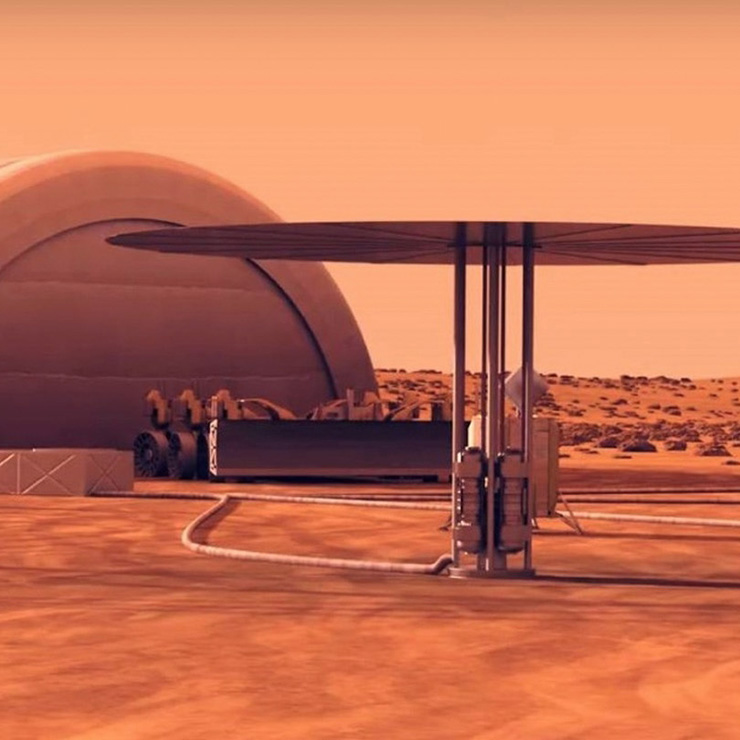
Visually, the most striking aspect of the reactor design is something that looks like a parasol on the top. It is for heat diffusion. Because there is no water to cool the reactor, as is done on earth, and no atmosphere on the Moon and not much on Mars, the reactor needs a large surface to disperse the heat. It makes the trip folded up like an umbrella, and then opens on site.
Many NASA missions have used solar power. But Mars is one-and-a-half times further from the sun than the Earth and as a result, sunlight is only 40 percent as strong. And dust storms often obscure the sun and coat solar panels. On the moon, the night is two weeks long, and some locations where electricity will be needed are in the shadow of crater walls. So, the Moon faces the same perennial problems the Earth does when generating power—what to do when the sun doesn’t shine—and NASA scientists have zeroed in on a familiar solution: nuclear power.
NASA says that a Kilopower reactor could also be used for propulsion to reach the planet. The reactor’s energy would be used to fling tiny charged particles into space, pushing the spacecraft forward. This could be easier than launching a rocket with enough relatively-heavy chemical fuel to do the same work.
“There will come a point where carrying all the materials needed or attempting to resupply becomes very cost prohibitive,’’ Poston said. The astronauts will have to bring “the resources required to stay and explore,” he said.
As it turns out, Mars may be a perfect fit for nuclear energy.