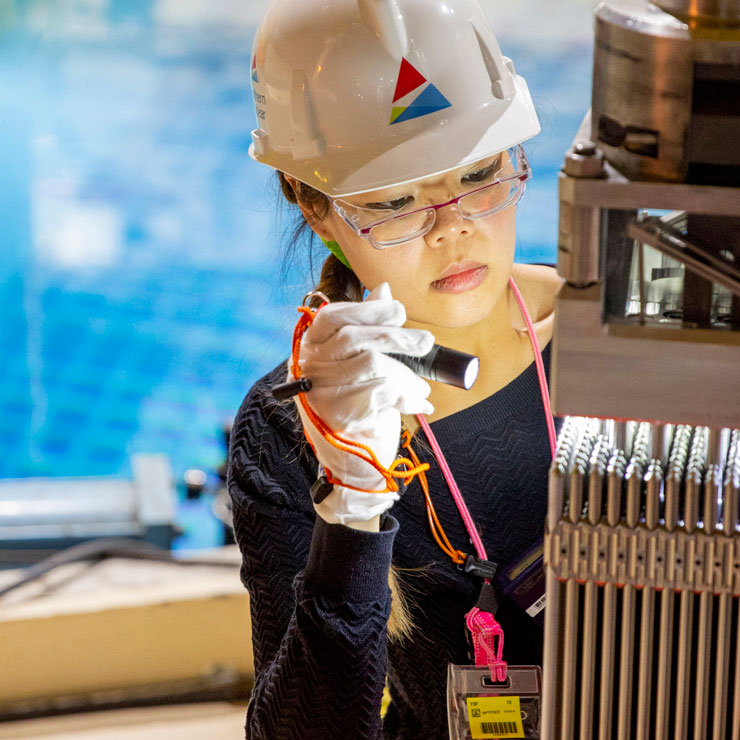
You’ve probably heard of 3D printing being used to create scale models and other novelties. You may even have a 3D printer at home. The technology—also called additive manufacturing—was first pioneered in the 1980s and in the last 10 years has created a revolution in manufacturing just about anything. Today, we can print with more than just plastic; we can print with metals and other materials used in high tech industries.
Some people have even wondered if we could 3D-print a nuclear reactor. Well, it turns out that this idea is not so far-fetched. The nuclear industry is developing micro-reactors, which are very small nuclear reactors typically less than 10 megawatts and capable of fitting on the back of a tractor trailer. Just last week, I was at Oak Ridge National Laboratory and saw a submersible they 3D-printed for the U.S. Navy which was about the same size as a micro-reactor.
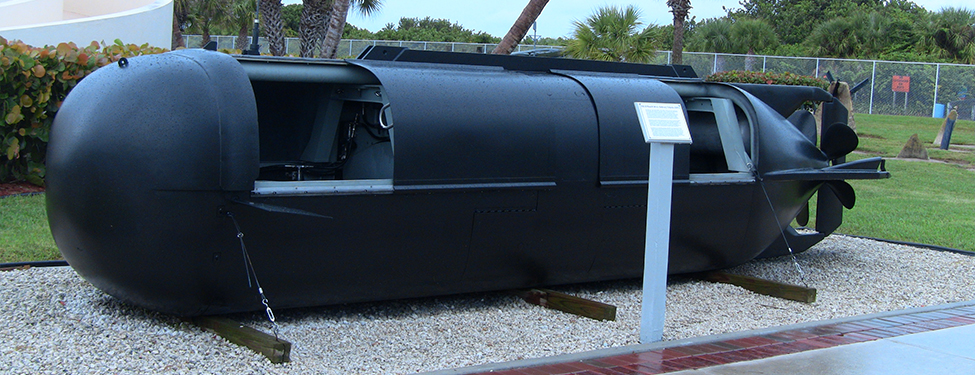 3D-printed submersible on display at Oak Ridge National Laboratory.
So what does this mean for nuclear energy?
Well, the Navy submersible was 3D-printed in weeks instead of months and for only 10 percent of the cost that it would take for conventional manufacturing. While the internal components of a micro-reactor may be complex, the aerospace industry has experience 3D-printing complex jet engine components in less time and for lower costs than conventional methods.
We don’t have to wait for the future to see 3D-printed parts make their way into nuclear power plants. Companies are looking to put 3D-printed fuel components into reactors this year, and advanced test reactors use 3D-printing to manufacture test capsules. Replacement of discontinued parts is a challenge for nuclear plants, and 3D printers could be used to manufacture replacement parts.
In addition, we are looking at other advanced manufacturing technologies. Larger components, such as pressure vessels for small modular reactors, could use advanced methods—like powder metallurgy hot isostatic pressing (a very technical term for pressing metal powder into solid shapes) and electron beam welding (welding at the molecular level)—to reduce the cost and schedule of manufacturing. In fact, our recent report on advanced manufacturing found that there are 16 methods of most interest to the nuclear industry.
Innovation drives the nuclear industry. 3D-printing—like I saw with Oak Ridge and the Navy—and advanced manufacturing can revolutionize how we use carbon-free nuclear energy to power our way of life.
Video footage courtesy of Oak Ridge National Laboratory, U.S. Department of Energy.