Around the United States and the world, demand for clean electricity is growing. So are worries about water. As rainfall patterns shift, many places in the world are going to need new sources of water to mitigate climate change. The water is for all purposes, including electricity generation, and the job should be done in a way that does not make the environment worse.
A new nuclear project in Idaho is addressing all these issues at once with a pioneering dry cooling system.
Nuclear plants, like most power-generating stations, consume water. The power-producing portion of the plant generates heat that is used make steam, but the product people want is electricity. Converting the steam’s energy to electricity means using steam to spin a turbine, a propeller-like device. The turbine turns a generator that makes the electricity. Then the steam is cooled back into water so it can be sent back to the reactor to be boiled into steam again. Cooling the steam back down typically requires a separate water supply to feed cooling towers, or a large river or other body of water.
That works well in most places, but eastern Idaho is dry and has a lot of competing uses for water. So the agency that is planning a nuclear project there, the Utah Associated Municipal Power Systems, which serves members in six Western states, has decided to equip the plant with big electrically-driven fans, instead of cooling towers. Water use will be cut by more than 90 percent.
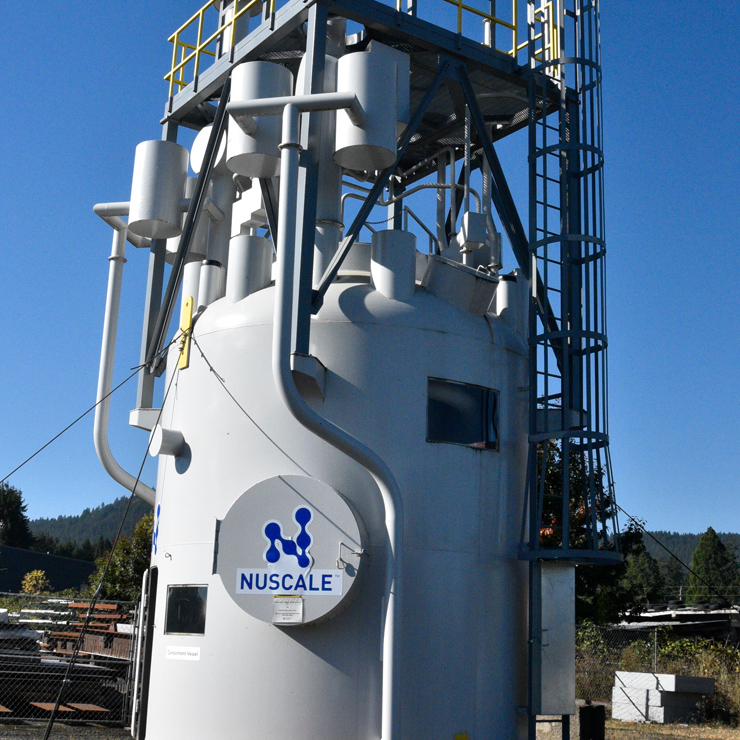
NuScale's Air-Cooled Condenser
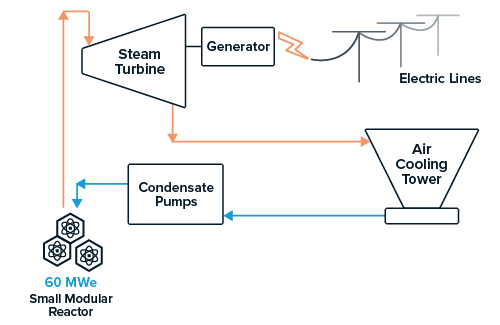 UAMPS' Carbon Free Power Project will use air instead of water for cooling, and cut water use by more than 90%25.
“Water is an incredibly precious resource, especially in the west, so dry cooling is the best option for the Carbon Free Power Project,” said Doug Hunter, UAMPS chief executive officer and general manager. “For a nuclear plant, this is a revolutionary feature. The project will be friendly to air quality and climate, with no carbon emissions; friendly to the land, with its very small footprint; and, now, friendly to water resources and local water interests. It will be the most environmentally-friendly nuclear plant in the world.”
Around the world, many places are afflicted with droughts, which is one of the manifestations of global climate change. Some will choose dry cooling systems because of concern over climate, or simply because on a local basis, it is the right thing to do.
The system, called a “dry condenser,” is not entirely new; a handful of fossil-powered plants use them. The Idaho project, a cluster of small modular reactors that will be supplied by NuScale Power, would be the first grid-scale reactor project to use dry cooling.
That will add flexibility in choosing a place to build. Nuclear plants need only a few truckloads of fuel per year, which removes one complication when picking a site; not needing much water removes another factor.
“It certainly does open up more areas,” said Zack Houghton, an engineering manager at NuScale. And more and more places around the world experience water shortages, he said.
But dry cooling consumes some electricity. The system resembles a car radiator, with a fan to move air across the pipes that hold the water. But air cooling is not quite as efficient, so electricity output drops by 5 to 7 percent.
In places where the water is expensive, dry cooling makes sense, Mr. Houghton said. He said that multiple potential customers have expressed interest in dry cooling. There is another reason to move to a dry condenser: in the future, the primary job of some reactors is likely to be making potable water, or pumping it to where it is needed. As NuScale points out on its website, producing energy takes water, and making water takes energy.
A single module in a NuScale plant could run a reverse osmosis water plant that made 60 million gallons of potable water per day. NuScale calculates that a 12-module plant could provide all the water needed for a city like Cape Town, South Africa, a place that almost ran out of water in 2019. Around the world, more cities will face problems like that as a changing climate changes rainfall patterns, and as increasing urbanization raises water demand.
Eastern Idaho’s situation is not so dire, but in that region, every gallon counts.
George Griffith, the Small Modular Reactor project manager at the Idaho National Laboratory, said, “The ability to use air cooling for a nuclear power plants represents a technological advance and demonstrates that nuclear power can be sited even in locations with limited access to cooling water.’’
Griffith and other experts say that the UAMPS project there will point the way for similar deployments around the world.