How can engineers in California use a stew of tiny particles heated to 300 million degrees Fahrenheit to point the way to a technology that will power a city and protect the climate?
In a nondescript building in San Diego, researchers at General Atomics are exploring that question. Working with that swarm of particles (technically a plasma), they are creating an environment in which they can cause atoms to combine, a process called fusion, and by doing so produce an enormous amount of energy without carbon emissions.
The broad outline of nuclear energy is simple: break the bonds that hold together the nucleus of an atom, and harvest the heat to make electricity. We’ve done that on a commercial basis for almost 70 years by splitting the atom in a process called fission. America’s 96 nuclear plants are currently the largest source of carbon-free energy in the country, and many companies are working to bring advanced nuclear reactors on line in the next decade. But researchers—like the ones at General Atomics—are also moving towards fusing atomic nuclei together.
The path to get there is complicated, because they are trying to create conditions similar to how fusion naturally occurs—in the center of a star.
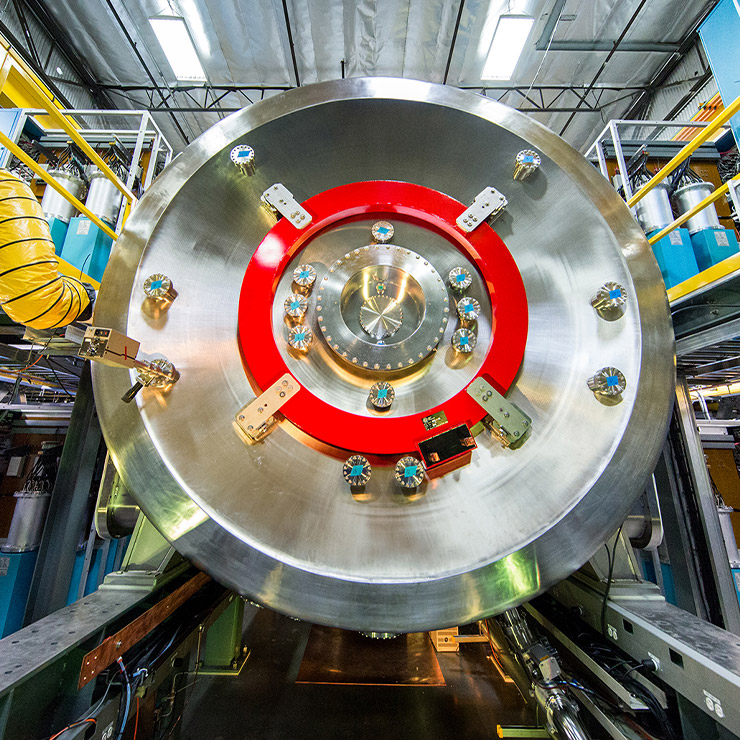
General Atomics operates a tokamak, a large, donut-shaped device that creates conditions favorable for fusion. In it, particles are heated so hot that they lose their electrons and become electrically charged ions. But the ions have to be squeezed together in a cloud of a particular shape, speed and density for fusion to happen. At these temperatures, no steel or ceramic could hold them.
The solution is to confine the ions with magnetism, in much the same way scattered iron particles can be organized by a magnet. A tokamak is surrounded by powerful magnets to contain and shape the blob of plasma. Lasers are pumped in from four points to help steer the plasma, and microwaves are forced in to heat it. One device spits pellets of fuel into the machine at 200 miles per hour.
The approach at General Atomics is to squeeze together types of hydrogen atoms. Researchers elsewhere are trying to combine hydrogen with boron.
“You have to get inside the nucleus to harness the energy required to change the course of humanity,” explains Zabrina Johal, director of business development in the energy group for General Atomics.
To be viable for commercial use, the machine must produce more energy than it takes to operate. Researchers are aiming for a system that produces ten watts for every watt it consumes, though that still won’t be quite enough for commercial generation. The General Atomics tokamak consumes 35 megawatts when it is running, which is enough to power a whole town.
When achieved, the payoff will be huge: two pounds of fusion fuel has around the same energy content as a railroad car full of coal, about 18 million pounds. And instead of tens of millions of pounds of carbon dioxide and other pollutants, the only byproduct is helium, an inert gas, enough to fill about 400 party balloons.
The work is progressing and pointing the way to the design of ITER, a much larger fusion machine under construction in southern France by a consortium of 35 countries, including the United States. General Atomics is building some of the hardware for ITER, which will have a radius four times larger than the General Atomics device. If all goes well, ITER will demonstrate self-sustaining fusion.
Physicists working on the problem say that commercial success is still years away. But a cadre of researchers is heavily invested in it. Success for General Atomics—and other fusion innovators like it—will mean a promising new form of nuclear energy. As the world aims to reduce emissions, even more carbon-free sources like this will be needed to protect the climate.