Summer months typically mean family vacations, time spent out by the pool or beach, baseball games and lots of sunshine. If you happen to reside in one of the three-quarters of homes in the United States that has an air conditioner, summertime also means running your AC to stay cool when the temperatures start rising.
The majority of Americans use air conditioning to beat the heat, and it doesn’t look like use will be slowing down anytime soon.
According to the National Centers for Environmental Information, the June 2021 contiguous U.S. temperature was 72.6 degrees Fahrenheit, 4.2 degrees Fahrenheit above the 20th-century average, marking June 2021 as the warmest in 127 years and surpassing a previous June record by 0.9 degrees Fahrenheit.
In July, Death Valley saw temperatures soar to 130 degrees Fahrenheit. In extreme heat like this, air conditioning is not only needed for comfort, but also for health reasons.
While air conditioning keeps us cool, keeping it running in the United States isn’t a small affair. Air conditioners consume nearly six percent of all electricity produced in the U.S., cost approximately $29 billion annually to homeowners and release approximately 117 million metric tons of carbon dioxide.
That, combined with the increased temperatures we’ve seen this year and continued commitments to addressing climate change, demonstrates the pressing need for a reliable, resilient energy source that also has minimal environmental impact to meet these significant energy demands.
These concerns are likely top of mind for many states, and in particular, states that have experienced energy shortages. The North American Electric Reliability Corp.'s (NERC) 2021 Summer Reliability Assessment warned that California would need energy transfers to meet system demand as solar output declines and Texas, New England and parts of the Midwest could also face shortages.
According to the U.S. Energy and Information Administration, Texas primarily generates its electricity with large shares of natural gas combined with coal, nuclear, hydroelectric, and renewables like wind while California generates its electricity with large shares of natural gas and renewables like solar combined with coal, nuclear, and hydroelectric.
Meeting the increased energy demand resulting from rising temperatures will not only put a strain on the power grids of states, but it will also result in an increase of carbon emissions, particularly for states relying on energy sources that aren’t renewable, such as fossil fuels.
Take for example, New York. Earlier this summer during a heat wave, New York City Mayor Bill de Blasio requested that city residents reduce their use of electricity at home or at their businesses to avoid power outages.
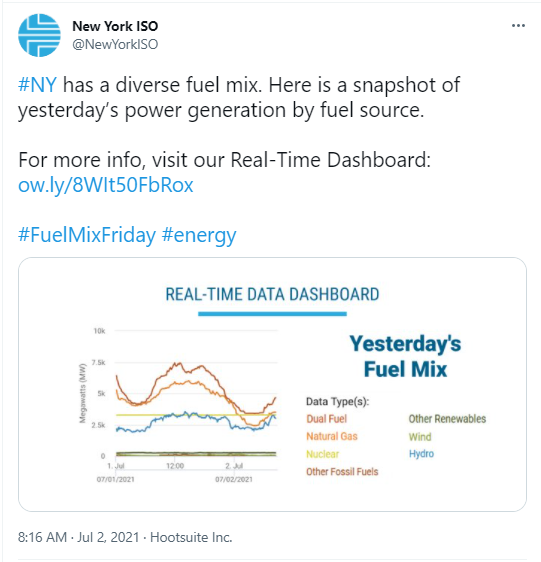
According to the New York Independent System Operator, throughout the day nuclear energy was the only energy source that consistently and reliably provided power, despite the recent closure of the state’s Indian Point nuclear power plant. Renewable energy sources, solar and wind, didn’t register significantly throughout the day and the remaining energy sources, natural gas and other fossil fuels, provided energy at varying rates.
As temperatures continue to rise and the U.S. experiences record-breaking heat, it’s evidently clear that states will need to reconsider their energy sources, especially as their residents attempt to stay cool and healthy in the summer and as we as a country work to address climate change.
As seen in New York, nuclear energy is a vital part of the electricity portfolio given its steadfast reliability to produce carbon-free power, making it an important complement to wind and solar in the long-term solution to support the increasing energy needs of states. Without this reliable energy mix, we will continue to see states like Texas asking residents to set thermostats at 78 degrees or higher, and for many, that just won’t work.