I spend a lot of my time on planes, trains, and cars that take me across the world to talk to energy ministers, business leaders, politicians, investors, and other audiences about the value of nuclear energy—a secure and carbon-free energy solution. People are interested. Countries are interested. Businesses are interested. And this interest is translating to demand.
The term “renaissance” and “new dawn” are often invoked when discussing the spread of nuclear—but the magnitude of the demand we’re seeing eclipses past projections.
The reality is that countries across the world have taken a hard look at their options and are re-appreciating the unique set of benefits that nuclear offers—reliable, affordable, secure, clean energy.
I was just in Croatia at a meeting of the Partnership for Transatlantic Energy and Climate Cooperation (P-TECC), discussing the importance of partnering on nuclear energy innovation and the carbon-free energy transition. I met with leaders who are dedicated to working together on a nuclear strategy that works for our people and our planet.
I saw these conversations happening at the United Nations (UN) Framework Convention on Climate Change in Sharm El-Sheikh, Egypt last year, where we saw the first ever major nuclear-focused pavilion at COP.
And later this year, I will be traveling to Canada, Japan, the Czech Republic, Poland, Italy, the UAE, and Ghana—to name a few—to talk to more parties interested in nuclear energy as a pillar of their clean energy plans.
We’re already seeing some of these plans come together.
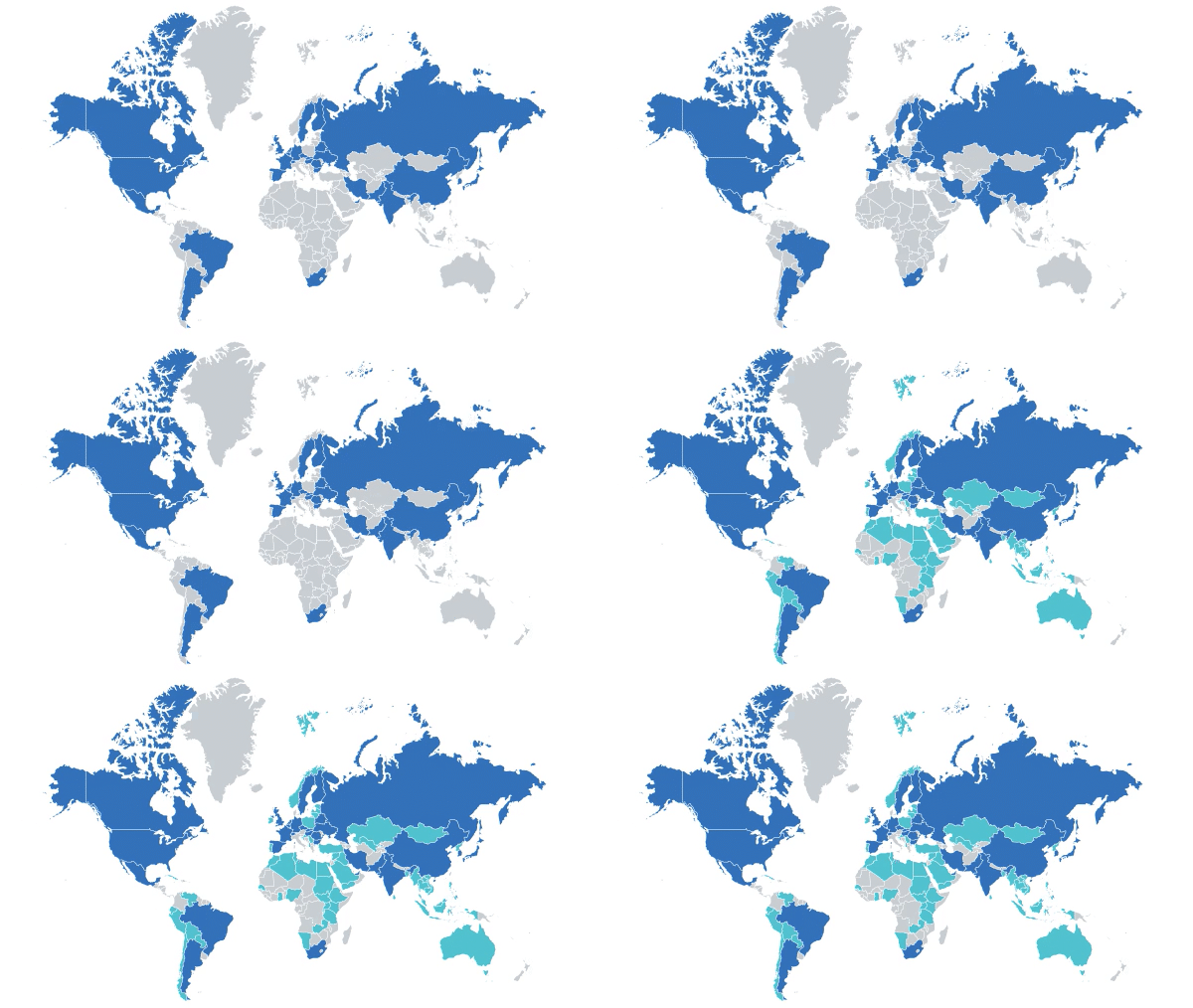
We saw Canada establish tax credits that will spur nuclear deployment. Ontario Power Generation has announced a pioneering partnership with Tennessee Valley Authority to develop and deploy advanced nuclear technology on both sides of our borders.
Japan recently reversed course with plans to reopen as many plants as possible.
Poland is partnering with Westinghouse, an American nuclear technology supplier, to build its first plant.
As the Czech Republic moves away from coal, it launched a tender for a new reactor at the Dukovany site, and the country is planning additional reactors beyond that—both large-scale power plants and smaller modular nuclear reactors.
France went from planning to phase down nuclear to announcing plans to build up to 14 new plants by 2050, and President Emmanuel Macron recently broke down bureaucratic barriers for nationwide site approvals.
Brazil, the Netherlands, Romania, India, and the UK are all making nuclear a key part of their future energy plans.
And here at home, we know there is a great deal of demand for new nuclear projects, spurred by the incentives in the IRA to deploy clean energy. NEI polled Chief Nuclear Officers at our member utilities. Together, they are expecting to add 100 gigawatts of nuclear power to the grid in the U.S. The emissions avoided by this amount of nuclear power is equivalent to taking more than 100 million cars off the road.
This momentum reflects the fact that over the course of the past year, the global conversation around energy has changed dramatically. We just passed the first anniversary of Russia’s tragic invasion of Ukraine—and we continue to see energy security join climate security as a key consideration of our global energy future.
This is all important because with each new nuclear project, we increase the world’s supply of reliable, secure power, which can shield us from the daily impact of price fluctuations, supply disruptions, power blackouts, and geopolitical instability. The world has moved past discussion and debate to real, concrete actions—with nuclear at the center—that will achieve these goals while decarbonizing entire regions and economies.
The energy system of the future is happening now. It’s time for nuclear to lead the way.