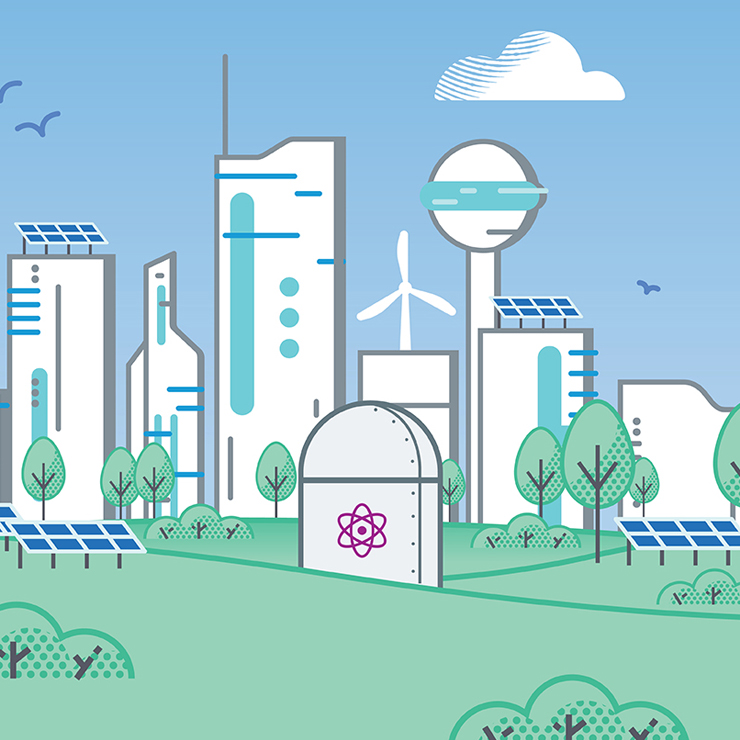
We’ve seen ambitious carbon-free announcements during the 27th Conference of the Parties (COP27) of the United Nation’s (UN) Framework Convention on Climate Change, hosted this year in Sharm El-Sheikh, Egypt—and carbon-free nuclear power has shown up as a key player.
This week, nuclear energy and technology companies—Nuclearelectrica, NuScale, TerraPower, Terrestrial Energy and Westinghouse—joined the UN’s 24/7 Carbon-Free Energy Compact, which presents a set of principles and actions driving toward rapid decarbonization in the electricity sector. Influential companies like Google and Microsoft are signatories, and energy buyers, suppliers, governments, investors and other organizations have committed to the compact in order to achieve a transformative approach to energy procurement, supply, and policy design that delivers clean, scalable solutions.
“NuScale is looking forward to working with Carbon-Free Energy Compact members to advance global decarbonization and accelerate the deployment of solutions such as our VOYGR SMR, which can meet the growing need for clean energy and energy security,” said John Hopkins, NuScale President and Chief Executive Officer.
NEI was an early signatory, and Constellation Energy Corporation, Energy Harbor, and Xcel Energy, are also members of the compact.
“Industry and government have come together under a shared goal of building a just and affordable energy transition during this critical moment for our climate and economy,” said Maria Korsnick, president and chief executive officer at the Nuclear Energy Institute.
Study after study has shown that there is no global solution without power reliability, energy security, affordability and economic growth—and nuclear checks all the boxes.
Nucor Corporation, the largest American steel producer, announced this week that they are the first major industrial company to join this global effort, and AVF Beltrame Group, a leading European steel producer, also joined the 24/7 CFE Compact. Both of these companies are choosing 24/7 clean energy and looking to nuclear to help them accelerate decarbonization.
"In order for us to achieve a carbon-free energy future while also meeting the growing demand for energy, it is critical that we embrace all forms of clean, zero-carbon energy sources, from wind, solar and hydro, to nuclear power,” said Leon Topalian, Nucor's Chair, President, and Chief Executive Officer.
Another historic step took place this week when the U.S. General Services Administration (GSA) announced a Memorandum of Understanding (MOU) with Entergy Arkansas, LLC, to help federal agencies in Arkansas source 100 percent of the federal government’s electricity from carbon- and pollution-free sources by 2030, at least 50 percent of which would be delivered on a 24/7 basis. This is the administration’s first MOU with a utility to work toward this goal.
Technology-inclusive strategies that value around-the-clock, carbon-free energy like nuclear are at the core of rapidly decarbonizing electricity systems. Here in the U.S., there is strong support for nuclear. The recently passed Inflation Reduction Act, which President Biden called the “biggest step forward on climate ever,” included incentives to ensure exiting reactors are able to provide reliable, carbon-free energy for years to come, and it also encourages cutting-edge new nuclear, which will propel us toward a clean energy grid and economic future.
“We have now come to COP with a suite of technology incentives for nuclear that are very exciting,” said U.S. Secretary of Energy Jennifer Granholm at a COP side event. “People understand atoms now as being a really important piece of the clean energy future.”
U.S. Special Presidential Envoy for Climate John Kerry announced two new climate initiatives that showcase how innovative small modular reactors (SMRs) can power “net-zero economies in hard-to-abate energy sectors.” A demonstration in Ukraine will be launched to produce clean hydrogen and ammonia, products which will create clean fuels and advance food security, and Project Phoenix will help move Europe from coal-fired plants to nuclear in order to retain local jobs and produce clean energy.
Cooperation between nations is one of the pillars of COP, and Kerry attended a news conference at the summit announcing the U.S. Export-Import Bank (EXIM)’s issuance of two letters of interest in utilizing U.S. exports for a nuclear power project in Romania.
“New approaches to clean-energy resources like geothermal and a next generation of nuclear can provide a baseload foundation of zero-emissions energy for economies around the world,” said Kerry when discussing the U.S. climate effort.
The importance of nuclear energy has been center stage at many different forums, but especially the #ATOMS4CLIMATE pavilion—the first ever major nuclear-focused pavilion at COP—which hosted more than 40 events relating to how nuclear energy, science and technology play a crucial role in meeting global climate goals.
All signs point to the fact that nuclear energy is a key to our carbon-free future and will play a critical role in the climate solution.
This week, nuclear energy and technology companies—Nuclearelectrica, NuScale, TerraPower, Terrestrial Energy and Westinghouse—joined the UN’s 24/7 Carbon-Free Energy Compact, which presents a set of principles and actions driving toward rapid decarbonization in the electricity sector. Influential companies like Google and Microsoft are signatories, and energy buyers, suppliers, governments, investors and other organizations have committed to the compact in order to achieve a transformative approach to energy procurement, supply, and policy design that delivers clean, scalable solutions.
“NuScale is looking forward to working with Carbon-Free Energy Compact members to advance global decarbonization and accelerate the deployment of solutions such as our VOYGR SMR, which can meet the growing need for clean energy and energy security,” said John Hopkins, NuScale President and Chief Executive Officer.
NEI was an early signatory, and Constellation Energy Corporation, Energy Harbor, and Xcel Energy, are also members of the compact.
“Industry and government have come together under a shared goal of building a just and affordable energy transition during this critical moment for our climate and economy,” said Maria Korsnick, president and chief executive officer at the Nuclear Energy Institute.
Study after study has shown that there is no global solution without power reliability, energy security, affordability and economic growth—and nuclear checks all the boxes.
Nucor Corporation, the largest American steel producer, announced this week that they are the first major industrial company to join this global effort, and AVF Beltrame Group, a leading European steel producer, also joined the 24/7 CFE Compact. Both of these companies are choosing 24/7 clean energy and looking to nuclear to help them accelerate decarbonization.
"In order for us to achieve a carbon-free energy future while also meeting the growing demand for energy, it is critical that we embrace all forms of clean, zero-carbon energy sources, from wind, solar and hydro, to nuclear power,” said Leon Topalian, Nucor's Chair, President, and Chief Executive Officer.
Another historic step took place this week when the U.S. General Services Administration (GSA) announced a Memorandum of Understanding (MOU) with Entergy Arkansas, LLC, to help federal agencies in Arkansas source 100 percent of the federal government’s electricity from carbon- and pollution-free sources by 2030, at least 50 percent of which would be delivered on a 24/7 basis. This is the administration’s first MOU with a utility to work toward this goal.
Technology-inclusive strategies that value around-the-clock, carbon-free energy like nuclear are at the core of rapidly decarbonizing electricity systems. Here in the U.S., there is strong support for nuclear. The recently passed Inflation Reduction Act, which President Biden called the “biggest step forward on climate ever,” included incentives to ensure exiting reactors are able to provide reliable, carbon-free energy for years to come, and it also encourages cutting-edge new nuclear, which will propel us toward a clean energy grid and economic future.
“We have now come to COP with a suite of technology incentives for nuclear that are very exciting,” said U.S. Secretary of Energy Jennifer Granholm at a COP side event. “People understand atoms now as being a really important piece of the clean energy future.”
U.S. Special Presidential Envoy for Climate John Kerry announced two new climate initiatives that showcase how innovative small modular reactors (SMRs) can power “net-zero economies in hard-to-abate energy sectors.” A demonstration in Ukraine will be launched to produce clean hydrogen and ammonia, products which will create clean fuels and advance food security, and Project Phoenix will help move Europe from coal-fired plants to nuclear in order to retain local jobs and produce clean energy.
Cooperation between nations is one of the pillars of COP, and Kerry attended a news conference at the summit announcing the U.S. Export-Import Bank (EXIM)’s issuance of two letters of interest in utilizing U.S. exports for a nuclear power project in Romania.
“New approaches to clean-energy resources like geothermal and a next generation of nuclear can provide a baseload foundation of zero-emissions energy for economies around the world,” said Kerry when discussing the U.S. climate effort.
The importance of nuclear energy has been center stage at many different forums, but especially the #ATOMS4CLIMATE pavilion—the first ever major nuclear-focused pavilion at COP—which hosted more than 40 events relating to how nuclear energy, science and technology play a crucial role in meeting global climate goals.
All signs point to the fact that nuclear energy is a key to our carbon-free future and will play a critical role in the climate solution.

Carol Berrigan
Exec. Director, Federal Programs & Supplier Relations