The only reason Buzz Lightyear was never able to explore outer space in Toy Story is because he didn’t have the necessary technology. I think that was the plot of Toy Story, but don’t quote me on that. Luckily, infinity and beyond may now be within our reach.
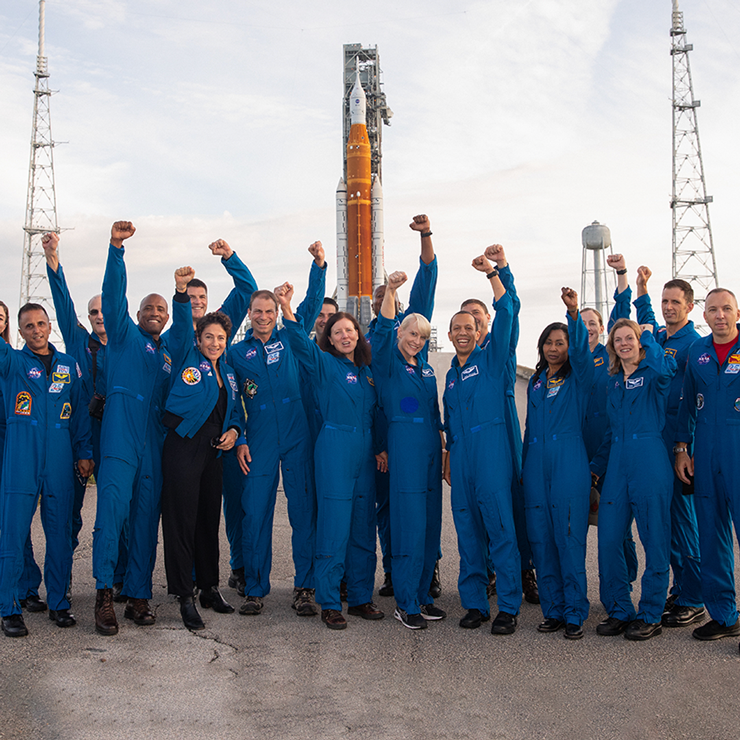
One year ago, on November 16th, Artemis I launched. This was the first in a series of integrated flight tests of NASA’s Space Launch System and Orion spacecraft. Artemis II is set to launch in November 2024; the program is designed to enable exploration and settlement of our moon, Mars, and more. But does any of this relate to nuclear?
Yes! Nuclear is integral to long-term space exploration and settlement. As we mentioned last year (on this very blog), nuclear fission surface power will ensure reliable access to electricity no matter the terrain or temperature. That’s just the tip of the isotope, though—there are countless applications for nuclear technologies in the field of space exploration.
Earlier this year, Zeno Power was granted $30 million to build a radioisotope-powered satellite for the military, which is set to be finished by 2025, and would convert the heat from decaying nuclear materials directly into electricity. Currently, radioisotope-powered satellites utilize a rare isotope, plutonium-238, that is controlled and limited to mission-critical NASA missions. The Zeno Power radioisotope-powered satellite is an important innovation because it uses more readily available radioisotopes and smaller satellites, widening their applications for the military in space and on Earth.
This year it was also announced that BWX Technologies, Inc. (BWXT) will be working with Lockheed Martin on the world’s first demonstration spacecraft using nuclear thermal propulsion. BWXT "will complete final design of the nuclear reactor, manufacture the reactor’s hardware and fuel, assemble the components and deliver the fueled reactor as a complete subsystem for integration into the Defense Advanced Research Projects Agency’s (DARPA) Demonstration Rocket for Agile Cislunar Operations, known as DRACO.”
The spacecraft is looking to launch from Earth in 2027. The significance of this launch for the future of space exploration cannot be understated, as these nuclear thermal propulsion systems are expected to provide faster transit times which would enable humans to successfully travel to far away places like Mars as well as provide insurance for their survival by enabling more ways for the crew to return to Earth, which traditional rockets cannot do.
This technology isn’t just important for space travel; this is technology that can help here on Earth as well. Just last month, Zeno Power was granted $7.5 million from the Department of Defense for an underwater radioisotope power system. The goal of this project is to “develop decentralized nodes for energy generation and distribution on the seabed. Such a system could open the way for long-endurance seafloor sensor systems and charging stations for autonomous undersea vehicles.”
The more time passes, the more we are able to see the benefits of investing in nuclear energy—nuclear systems will improve our capabilities in space, underwater, and on land. So, tune into Toy Story 5: Buzz’s Cosmic Odyssey, where Buzz Lightyear uses nuclear energy to go underwater and also into outer space. Maybe? I could be wrong about Toy Story, but I’m certain that the advancements being made by organizations like Zeno Power and BWXT will help transform our ability to explore the mysteries here on Earth and enable humans to travel to infinity and beyond.

.png?language=en-US)