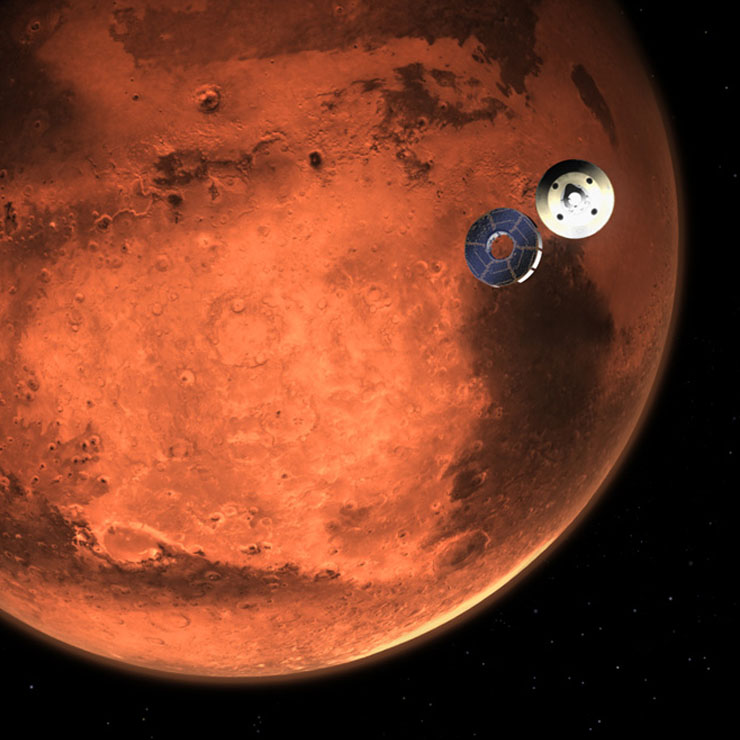
The last time humans stepped foot on the Moon—or even traveled beyond low Earth orbit—was in 1972, the final mission of NASA's historic Apollo space program. Today, nearly 50 years later, NASA launched uncrewed Artemis I, the first in a series of missions with ambitious goals that nuclear energy will help achieve.
The Artemis space program is historic for two reasons: it will land the first woman and person of color on the Moon in 2024 with Artemis III, and it aims to establish sustainable, long-term human space exploration before 2030.
This long-duration exploration will start with the Artemis Base Camp in the lunar South Pole, somewhere no human has been before. The region holds ideal locations for a permanent base in part because certain areas experience near-constant sunlight, providing a readily available source for solar power.
But what happens when darkness inevitably falls? That’s where nuclear energy comes in.
The lunar night is a cold, harsh environment for our space explorers to live and work within, but nuclear fission surface power will ensure reliable access to electricity no matter the terrain or temperature. It creates electricity by converting the heat generated from splitting uranium atoms, a process that doesn’t rely on available sunlight.
The Fission Surface Power project is a very achievable first step toward the United States establishing nuclear power on the Moon.
Earlier this year, NASA selected three design proposals for a nuclear power system that could last upwards of 10 years on the Moon, and the Department of Energy’s Idaho National Laboratory awarded $5 million contracts to each of the following U.S. companies:
- Lockheed Martin, partnering with BWX Technologies and Creare
- Westinghouse, partnering with Aerojet Rocketdyne
- IX, a joint venture of Intuitive Machines and X-Energy, partnering with Maxar and Boeing
This small lunar power plant will be capable of generating the energy required to power the vital infrastructure and equipment needed during later Artemis missions. These fission surface power systems could also be scaled up to match the growing energy demands of larger permanent bases and will be an important steppingstone for establishing an outpost on Mars. Similar to long-term occupants on the Moon (and our own planet Earth), Martian astronauts will need access to a reliable, continuous energy source that can also operate in a harsh landscape.
“Our experience on the Moon this decade will prepare us for an even greater adventure in the universe—human exploration of Mars,” said NASA's Associate Administrator for the Space Operations Missions Directorate Kathryn Lueders.
NASA has a long history of utilizing nuclear energy to power its missions in space. Radioisotope power systems (RPS) convert the heat generated by the decay of plutonium-238 to electricity—these critical systems have been behind the Voyager missions, the Cassini-Huygens spacecraft, the Perseverance rover and the New Horizons mission.
This Artemis generation of scientists, engineers and explorers will build on America’s proven legacy as leaders and innovators in the advanced technologies that these ambitious pursuits require. In 1969, Americans were the first to step foot on the Moon. Before the end of this decade, we will be the first to stay on the Moon.
Today, more than 60 years after launching NASA’s first nuclear-operated spacecraft, no other technology is capable of powering long-duration space missions more reliably than nuclear energy. The Artemis program—and the fission surface power behind it—is the next leg of our journey into space.

.jpg?language=en-US)