When many of us think about space, images of Neil Armstrong and Buzz Aldrin walking on the surface of the moon come quickly to mind—"one small step for man and one giant leap for mankind.”
The moon remains just as important now, as it is our closest astral body in the Solar System, our only natural satellite, and our next logical step for a permanent presence.
However, the lunar night poses a challenge to this mission.
Because one rotation of the moon lasts about 28 days on Earth, the lunar night, which is when the surface of the moon is not exposed to the sun, lasts about 14 days. This long night cycle means that temperatures drop drastically, down to about negative 280 degrees Fahrenheit, creating an incredibly intense environment and destroying the capabilities of most equipment.
Phases of the Moon
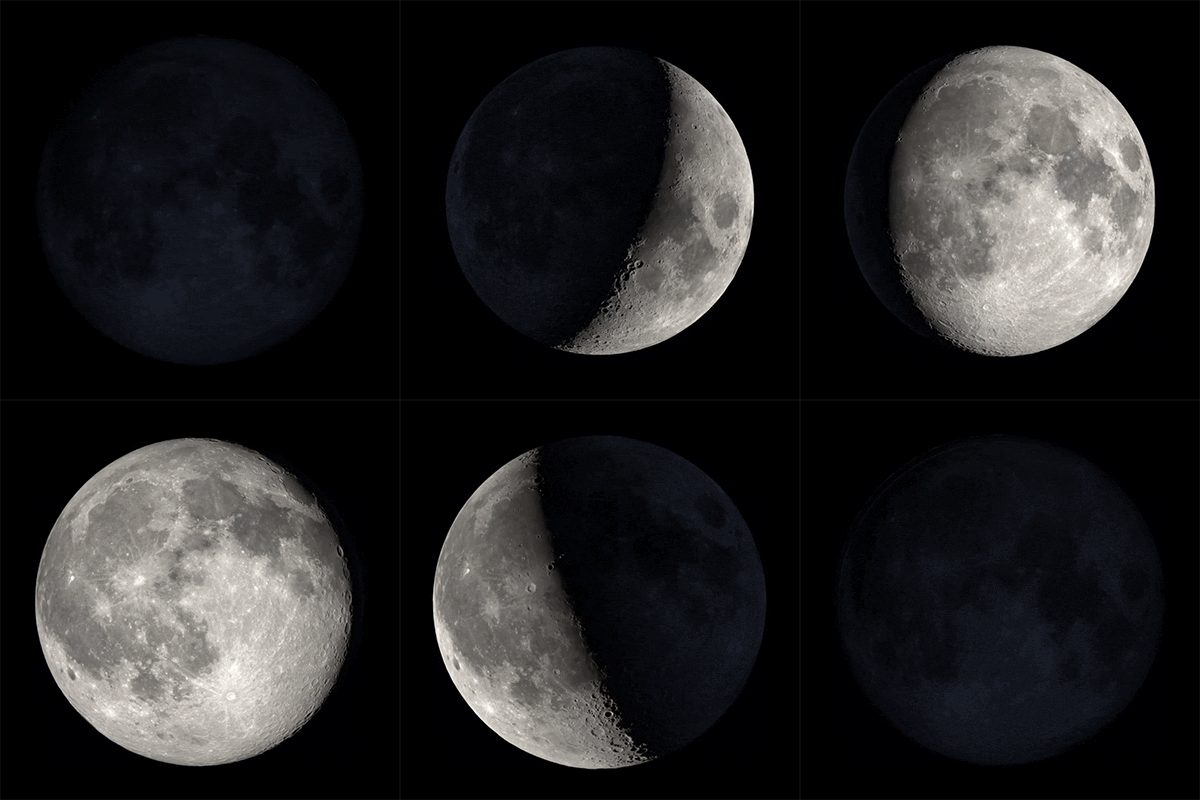 The Moon has a day side and a night side, which change as it rotates. How much we are able to see of the illuminated half changes as the Moon travels through its orbit. Source: NASA
To complete long-duration missions on the moon and eventually establish a long-term presence, operational viability during the lunar night is key. Developing this technology will also help us explore other thermally extreme environments.
Next-generation radioisotope power systems (RPSs) are poised to overcome this barrier.
According to NASA, currently, there are only two practical, reliable ways to power our spacecrafts—the heat from the sun or heat from nuclear sources.
Solar power provides an excellent power source for certain missions, but RPSs, which are essentially nuclear batteries that convert or channel heat into electric power, are necessary to explore the darker, colder areas in our Solar System. RPSs have been making historic contributions to space exploration for over 60 years and continue to power space exploration today.
“Radioisotope power systems don’t have moving parts that can be damaged during take-off or reentry. They’re rocket-proof, so to speak, and it’s hard to think of another system so well-suited for powering spacecraft,” said Michael Smith, a nuclear space systems engineer at the DOE’s Oak Ridge National Laboratory.
Next-generation RPSs are being studied by NASA and developed by companies such as Zeno Power Systems. Some designs of these systems can use radioisotopes from spent fuel and run from two weeks to many years.
These next generation RPSs, which are expected to be in use in the next couple of years, also have applications powering early unmanned missions, earth satellites, and missions to other planets, such as Mars.
Because these RPSs can withstand extremely cold temperatures, they can survive the lunar night and be used as early stage power systems for remote imaging and communications.
The potential of RPSs to help create a moon base is increasingly relevant as geopolitics shift and different countries look to establish a more permanent presence in space.
Congress authorized the International Space Station through 2024 with likely expansion to 2028, but in the coming years, it will have to retire. As this productive geopolitical hub goes away, many countries and programs, including China, Russia and the European Space Agency, have expressed an interest in a lunar colony.
Nasa is currently preparing for a permanent presence on the Moon with the Artemis program, which is designed to maintain U.S. leadership in space exploration and build global alliances. This mission plans to land the first woman and first person of color on the Moon in 2024 and establish collaboration with international and commercial partners to form a base camp, allowing lunar exploration in the mid- to late 2020s.
A moon base holds the potential to be a significant stepping stone to exploring more of our Solar System and would also allow us to conduct more science than ever before, contributing to our understanding of our own planet, as well as the rest of our galaxy and universe.