Space and nuclear—maybe not a pairing you’ve thought much about—but a very important one to space development and exploration. Nuclear energy has safely and successfully powered U.S. space travel for over half a century.
Now, recent investments in new nuclear technologies have the potential to revolutionize space travel. Think Star Trek’s famous quote: “to boldly go where no man has gone before.”
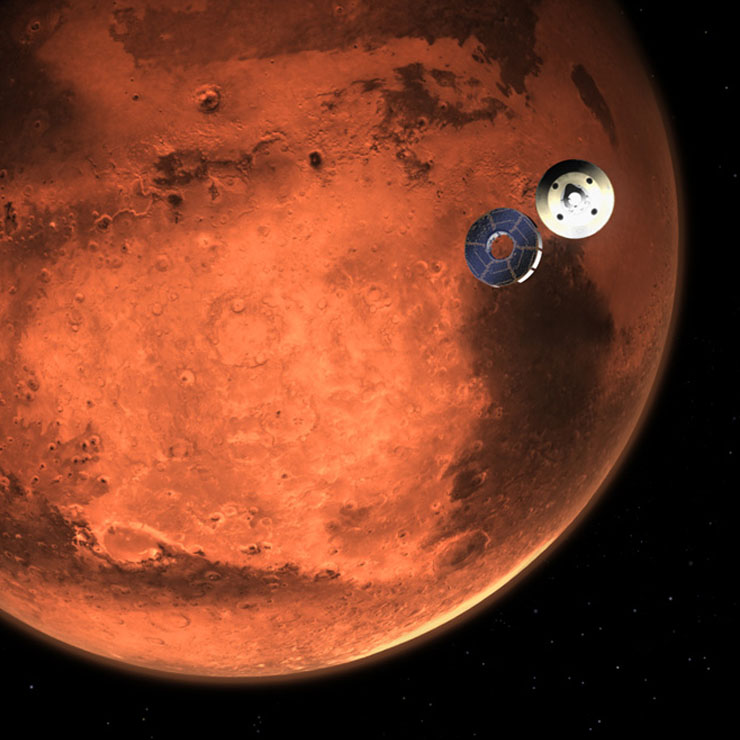
These new technologies could help us get to Mars faster, create surface power, and travel further into space.
New Developments in Nuclear-Powered Spacecraft and Reactors
Over the years, the National Aeronautics and Space Administration (NASA), the Department of Defense (DOD) and the Department of Energy (DOE) have explored different kinds of nuclear power in space, such as space nuclear reactors, and for decades they have been interested in nuclear thermal propulsion. This is a process where a propellent, such as liquid hydrogen, is heated by a reactor and expelled at a high speed.
An engine powered by nuclear thermal propulsion could reduce flight time, decreasing challenges with keeping crews living in flight and reducing their exposure to radiation.
NASA and DOE have led efforts to advance these space nuclear technologies.
This year, the agencies chose three nuclear thermal propulsion reactor design concepts to fund. The $5 million contracts were awarded to BWX Technologies partnered with Lockheed Martin, General Atomics Electromagnetic Systems partnered with X-energy and Aerojet Rocketdyne, and Ultra Safe Nuclear Technologies partnered with GE Hitachi, General Electric Research, and others.
These reactor designs allow us to explore deeper into space, traveling further away from the sun where we are unable to harness the power of solar energy.
Nuclear fission can be utilized to provide surface power on the moon and Mars, and small, light fission reactors could provide up to 10 kilowatts of electrical power for at least 10 years. This is enough electricity to power several households. NASA, in collaboration with the DOE, is planning to design and test one of these systems, using low enriched uranium fuels, on the moon by the late 2020s.
The reliable and continuous nature of fission reactors would allow easy access to electricity regardless of conditions, and astronauts could take advantage of this constant source of power to further explore these planets.
“Nuclear technology has powered space exploration for decades,” said Everett Redmond, a senior technical advisor for the Nuclear Energy Institute. “It’s really exciting to think about the potential for travel to Mars, moon bases and other opportunities that will be enabled by nuclear thermal propulsion and fission surface power. It’s just a matter of time before all of this happens.”
History of Nuclear Power in Space
Nuclear power has a proven track record of safely and reliably powering interplanetary research missions. Radioisotope power systems, called “space batteries” or “plutonium batteries,” are essentially nuclear batteries that reliably convert heat generated by the decay of plutonium-238 into electric power.
These nuclear space batteries are often paired with radioisotope heater units that keep the craft’s instruments warm enough to operate properly.
In 1961, the U.S. Navy’s Transit 4A navigation satellite was the first U.S. spacecraft powered by nuclear energy, and in 1977, Voyager 1 and Voyager 2, both powered by nuclear, launched and have yielded some of the most important discoveries in U.S. space exploration history. The Voyager missions are both in interstellar space, making them the most distant human-made objects in space.
These power systems allow us to travel further from the sun, and they have fueled missions to explore other planets, such as the first spacecraft to orbit Jupiter in 1989.
Nuclear-powered space travel has provided decades of successful space missions, and two of the most important, due to the information they’ve gathered, are Cassini and Curiosity.
Cassini, powered by nuclear, is an ongoing exploration of Saturn and its moons. It has released the Huygens probe, which successfully landed on Titian in 2005, completing the first ever landing of a craft from earth into the outer solar system. Data collected from this international mission is helping scientists understand more about earth and its climate before humans.
The most recent nuclear-powered space mission is Curiosity, which launched in 2011 and is still roaming Mars to this day. The rover studies rocks and climate, helping us understand Mars’s conditions. Not only is Curiosity advancing science, the rover also keeping everyone in the loop on its Twitter page.
— Curiosity Rover (@MarsCuriosity) August 17, 2021
Nuclear power has been a critical component of our space exploration thus far, and it will play an important role in advancing technologies that revolutionize how we build spacecraft and explore our universe.