As the internet prepares to raid Area 51 for aliens, NASA is using nuclear energy to go to deep space, seeking signs of extraterrestrial life on Saturn’s largest moon, Titan.
The space agency recently announced the mission, which includes a rotorcraft nicknamed Dragonfly, the latest spacecraft in the New Frontiers planetary science missions. It will take eight years to get there and, upon arrival, NASA plans to tour the moon using this nuclear-powered, electric helicopter. Dragonfly is scheduled to launch in 2026 and land on Titan in 2034 where it will then spend almost three years hopping across the moon.
Like the Mars Curiosity rover, Dragonfly will use a radioisotope thermoelectric generator (RTG), that is “designed to operate on planetary bodies with atmospheres … as well as in the vacuum of space,” according to NASA.
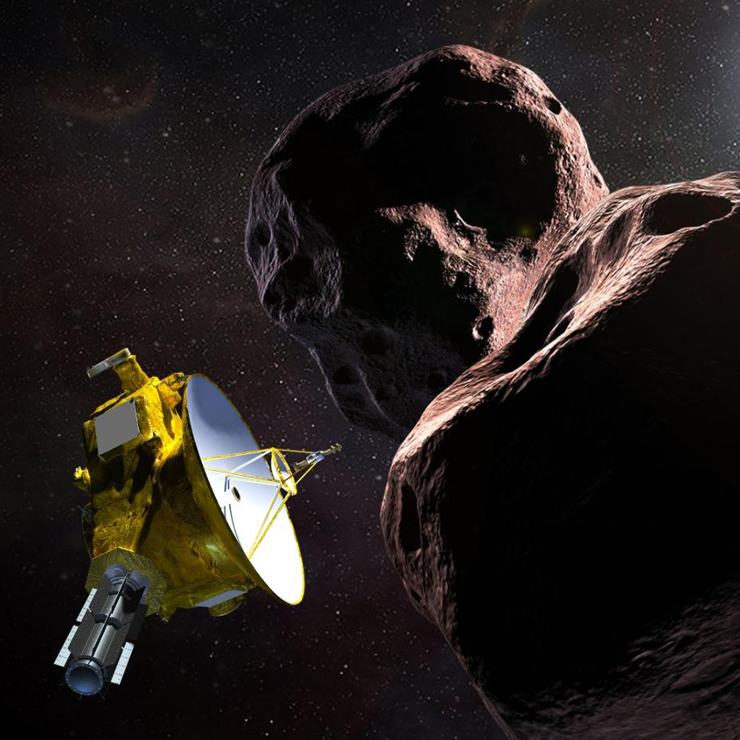
This is simpler than a reactor. RTGs are basically nuclear batteries that work by converting heat from the natural decay of Plutonium-238 into electricity to power spacecrafts, while using the excess heat to protect equipment and instruments. RTGs have been used in 27 different space missions, from the Apollo missions to the moon, to the Pluto New Horizons missions to the outer solar system.
Nuclear has been an integral part of space exploration for decades. Dragonfly will rely on nuclear energy to power the two-and-a-half-year tour, just like numerous other missions have before. Titan’s dense and hazy atmosphere, and distance from the sun, makes it impossible to harness solar power for the mission.
Dragonfly will be an autonomous drone. It has to be, because radio signals take hours to travel back from Titan. The innovative design is a dual-quadcopter, set to fly in short segments that will allow it to go farther in an hour than any Mars rovers could go over their lifetime. Dragonfly will conduct many tests and studies over the years, but its main goal is to explore Titan’s complex environment for signs of life, past or present.
Scientists are excited about the opportunity to examine Titan due to the similarities they see with prehistoric Earth. Specifically, as the organic molecules build up on the moon over time, eruptions from “cryovolcanoes”—which are volcanoes that create flows of water ice, not lava, and were previously observed by the Cassini spacecraft—could cause the organic material to mix with the liquid water below Titan’s surface while the thin sunlight provides energy for what could lead to life.
As noted by Elizabeth Turtle, the principal investigator, “We have all these ingredients necessary for life as we know it, and they’re just sitting there doing chemistry experiments on the surface of Titan.”
If Dragonfly does find signs of life, it probably won’t be the little green beings that Hollywood has told us to expect. Dragonfly’s mission to Titan presents an invaluable opportunity to start getting real answers about our place in the universe. As the first space probe of its kind, Dragonfly will spend years running tests across Titan that could help us understand how life came to be on Earth.
This cutting-edge mission applies some existing technologies and points to the need for some new ones. Whether we look to explore and settle the moon and Mars or speed up space travel with the help of nuclear rockets next, it is clear that nuclear energy can propel us to a deeper understanding of the universe.
Video credits: NASA