That phrase was transmitted via flashing light from the Nautilus, the first nuclear-powered submarine, sixty-four years ago this month. But the message is relevant, and inspiring right now, as two NASA space probes explore the outer reaches of the solar system, and beyond, sending back gigabytes of priceless data, using nuclear energy.
New Horizons, the space probe that wowed the scientific world in July 2015, with a flyby of Pluto, radioed back data on New Year’s Eve and New Year’s Day from another flyby, with a 12-mile-long rock about a billion miles further out, nicknamed Ultima Thule (the name means “beyond the borders of the known world”). It’s the most distant object ever examined by a space probe fly-by.
And three months ago, Voyager 2’s instruments indicated it had exited our solar system, providing a second data point as to where the solar system actually ends.
For both spaceships the sun is merely a bright star, so solar panels are not a possibility. Sunlight for New Horizons is less than one one-thousandth of the level on earth. Sunlight for Voyager was down to 4 percent of earth levels by the time it passed Jupiter, and is far less now. And these are long-duration missions. Voyager 2 has already been at work in space for more than 40 years, and New Horizons will be working for at least 14 and possibly much longer.
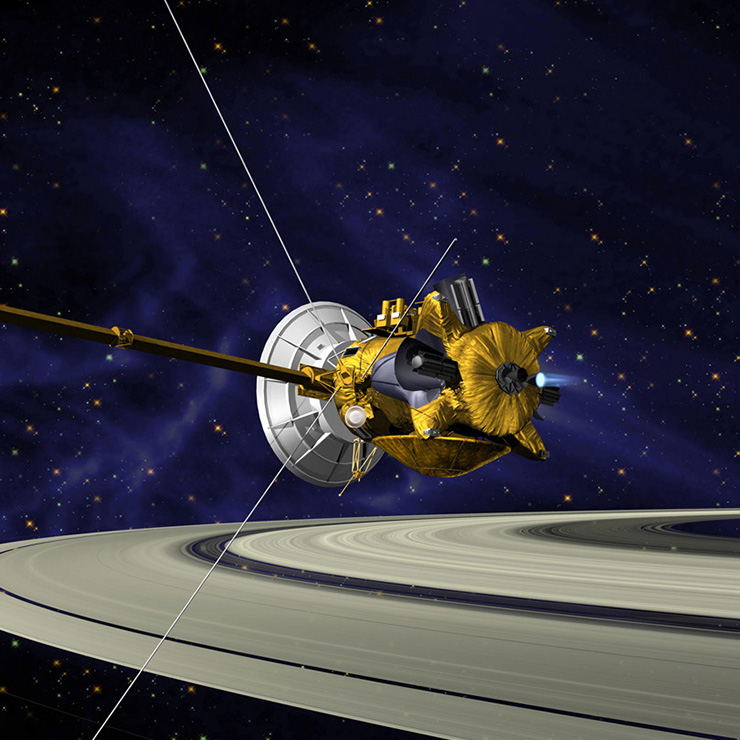
For both, the solution is several kilos of a man-made material, plutonium 238, which produces heat through radioactive decay. The system, called a Radioisotope Thermoelectric Generator, makes heat that is converted directly to electricity. This is not like nuclear energy on Earth, which is made by splitting atoms. But it does share some characteristics with commercial nuclear power: it’s compact, reliable and durable. And it doesn’t need air, important on Earth because nuclear is emissions-free, and in space because, of course, there isn’t any.
Voyager 2’s twin, Voyager 1 is also maintaining radio contact with earth, thanks to nuclear energy. It was launched 16 days after Voyager 2, but on a faster, more direct route to the outer planets, and it exited the solar system in 2014.
The two Voyagers produced 470 watts at launch, about half what a hand-held hair dryer requires. New Horizons is smaller and produced 245 watts at launch.
The plutonium’s radioactivity—and heat production—falls by half every 88 years, so the battery is not eternal. Voyager 2 sent back cosmic ray and magnetic field data to indicate that it was passing out of the solar system and into interstellar space. It is only the second man-made object to radio back data from so far away. (Voyager 1 was the first.) It’s expected to keep running until 2025, which would mean its power system operated for 48 years.
New Horizons has seven instruments with power consumption ranging from 2.3 watts to 6.3 watts—a consumption equal to something between a small night-light and a very small night-light. The power hog is the radio, at 15 watts. (This is small too; on Earth, a walkie-talkie with a range of a few miles is only about 5 watts.)
New Horizons was launched in 2006, and will take about 20 months to radio back the seven gigabytes of data it gathered on Ultima Thule. The mission will continue until at least April 2021, but the limit isn’t energy, it’s money. (The mission has cost about $700 million so far.) Power should last until the late 2030s, and the ship will be in the Kuiper Belt, the distant region of small objects thought to be primordial leftovers of the solar system’s creation, until 2027 or 2029.
The power packs were supplied by the U.S. Department of Energy (DOE). They continue to expand our reach as they fly off in different directions. If the solar system were a clock face, New Horizons is pointed towards 7:30, Voyager 2 towards 6:30, and Voyager 1 towards 10.
NASA and DOE also are prototyping reactors for use on the Moon and Mars. These might be 10 to 100 times more powerful than the ones on the space probes, but would solve a similar problem: making science and exploration possible in places without substantial air, wind or sun.
The role of nuclear energy is likely to expand in space in other ways. All three space probes were launched on chemical rockets, with small supplies of propellant to make course changes, but for the future, NASA is looking at nuclear reactors that would function as rockets, and propel spacecraft by accelerating tiny charged particles to enormous velocities, to provide thrust.