Sept. 20, 2019, is a big day for the climate. Millions of young people in hundreds of locations in 150 countries will lead an international protest—the Global Climate Strike—calling for immediate steps to stabilize the environment.
And on the same day, an event in Pennsylvania will set the drive for carbon-free energy back—way back. The Three Mile Island (TMI) 1 nuclear reactor, which has reliably delivered huge amounts of carbon-free energy, 6 to 7 million megawatt-hours each year for nearly 45 years, will retire early. That’s like moving the electricity supply of 800,000 households from carbon-free to fossil fuel.
At the rate that Pennsylvania is adding zero-carbon wind and solar power, it will take 687 years to make that up. Keep in mind that the goal of the climate strikers isn’t to maintain carbon output at current levels—it is to reduce it to near zero in the next few decades.
Yet the TMI reactor closure in Pennsylvania isn’t a surprise; it’s been discussed and debated for years. And more premature reactor retirements are planned.
How is this possible? How can we have a global movement to stop overloading the atmosphere with destabilizing carbon dioxide, and simultaneously allow the premature closure of nuclear plants, the top workhorses of carbon-free energy?
The essential problem is that our electricity system is intensively managed to a goal, but the goal isn’t clean air or protecting our climate. The goal is least-cost electricity, as if electricity were a commodity regardless of its source. For a long time, running a reactor was inexpensive compared with the competing fossil fuels. Clean air and zero-carbon emissions were free byproducts of nuclear energy.
But then came hydraulic fracturing in shale, a technology that has made natural gas plentiful and cheap. That crashed the wholesale price of electricity. Though nuclear plants have gotten more efficient and raised their output in response, some reactors are not earning back their costs.
Around the country, we can see visible signs of progress toward an increasingly popular goal, a clean energy grid. We see more and more solar panels on roofs or wind farms on ridgelines. But a closer look at the numbers shows we are going backwards.
Last year, Pennsylvania produced about 3.6 million megawatt-hours from wind and 69,000 megawatt-hours from solar, which pales in comparison to the 7.3 million megawatt-hours at the Three Mile Island plant last year. And on Friday, it stops operating forever.
Two larger reactors in western Pennsylvania at the Beaver Valley plant are also scheduled to retire, absent action by the Pennsylvania legislature, creating even more dire circumstances for achieving our clean energy goal.
Illinois, New York, Connecticut and New Jersey have recognized this contradiction and moved to protect these assets, by giving reactors a supplemental income, akin to what the federal government gives renewable energy. In Pennsylvania, this concept is still under discussion.
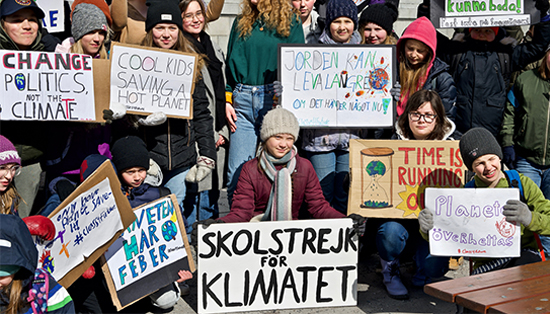 Teen activist Greta Thunberg leads students in protest for solutions to climate change. Image: Shutterstock/Liv Oeian
Meeting our climate challenge is going to take preserving all of our low-carbon assets and adding more of whatever technology can get the job done.
The climate strike grows out of the efforts of a Swedish teenager, Greta Thunberg, who has been leading a movement of students to strike and leave school every Friday for climate-related events. She’s been photographed sitting on a sidewalk outside the Parliament in Stockholm with a handwritten sign that reads, “Skolstrejk för klimatet.”
Loosely translated from the Swedish, it means, “Let’s get our act together.”
Video: Shutterstock/NewFabrika