Around the world, perhaps the best predictor of health, nutrition, prosperity, education and upward mobility is reliable access to electricity. For millions of people, life stops at sunset because there is no light; cooking is done over dirty indoor fires, and the supply of fresh food and clean water is often uncertain. We need to supply hundreds of millions of people with reliable electricity, but to preserve the climate we must do it cleanly, and clean up the generating system already in place.
A new documentary, “Juice: How Electricity Explains the World,” looks at the importance of electricity to human life on four continents, and what it means when electricity is unreliable, expensive, or simply unavailable.
The film’s co-producer and narrator, Robert Bryce, is a journalist and author of six books about energy and technology. His most recent, “A Question of Power: Electricity and the Wealth of Nations,” is a companion to the movie. He answered some questions for us about his latest project from his home in Austin, Texas.
Q. What motivated you to make this film?
A. We wanted to tell the human story of electricity. There are plenty of academics and policy experts who talk about energy and how we should be powering society, but we live in a video age. We wanted to make a film that allowed people tell their stories about electricity, what it means to them, and how critical it is to their lives. Put another way, we didn’t want to tell people what to think about electricity. We wanted to show them how important it is.
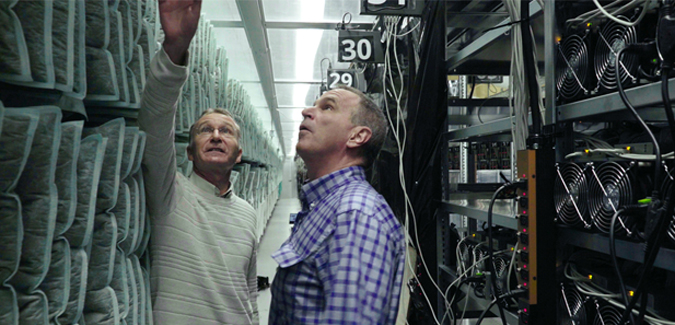 Helmut Rauth and Robert Bryce in a Crypto Datacenter.
Q. Has your thinking on energy and environment evolved? How?
A. I have long prided myself on my ability to make numbers meaningful. Energy and power can be difficult to understand. (Energy, measured in joules, is the ability to do work. Power, measured in watts, is the rate at which work gets done). But I’ve realized that numbers and units really resonate when they are put in a human context. That’s why I used my old kitchen refrigerator as a metric in the film. It used about 1,000 kilowatt-hours of energy per year. There are 3 billion people who now live in places where per-capita electricity use is less than that. In this stage of my career, I’m more focused on the human side of the energy and environment discussion. That’s why we went to Africa, India, Lebanon and Puerto Rico to show what electricity means to the people who don’t have it, or don’t have enough of it.
I was surprised by the level of energy poverty that we saw, particularly in India and Puerto Rico. I thought I knew destitute. I didn’t.
Q. What lessons should we draw from the pandemic about energy, environment and health?
A. Nearly every aspect of the response to the pandemic requires electricity. From sheltering at home, where we connect via the Internet, to the testing machines needed to detect the virus, to the hospitals that are treating victims, COVID-19 has underscored our society’s near-total dependence on reliable and affordable electricity.
{^youtubevideo|(width)560|(height)340|(fs)True|(rel)False|(url)https://www.youtube.com/watch?v=tlYVo7FpsEc|(autoplay)False^}
Q. What gives you hope?
A. Humans give me hope. I believe in ingenuity and progress. I believe in technology. We face a lot of challenges, no doubt about it. But we are going to get through the pandemic. We are going to find better, cheaper, lower-carbon ways of producing electricity (and yes, I’m talking about nuclear energy). I’m hopeful because hope is life giving. Being hopeful — expecting the best and embracing the challenges we face — that is what is needed for a happy and successful life.
Because of the pandemic, this film is not coming to a theater near you. But it is available on iTunes on June 2.