If there was ever life on Mars, nuclear technology will help find it.
You may recognize nuclear energy as the workhorse of the electric grid, but innovation has made the technology essential for tasks well beyond electricity generation – and beyond our planet, too. Nuclear energy powers the increasingly sophisticated rovers that NASA sends to Mars.
Despite the COVID-19 pandemic, NASA says it is on track to meet the schedule dictated by the dance of the planets, and launch its new rover Perseverance sometime between July 30 and August 11. It will carry a nuclear electric generator, which will power its electric drive motors, radios, cameras, lasers and other chemistry lab equipment, and a drill to penetrate the surface.
Once on Mars, the rover will look for telltale chemical and geological clues about life. Scientists say that if it finds evidence, the most likely would be ancient microbes, but even that would be a major scientific achievement.
Perseverance will also experiment with producing oxygen on the surface, for use by human astronauts to follow, and who would need air and other supplies for a stay of weeks or months. Making materials on Mars itself to sustain human life, or to provide fuel for the return trip, vastly reduces the amount of material that would have to be sent there from Earth; all of that work requires large amounts of energy, which a nuclear system can provide. NASA and the Department of Energy are already working on a reactor for that purpose.
For now, though, the nuclear electric generator will power the rover itself.
Perseverance’s overall size is about the same size as an earlier nuclear-powered rover, Curiosity, but has a lot more on board, and weighs about 2.1 tons, nearly 15 percent more than its predecessor. Curiosity arrived on Mars in August 2012, and is still operating on the surface, although it was intended to run only two years. The Perseverance’s nuclear energy pack is designed for a 14-year life.
Endurance and Curiosity use the plutonium in a device called a radioisotope thermoelectric generator. These generators do not split atoms the way that earth-bound reactors do; they make electricity from the heat given off through radioactive decay. They use a short-lived form of Plutonium, created by reactors at the Department of Energy.
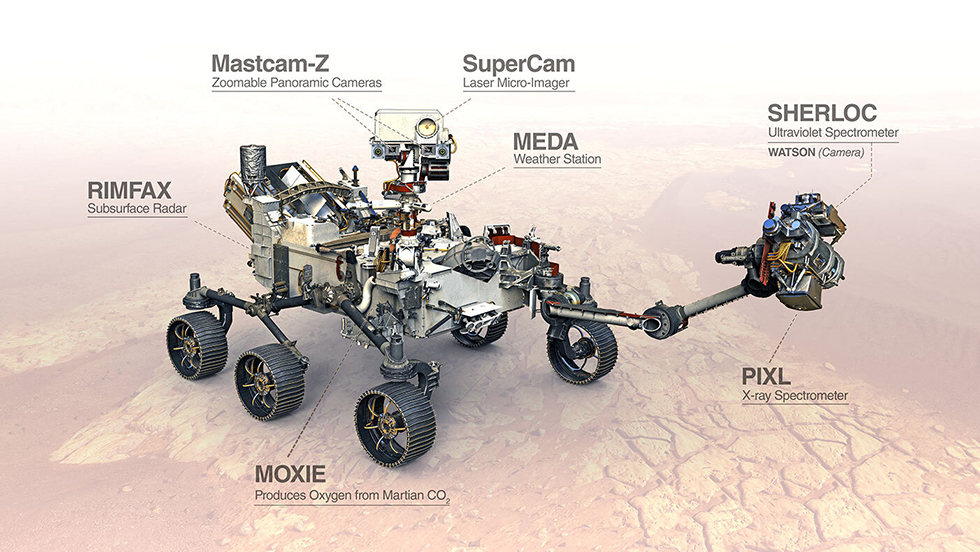 Perseverance will carry a wide variety of scientific instruments, all requiring electricity, which will be supplied by the plutonium power pack.
Output on arrival on Mars, 110 watts, isn’t much; on earth it would be about enough to run two laptop computers. So Perseverance will carry two lithium-ion batteries, which can charge up when the rover isn’t using a lot of electricity, and discharge when it needs more than the maximum output of the nuclear device.
Some Mars rovers have used solar power, but NASA points out that Mars, like the Earth, has seasons, and says that at certain times of the Martian year (which is twice as long as an Earth year) there isn’t enough energy in the light from the Sun, which on Mars is always dimmer than it is on Earth.
Perseverance is another step in preparation for a human mission to Mars, which is highly likely to rely on nuclear energy on the surface.
And Perseverance has another ambitious goal that will benefit from a long-lived, reliable power source. It is supposed to gather soil samples from the surface and subsurface, and wait for another NASA probe to come and pick them up for a return trip to Earth. That could be years away, but with a nuclear generator on board, the rover should have no trouble persevering.
Correction: Following the publication of this piece, NASA announced that Perseverance's launch would be delayed to no earlier than July 30, 2020. This change is now reflected in the article.