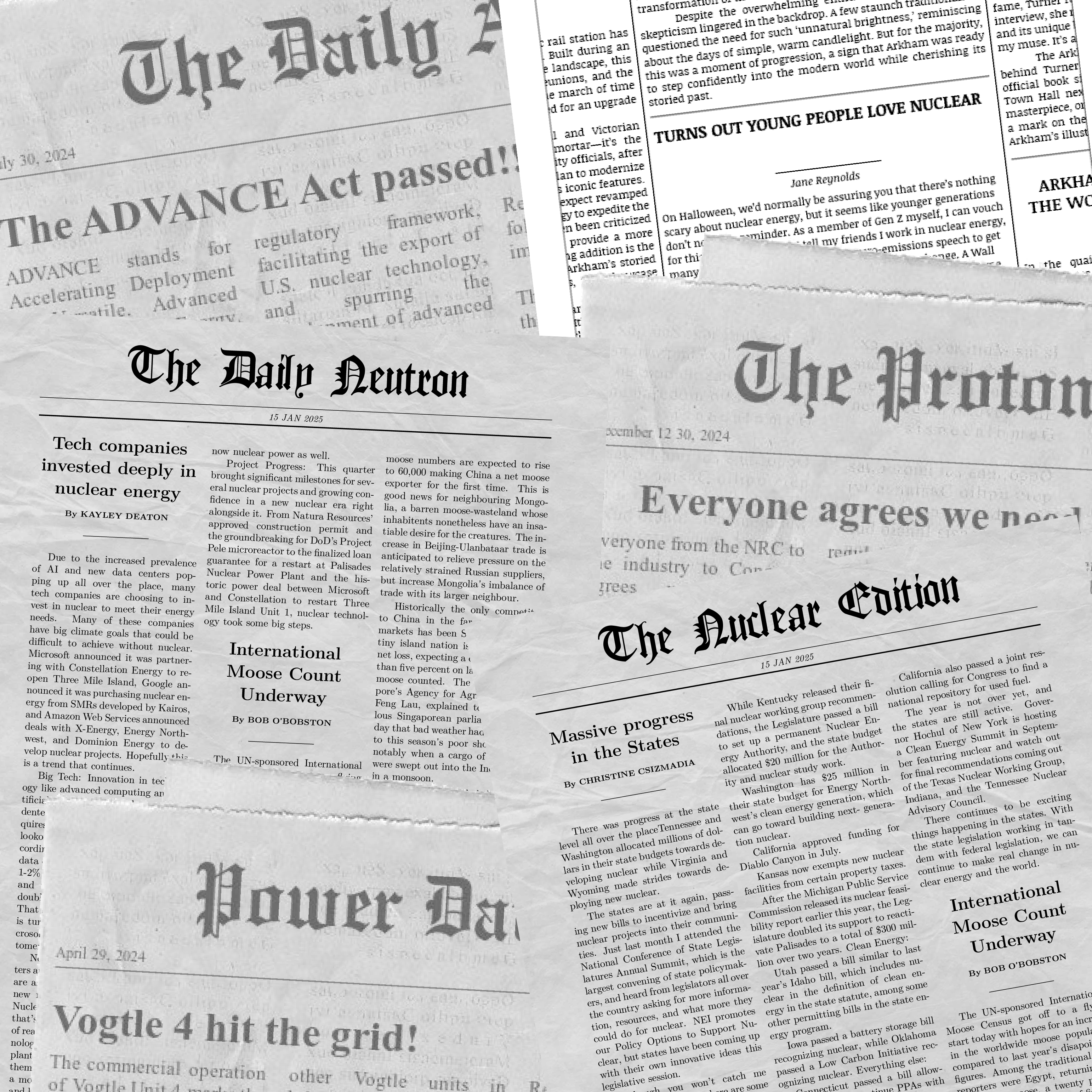
Happy Spring, Fissionaries! It’s been a few months since we last podcasted and so much has happened. The Last of Us, Righteous Gemstones, White Lotus, and The Rehearsal all came back!! Also, some stuff happened in the world of nuclear. I guess that’s probably why you’re here. Don’t worry, Mary Carpenter and Jordan Houghton have you covered.
In the Season 4 premiere, Mary and Jordan catch up on just how fast things are moving in the world of nuclear. From billion-dollar investments and new reactor projects breaking ground to nuclear’s role in powering AI and deep space missions, the pace of new developments has been wild—and it’s only speeding up.
There have been so many developments over—even just the last year, forget about the last two to three years—just the year. Working in communications in this industry, things are happening, like, at the speed of light. It's going so fast, the headlines are coming in fast and furious, so many new industries are jumping into nuclear and you're gonna hear that on Fissionary this season.
Nuclear has made major strides in recent years. We went from fighting for a seat at the table to getting investments from big tech companies and getting new plants like Vogtle 4 online. In the past few seasons, Mary and Jordan have spent a lot of time talking about what has happened in nuclear. This season, they plan to talk about what will happen.
I mean, talking about being the cool kid at the table, I was at South by Southwest a couple weeks ago and nuclear had a presence, which is really cool. People got to learn about nuclear, hear what it's about…But we're also at a lot of other tables. I know CERAWeek also happened a couple of weeks ago…there was a big announcement with some of the big tech companies. They joined 30 plus countries around the world and some of the largest financial institutions for a pledge to triple nuclear by 2050.
There’s been so much happening in the world of nuclear, and so much more left to happen. Listen to the full episode to learn more about the latest news and about what’s to come!
Mary Carpenter This is Fissionary, a show exploring how nuclear powers your world. I'm Mary Carpenter.
Jordan Houghton And I'm Jordan Houghton. Let's jump in.
Mary Carpenter We've spent the past three seasons exploring the world of nuclear energy, its impact, its challenges, its potential.
Jordan Houghton But this season, we're not just looking at what nuclear is, we're looking at where it's going.
Mary Carpenter That's why we're kicking things off a little differently. No guests today, just us, breaking down the pivotal moment nuclear is in right now. What's changed since we started the show and what's coming next?
Jordan Houghton Because right now, nuclear energy is standing on the edge of something huge. The momentum is real, the investments are happening, and the decisions made today will shape the future of energy for decades.
Mary Carpenter So, let's get into it. Welcome back, Fissionaries! We're so glad to have you back with us for season 4. As Jordan and I mentioned in the intro, we're doing things with this episode a little differently than we have in the past. Jordan and I wanted to take some time, just the two of us, to chat with you all about nuclear and the upcoming season, since so much has changed in the world of nuclear since we first started the show.
Jordan Houghton There have been so many developments over—even just the last year, forget about the last two to three years—just the year. Working in communications in this industry, things are happening, like, at the speed of light. It's going so fast, the headlines are coming in fast and furious, so many new industries are jumping into nuclear and you're gonna hear that on Fissionary this season, we're gonna bring in guests from some of the different industries that are engaging with nuclear, like space and tech. And yeah, we're just—let's catch everybody up, and take a minute to reflect on what's going on.
Mary Carpenter Yeah, we really spent the first few seasons talking about what's going on in nuclear, and we decided we wanted to focus this season on what's happening next. How nuclear is powering the world, not only around us now, but also into the future. And I think you guys are going to love some of the guests we have to help us share that with you.
Jordan Houghton So, Mary, I feel like nuclear—and we've talked about this off the podcast, just in conversations—nuclear is like the cool kid now.
Mary Carpenter Yeah.
Jordan Houghton There was a time when we were fighting for a seat at the table, to be heard, and now we have everybody's attention. And I think we should talk just a little bit about some of the big shifts in the last year. For example, Vogtle 4 entered commercial operation in 2024, which was huge. Following Vogtle 3 coming online right before that, but these are the first two new reactors in the US in decades.
Mary Carpenter Yeah. I mean, talking about being the cool kid at the table, I was at South by Southwest a couple weeks ago, and nuclear had a presence at South By, which is really cool. People got to go learn about nuclear, hear what it's about, and I hope that's kind of just the beginning that'll keep growing in that space. But we're also at a lot of other tables. I know CERAWeek also happened a couple of weeks ago. Several of our colleagues were there. And that's where, there was a big announcement with some of the big tech companies. They joined, I think, 30 plus countries around the world and some of the largest financial institutions for a pledge to triple nuclear by 2050. So, that's a big deal. And that's what's really driving a lot of the change in our industry right now is that big demand, not only from countries around the world, not only from the investments that we're seeing from the financial sector and new customers, but really that huge demand that we are seeing from tech companies. It's changing not only the future of nuclear, but the entire energy grid.
Jordan Houghton Yeah, the spring is always so busy with conferences for, like you said, South by Southwest, CERAWeek, there's always a lot going on, which adds to this being a really good time to reflect back, because recently there have been so many announcements and conversations happening. I think the CERAWeek announcement from the tech companies is really, really interesting, just as a reminder for listeners that that pledge initially was signed at COP28 at the end of 2023. And countries have signed on since then, and now here we are more than a year later, the tech companies coming back to it and saying, you know what, we want to be a part of this too.
Mary Carpenter Yeah, it's really exciting. And I think you guys will be hearing a little bit more about that this season as we dive into that big demand from tech companies. I mean, I was looking at a Utility Dive headline recently, it said five-year US load growth forecast surges 456 percent. I mean, that's huge. That's so much energy that we're going to need in just the next five years. And a lot of that can be contributed to the big tech demand, data centers. Energy is a hot topic right now. So, it's an exciting time, but it's also, we got to get moving.
Jordan Houghton I think we should talk about the tech demand in the context of AI for a second, because that has really surged in the last year, and I know that people are using it to make funny images, and, you know, there's sort of the whimsical properties of it, but it's really showing up everywhere, and I think no one can actively avoid it now. If you're doing a Google search, AI is brought into it. It's optimizing searches in a lot of different apps already, so it's behind the scenes in a lot of the places we operate already every day, and contextualizing the demand that that adds to our energy grid is important, I think, for our listeners to understand.
Mary Carpenter Yeah, and I wonder if that really brings it kind of forefront for some people, because our whole lives, we've used energy. We plug in our cell phones, we plug in our computers, you know, everything we need energy for. But I've really never thought about it. But now we see, you know, these AI chatbots in our Teams meetings. And even when you're at the doctor's office, you see them using different kinds of AI technology. So, it really is everywhere, and I wonder if that kind of shifts the thinking of some folks, because it really is just like in your face now, how much energy and how much AI is being used all around you.
Jordan Houghton Yeah, it's a lot. And obviously, if we're already using it as much as we are, you can imagine where we're going to be even a year from now, and then five years from now. So, we are hopeful that the momentum that we're seeing in nuclear means that deployment of new nuclear will eventually be able to help support some of this and catch up to it and add that important power to the grid.
Mary Carpenter Yeah, new nuclear and existing nuclear that's coming back. The big headline was Microsoft working with Constellation to restart the Three Mile Island nuclear plant. So, that's a big deal and that's a direct correlation to this big tech demand that we're seeing.
Jordan Houghton Yeah, this is so wild because we started this conversation talking about Vogtle coming online, which is new, but equally as interesting in the last year have been these announcements of several plants coming back online that already exist. So yeah, you've got the Crane Clean Energy Center coming back on in Pennsylvania, but we're also talking about Palisades in Michigan and the US Department of Energy actually disbursed $57 million of up to $1.52 billion loan guarantee for Palisades, so the money there is flowing to help get that plant back online.
Mary Carpenter That's really exciting. And it's also a testament to the continued support for nuclear from administration to administration. The conditional loan guarantee was part of an effort by the administration of former president Joe Biden to support nuclear energy. And now we're in a new administration, where we're seeing continued support for nuclear. I know on his third day in office, Energy Secretary Chris Wright signed an order that called for unleashing commercial nuclear power. So, we're thankful that we're in—you know, a lot of things are changing, but we're really in kind of the same place of support with our congressional leaders, with the White House, even though things have changed at the federal level, support remains. And we're also seeing it in the states. I know this year, at least 11 governors mentioned support for nuclear in their State of the State addresses. So, it's exciting. It's a good time and I'm glad to see the support continue.
Jordan Houghton Mary, that's so important because obviously when administrations change, you start getting asked, how are things going to change for you and for the industry? And we're really fortunate to be perhaps one of the few things our leaders agree on from a bipartisan perspective, Democrats and Republicans like nuclear and support nuclear. And so, for us, it's been great to see, like you mentioned, Secretary Wright, just after a few days in office, mentioned support for nuclear, and so it's really heartening to see that pick up and continue. And there was some great bipartisan legislation, the Advance Act, which was passed to help incentivize competition and modernize the regulatory structure. I think that we have a lot to look forward to. And I want to go back to what you said about the states too, because there is—we're talking—we usually focus on the federal government, that's the big national story that you hear, but there is an unprecedented amount of action happening at the state level from state legislatures to public utility commissions, to governors, like you mentioned, just in a way that we've never seen it before.
Mary Carpenter And, you know, while we're talking about all these exciting things, we also have to talk about, you know, what are we looking for this year? What do we need to help us move to that next step? Because we're going to need a lot of nuclear and we're gonna need it fast. As we were talking about, you know, this energy demand is growing so quickly, so we need to build fast. So, you know, we need protect the tax credits at the federal level that we already have. I know that's something that's been a big conversation. You know, these tax credits helped struggling nuclear plants go in the opposite direction. They're now thinking about power upgrades and life extensions and providing clean power to their communities. So, we need to support that, you know, we're going to have to help our first movers move. I mean, it takes a lot to be the first at something, so we need help with incentives and grants and cost mitigation to make sure these first-of-a-kind technologies are able to come to market and then create this whole new marketplace for all this new technology.
Jordan Houghton Yeah, we should break this down a little bit, I think. When we're talking about early mover investment and then, like, the tax credits supporting that, for example, Vogtle 3 and 4 is a really great example. Depending on where you look, you will see that there was a cost savings of 20 to 30 percent between Vogtle 3 and Vogtle 4. And why or how did that happen? Vogtle 3 was the first advanced reactor built, it was the first nuclear reactor built in a really long time in this country, and so it was basically like starting from scratch. Even though nuclear reactors have been built before, we hadn't done it in this country in decades. And so, it's it was kind of its own first of a kind. And it costs more to do something for the first time. There's things you have to learn. And the learning and the optimization was so great, even just between 3 and 4, that the costs went down significantly in the build out of 4 versus 3. And I think it's important for people to understand, because of that, there's like never been a better time for us to build more nuclear in this country now, because we know how to do it based on what we just learned going through that process.
Mary Carpenter Yeah, Vogtle is a great example of where we're headed and to get there, we also will need regulatory reform. The NRC is used to regulate a specific type of reactor, and we're moving into a whole new space. There's new designs, there's new technology. There's going to be times where we need the regulator to move faster without sacrificing safety. So, that's something I know that our organization that we work for has been working on with the NRC, just sharing some suggestions that can significantly reduce the time it takes to certify a reactor. And last year, Congress passed the Advance Act, which has been really helpful to share with the NRC that they should be focused on efficiency. And, you know, we've seen some improvements, but there's still a ways to go to make sure nuclear is able to provide the clean power that the world's going to need.
Jordan Houghton It's been heartening to see the advancements from a regulatory and legislative perspective over the last year, in part because they have been so supportive of speeding up deployment. From financial support, which is so important for these first projects to get off the ground, to optimizing the regulatory process, making it more efficient so that it doesn't take as much time and doesn't cost as much for applicants applying to license new reactors. It makes me really optimistic about seeing new projects come online, break ground, get going. And actually, we should talk about TerraPower's plant in Wyoming, in fact, did break ground last June, that was another really exciting milestone in new nuclear deployment last year. So, they're well underway in Wyoming.
Mary Carpenter Yeah, and they have such a great story of the impacts that they're having on the community. Jobs, local economic benefits, new restaurants and coffee shops that have opened just because of the influx of people going to work at TerraPower. They really do have a great story of community involvement, which plants across the country can have the more that they open.
Jordan Houghton So, we've talked a lot about power and nuclear powering the grid and helping AI run and helping our lights stay on and our air conditioner running as we're coming into the warm summer months. But it's so important, and we're going to be focusing on this in the season, that we are not just seeing huge leaps forward in power, but nuclear is being applied in so many different areas, and we've had some of these guests on Fissionary before, but we're gonna go back and we're going to do a deeper dive on some of these, and I'm talking about sectors like medicine, and space, and fashion, and it's just been so enlightening to hear all the different industries that are finding their work impacted by nuclear.
Mary Carpenter So, you're going to see all of this throughout our season. It's really talking about how nuclear is powering the future, so we'll be talking with SpaceNukes about how they're bringing nuclear to Mars with the reactors that are planned to offer service power on Mars. We'll be speaking with Amazon on their nuclear investments and SMR development, and other new customers that are looking to advanced nuclear technologies and current nuclear technologies to help power their businesses and their industries with carbon-free energy.
Jordan Houghton And, adding on to that, because this is a topic that always comes up when we're talking about nuclear, and that is the waste. And we're really excited to have a conversation about that this season, and specifically talking to some of our friends in Canada who have just approved a solution there. And we are looking forward to hearing their story about what their plans are.
Mary Carpenter So it's a really pivotal moment for nuclear, and we're trying to help share what's going on with the industry now, as well as what you're going to see in the future, and how nuclear impacts the world all around us. So, I hope you'll tune in for season 4.
Jordan Houghton Okay, Mary, what are you most looking forward to this season in nuclear?
Mary Carpenter There's so many things! I love talking about space, so I'm very excited to talk about nuclear on Mars. I think that's really cool. But I also am excited to speak with Amazon because it's such a big opportunity for our industry right now, so, really hearing firsthand from them is such a cool opportunity. So, I have to say two things.
Jordan Houghton Those are great. The tech momentum is just so amazing, space is always so cool. I loved our conversation in one of our earlier seasons about space. I'm really excited to dig back into it. I also have to say, I'm really excited talk about waste because I'm actually really optimistic for the solutions there, and I think a lot of people's perceptions of nuclear waste—I think that people just don't know, and I think that there's a lot to learn there, and I think that giving our listeners a chance to hear about it and learn about it, they will feel more comfortable with it and realize, oh, we can do this. This isn't as scary as it seems.
Mary Carpenter I agree. It's going to be a great season, and I hope you guys will join us.
Jordan Houghton Okay, so we are going to preview. We're gonna be asking our guests this season, what is a book that they have read recently that they recommend, and we thought we should kick it off by sharing our own answers to that question. So, Mary, is there something you've read recently that you think is worth noting?
Mary Carpenter This is a tough question. But since we're heading into summer and spring and a lot of folks are on spring break, beachy weather, I want to recommend something light and fun. And so, I'm going to go with The Perfect Couple by Elin Hilderbrand. And I know it was a Netflix show recently, so, the reason I'm recommending this is if you only watched the show, read the book. Because I loved the book a lot more than the show.
Jordan Houghton Have you read a lot of her books?
Mary Carpenter Yes, I have. I'm actually a—I'm a big fan. I'm about to start Swan Song. I finally got it off the library waitlist. It's been months, so I'm pretty excited about that.
Jordan Houghton Okay, I have not read anything from her yet, but I've had multiple people say you need to dive into her books, that they're really great, and so I'm taking this as my sign to add them to the reading list, which is just getting longer.
Mary Carpenter They're just so fun, easy reads, beach reads. I mean, it's nice to read her books after a day at work, because it's really just a nice way to turn off and relax.
Jordan Houghton That's awesome. I have to recommend—I've read a number of books this year already, a lot of them have been fine and lovely, they're not worth passing on. But at the very beginning of the year, I read The Wedding People.
Mary Carpenter Oh my gosh, that is on my list!
Jordan Houghton I loved it. I read it in January, and usually at the end of the I come back and reflect on what were my favorite books of the year, and honestly, when I read I was like, I know it's only January, but it's going to be hard to top this book this year. It is currently my favorite book that I've read this year, and I—honestly, it's going to be a huge challenge to find something I love more than that.
Mary Carpenter All right, once I get off the wait list for the library download book of Wedding People, I'm reading it. I'm very excited.
Jordan Houghton And I will say that The Wedding People, I feel like when you look at the cover, and you read the synopsis, it sounds like it's going to be like a light beach read, but it's not. I mean—
Mary Carpenter It's not?
Jordan Houghton It's not. There is like a really tender story in it, and it's so—it's emotional. It's an emotional book. So be prepared for that. It is worth it. But just so you know.
Mary Carpenter That is not what I was expecting at all. But that makes me even more excited for it.
Jordan Houghton Very good.
Mary Carpenter Well, at the end of the season, we are gonna put together a Fissionary book club recommendation, and we'll do a recap from the whole season. And hopefully by then I'll have gotten off the waiting list for The Wedding People.
Jordan Houghton Thank you so much for listening and hanging out with Mary and me, and we have a ton of great guests lined up this season, so make sure you are subscribed so you don't miss out on any episodes of season 4.
Mary Carpenter Thanks again for joining us, and if you're interested in what we were just talking about and want an even deeper dive into the state of the nuclear energy industry, I hope you'll join us at our CEO, Maria Korsnick's State of the Nuclear Energy Annual Address on May 20th, and visit NEI.org where you can sign up and learn even more about what's going on in the exciting world of nuclear. And make sure you subscribe on Apple, Spotify, or wherever you listen to stay updated on all things Fissionary, and we'll see you soon!
The next episode airs on Thursday, May 22—make sure you tune in, Fissionaries!

.png?language=en-US)
.png?language=en-US)