
Newsroom Archive

As America’s largest source of carbon-free power, nuclear energy facilities will play an important role in powering our rapidly growing fleet of electric vehicles without emissions. In response, electric utilities that operate nuclear power plants are investing in a range of initiatives to pave the way.

When it comes to innovation, it’s easy to think of new plant construction or advanced reactor technology, but the industry also is on the path to beating its own timeline for developing accident tolerant fuel—one of several new technologies that will help our current fleet achieve more efficiency. These advanced fuel designs will make plants even safer by allowing plant operators more time to respond to reactor conditions.

NEI's Harsh Desai describes nuclear technology and policy innovation showcased in Nuclear Innovation Week.

In this behind-the-scenes video extra, Monica Trauzzi and Katherine Hamilton, co-host of the Energy Gang podcast, talk about what it means to be a woman in the energy industry. After their conversation on clean energy, they opened up about the challenges women face in the workplace.
.jpg?language=en-US)
Katherine Hamilton, co-host of the Energy Gang podcast and chair of clean energy consulting firm 38 North Solutions, sits down with Monica Trauzzi in the eighth episode of “Off the Menu.” At Convivial in D.C.’s Shaw neighborhood, Katherine and Monica discuss the recent shift in the clean energy conversation and the proposals—like the Green New Deal—that are driving change.

Today the Nuclear Energy Leadership Act was introduced to the Senate Committee on Energy and Natural Resources. This is a statement by Maria Korsnick, president and chief executive officer of the Nuclear Energy Institute.

NEI's President and CEO Maria Korsnick outlines the state of the nuclear industry and the growing positive momentum behind nuclear energy in America.
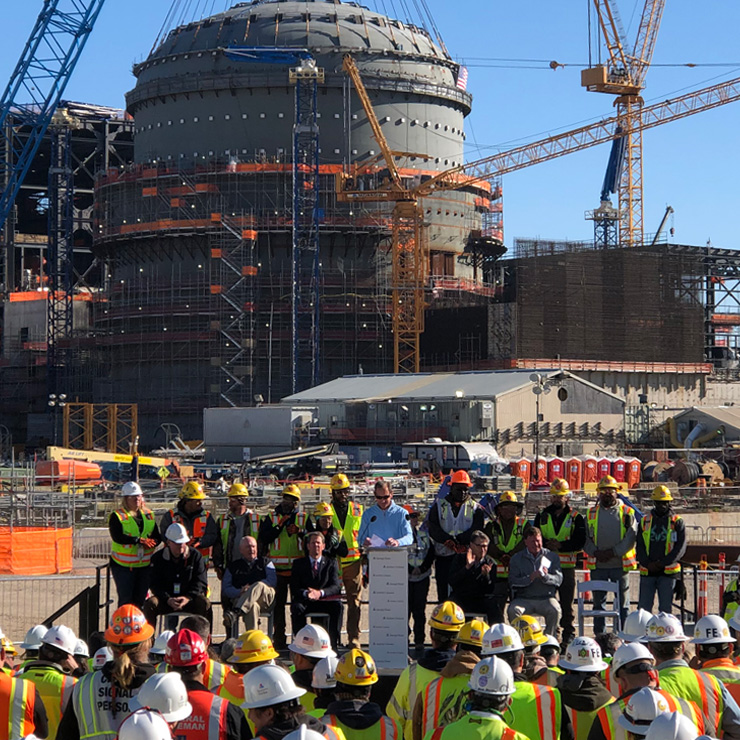
The Nuclear Energy Institute’s Maria Korsnick joined Secretary Perry and Governor Kemp for the capping of the containment vessel on Vogtle 3. The following is a statement on the historic day from Maria Korsnick, president and chief executive officer of NEI.

Why should a millennial care about nuclear energy? Because it’s a viable solution to many of those big problems we want to tackle.
The Nuclear Energy Institute announces Dr. Ralph Izzo, of Public Service Enterprise Group (PSEG), as incoming chairman of its board of directors and Mr. Paul D. Koonce, of Dominion Energy’s Power Generation Group, will serve as vice chairman of the board.

This week, Pennsylvania lawmakers introduced the Keep Powering Pennsylvania Act, which would amend the state’s Alternative Energy Portfolio Standard to include nuclear energy—a measure that would compensate nuclear plants for providing more than 93 percent of the state’s carbon-free electricity.
Today, the Pennsylvania legislature introduced HB11, which would update the Alternative Energy Portfolio Standards (AEPS) Act to include nuclear in the state's energy portfolio. The following is the Nuclear Energy Institute's statement regarding HB11.